Winter storms have you worried about power outages? I’m chatting with Rick True, president of Batchelor’s Service in Mobile, Ala., an expert in whole-house generator installation.
A whole-house generator can keep your home comfortable in the event of a power outage. (Lex20, Getty Images Pro)
When did you get introduced to installing whole-house generators?
Rick: Back in the ‘80s, a buddy of mine who had a heating and air conditioning company in Birmingham, Ala., suggested to me selling generators. He said with the hurricanes we have in Mobile, Ala., it will be a great deal.
He started selling generators because of the ice storms they have up there. Their power problems up there happen during the winter, and for us down here it’s during hurricane season.
He sent a Generac salesman to me. At the time, Generac was the only company making home standby generators, and that’s how we got started.
Aging infrastructure is leading to more and more power outages across the United States. (Guillermo Munt, Getty Images)
Infrastructure in the U.S. is aging. So, there’s a lot of opportunity for growth in the whole-house generator industry, right?
Rick: Yeah, there really is. Here’s something I learned from a manufacturer this past year when there was a real shortage of them — there’s a big demand for generators in California because of power phaseouts.
Out there, utility companies are shutting people’s power off for a couple of hours a day, so people are buying them so they can have continuous power.
Make sure your generator can provide power to your home’s essential appliances, like the refrigerator and water heater. (AndreyPapov, Getty Images Pro/JulNichols, Getty Images Signature)
How do you determine what size generator a home needs?
Rick: Now, all the manufacturers have an app or a calculator on their website where a homeowner can enter the square footage of their home, how many air conditioners they have, what type of dryer they have, all those kinds of questions.
The big thing is the number of 240-volt appliances you have in your home. That’s the real driver of the size requirement for a generator. Now with so many houses having LED lights, you can light a big house with not much kw of a generator. But when you start trying to run air conditioners, electric ovens and dryers, that’s when you start running up into bigger sizes.
The key things a homeowner should consider are electrical appliances that power on by themselves, like air conditioners and water heaters. If you don’t have those covered, it could trip the breaker on the generator, and then you’re out of power.
Installing a whole-house generator can bring numerous benefits to your home, such as providing backup power to ensure your home isn’t left without electricity during a power outage. (JodiJacobson, Getty Images Signature)
A lot of people think you can only get a standby generator in a new-construction home. Do you do a lot of retrofits?
Rick: Probably 95 percent of our whole-house generator installation is on existing homes.
Before installing a whole-house generator in a home, our technicians must first assess a home’s electrical situation.
A lot of times, the electrical service needs to be upgraded before we can install the transfer switch. The transfer switch needs to go between the meter and the main panel for the house so it will transfer properly.
Rick: Most of our customers have a maintenance plan we provide for them. We change the oil, check the batteries and stuff like that. Just like you get your car tuned up a couple of times a year, that’s what we kinda do with a generator.
A liquid-cooled standby generator, the big ones that are 25 kw and above, are basically car engines. The air-cooled, the smaller ones, are like a riding lawn mower engine. They all need maintenance.
Some of our customers like to change the oil in their generators, but most people don’t feel comfortable doing that.
What’s some advice you would give to a homeowner whose looking to buy a standby generator?
Rick: The brand you pick matters, but it’s no better than who’s going to be installing it for you.
Research who will install it for you and make sure they have a licensed electrician to do their electrical work, and a licensed plumber to do the gas work. Find out the company has technicians that are certified by whatever manufacturer you choose.
Sustainable living protects our ecosystem and preserves natural resources for future generations — and it improves the quality of our lives.
Living “green” means being aware of how your actions affect the environment and those around you. Then, you can take everyday actions to improve outcomes.
This may sound like a tall order, but this lifestyle shift doesn’t need to be overwhelming. Here are some simple things you can do now to transform your home for sustainable living.
A key part of sustainable living is using only energy you need — that starts with insulating your home. Doing so will conserve energy, save you money and increase personal comfort.
The North American Insulation Manufacturers Association estimates up to 90 percent of homes are underinsulated. So, your home probably could use more insulation!
However, not all insulation is equal — or sustainable. Some companies use large amounts of non-renewable energy to produce their insulation, which has negative environmental impact.
“Embodied carbon refers to the carbon dioxide equivalent emitted throughout the product life-cycle, including raw material extraction, transportation, and manufacture,” the company’s website states.
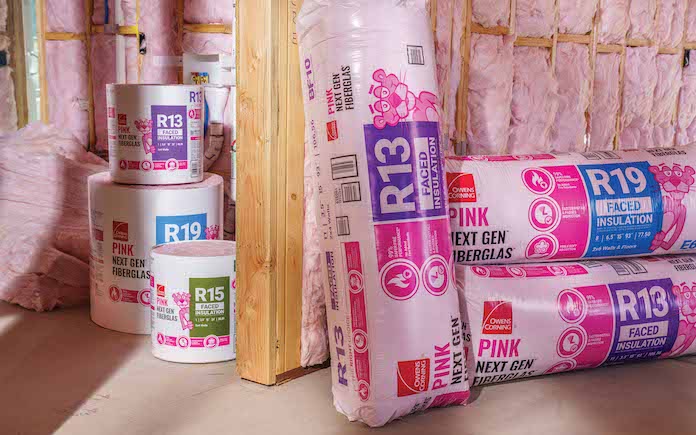
In addition to being sustainably produced and soft as cotton, it’s made with natural materials. Owens Corning PINK Next Gen Fiberglas Insulation has the highest recycled content in the industry.
PINK Next Gen Fiberglas batts come in pre-cut lengths to save time, making them ideal for framed cavities. The batts are extra stiff, so they slide in easily and resist slumping in areas like walls. And if you need to make cuts, they split cleanly.
After installing insulation in the attic and crawlspace, you need to prevent inside air from escaping, and outside air from getting in — here’s how to eliminate cracks and gaps:
Caulk around windows and doors. Homes expand and contract due to humidity changes, so you should do this each summer and winter.
Check each entry door’s threshold for damage and replace a failing rubber seal — or the entire threshold — as needed.
Check for gaps between the threshold and the door and install door sweeps as needed. Some door sweeps attach to the bottom of the door; others are mounted inside the door.
You also can insulate electrical outlets, install or replace weatherstripping in windows and doors, and cover window air conditioners for a weather-tight seal.
Garage sales are a great place to find like-new furnishings for your home. (shironosov, Getty Images)
2. Reduce, Reuse and Recycle
Living sustainably is all about keeping as much out of the landfill as you can. To do that, start with the 3 Rs — reduce, reuse, recycle.
Reduce: Ditch bottled water and install a home water filter to save money, have healthier drinking water, and help the environment. Eliminating bottled water consumption cuts down its carbon footprint left from transportation to stores and discarded plastic bottles.
Reuse: Furnishing your home? Avoid fast furniture! Like fast fashion, these furniture pieces are mass-produced and relatively inexpensive, so they’re easy to obtain and then abandon. Instead, look for second-hand furniture at online marketplaces, thrift stores and yard sales.
Recycle: Buying new items for your home? Look for the post-consumer label. This means the product is made from recycled materials. You might be surprised at how many things are made from post-consumer recyclables — fences, playground equipment, carpet, and even roofing shingles can be created from garbage.
But to get to that post-consumer point, people need to make the simple decision to recycle at home. Hang these recycling bins on your garage wall so they’re not only out of the way but also in plain sight so you won’t forget this important step!
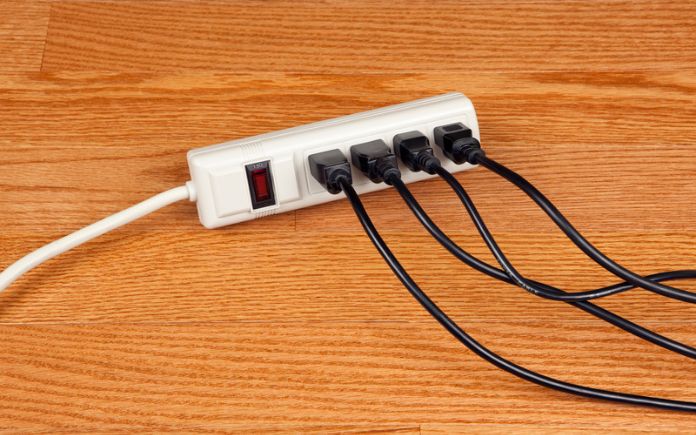
To keep electronics from using energy when they’re not in use, plug them into a power strip that you can turn on and off. (DonNichols, Getty Images Signature)
3. Unplug Devices Not in Use
Just because an electronic device is turned off doesn’t mean it’s using no power.
Energy vampires are electronic items that suck up electricity when not in use (phantom power) — adding at least 10 percent to your monthly utility bill, according to the U.S. Department of Energy.
If you have a light switch that can turn outlets off and on, plug your biggest electronic items (such as TVs and computers) into these switch-controlled outlets, and simply flip the switch when you no longer need the device.
Alternatively, plug media devices — some of the worst energy-sucking offenders — into a power strip and, again, control their power use with a switch.
If neither is an option, avoid leaving your TV or computer idle; power off the flat screen and put the laptop in sleep or hibernate mode. Or simply unplug devices you’re not currently using.
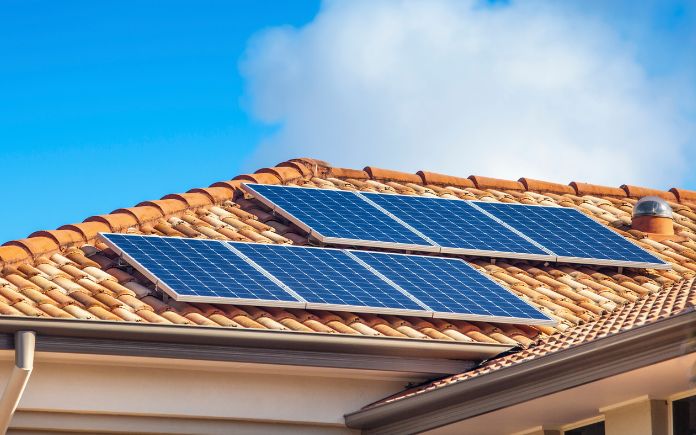
Solar power panels can provide electricity and heat your home’s water. (zstockphotos)
4. Use Renewable Energy Sources
Reducing dependence on non-renewable fuels is at the core of sustainable living, and there’s no better renewable energy source than the sun.
Solar technologies convert sunlight into electrical energy through photovoltaic panels or mirrors that concentrate solar radiation, according to energy.gov. Integrating solar power into your home can be as simple as installing a single panel and battery system or as robust as having a full array of panels powering your entire home.
Solar power can provide electricity for air conditioning, lighting and appliances, and it has virtually no environmental footprint. You can also use solar power to heat your home’s water.
Solar water-heating systems likey won’t provide all the hot water you may need, but for most folks, it can cover 50-80 percent of your hot water needs. Although these systems use some energy, the cost to operate them is only about 10 percent of a conventional water heating system.
Not ready to commit to these big-ticket solar-powered items? Start small with solar lighting to illuminate your landscape and — bonus — deter intruders from coming near your home.
A Little Free Library can foster a sense of community and promote education and literacy. (Scott Fields, Getty Images)
5. Share and Share Alike
Sustainable living isn’t just about the environment. The three pillars of sustainability are environmental, economic and social, and one of the social goals is to educate your community.
You can share knowledge with neighbors by passing along books you’ve read. Little Free Library, a nonprofit organization, promotes literacy, creativity and community through book exchanges.
The signature bookcase — resembling a small building — makes a Little Free Library instantly recognizable. It’s usually made of wood, mounted on a post, and has a door with a window to protect books from the elements.
Another way to share with your community is to grow a community or victory garden. Conventional food distribution with long-distance transportation to grocery stores exhausts energy and human resources.
By growing produce, you can reduce the demand for commercially grown vegetables. Plus, if you grow enough, your can share your surplus harvest with neighbors and reduce food waste.
These are just a few lifestyle changes you can make to live more sustainably. Find more information and tools to help reduce your impact on the environment on the EPA’s Greener Living website.
This week, Artie McGowan, master plumber and owner of Colony Plumbing in Mobile, Ala., joins me to provide solutions to some of the most common plumbing problems, like low water pressure and clogged drains.
He’s a long-time friend of mine who’s also done hundreds of jobs for my construction company.
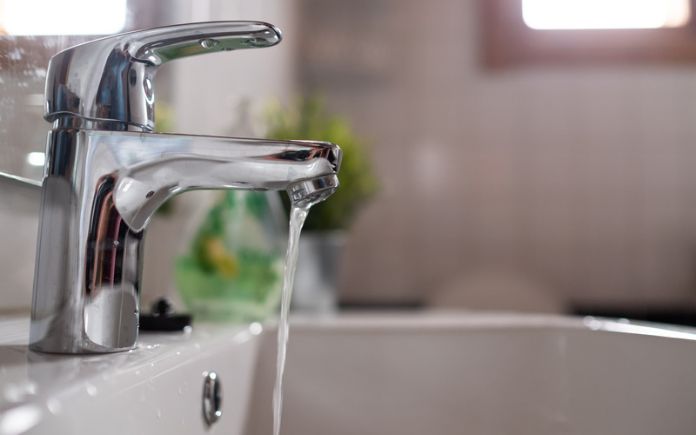
Increasing the water pressure on a sink faucet might be as simple as cleaning the aerator. (Koldunova_Anna, Getty Images)
Low Water Pressure
If a homeowner is experiencing low water pressure, what would be the likely cause?
Artie: Well sometimes, it might just be that ol’ cousin Earl parked his truck over your water meter and squished the line. But more often than not it’s something else.
First, take a look at where the problem is. In the kitchen bathroom sink or lavatory, sometimes debris comes up through the water and gets into the faucet aerator to slow it down or almost clog it.
Some houses are a bit more complicated and have a water pressure-reducing valve that comes right off the meter. When it does, it goes bad over the years. It’s best to let a professional repair this because most of the time it has to be replaced.
If you need to replace a 3/4-inch supply line, is there any advantage to stepping that up to a 1-inch line?
Artie: The best thing to do is to increase it. This will give you a little bit more velocity at the faucet.
When the water’s running through, let’s say if you run it through a small half-inch line, once the fixture starts delivering that water, the pressure drops really quickly.
The larger pipe you have, the more volume of water you have. It’s less likely to drop in pressure, especially if it’s a long run to the house.
What would you say is the right PSI going to a house?
Artie: The optimal water pressure I prefer is 75 PSI on a three-quarter line. Most city water is about that PSI, some of it is in the 60s and 50s, depending on how new the system is.
On wells, most of the time it’s about 45 PSI, but you can increase it. A well has a pressure holding tank, so you can have a little bit lower pressure at the pump, but that tank will keep it up.
Occasionally, sinks clog, and when that happens, you don’t need to call a handyman or plumber to fix the problem. (laymul, Getty Images)
Slow Draining
We get a lot of questions about how to fix a slow-draining sink or tub. What is the common cause?
Artie: If you run the water and it backs up immediately, the clog is between the top of the sink and the bottom of the trap. It’s more likely hair catching on a trip lever that operates the pop-up valve. Easily fix this by removing the pop-up valve and pulling the hair out with needle-nose pliers.
But, if you run the water and it takes about 30 seconds for it to fill up, the problem is down the line in the drain. It could be five, six, or 10 feet away from where you are. If that’s the case, you use a liquid drain cleaner with high sulfuric acid content. You can easily find this type because it’s packaged double — in a bottle and also in a bag.
Follow the directions, and wear the proper safety equipment, like glasses and gloves. You should let it sit in the drain for about 30 minutes.
If it doesn’t work, then call a professional to route it out with an auger.
A running toilet wastes a lot of water and costs you a lot of cash. (DepositPhotos)
Running Toilet
Another common question we receive is that their toilet seems to be constantly running. What’s the cause/solution for that?
Artie: This means there’s a problem with the flush valve, the apparatus that holds the flapper.
Most times, you need to replace the flapper, but sometimes it could be a crack in the flush valve and water is finding its way into the bowl.
You can do the food coloring test to check for leaks. Then, you know the problem is in the flush valve and flapper area.
There are many products out there that make flapper replacement easy. For instance, Fluidmaster’s 502 PerforMAX Water-Saving, Adjustable Flapper offers a customized flush. To use it, you just have to turn the dial left for more water per flush, or right for less, depending on your needs.
The good thing about plumbing today is that it’s become so user-friendly because of products like Fluidmaster’s. I use their flappers, fill valves and flush valves often because I’ve had so much success with them.
If you work on projects with small parts, the biggest challenge can be seeing what you’re working on. Ryobi’s solved this dilemma with its new clamping magnifying glass with light.
This page contains affiliate links. If you purchase a product from these links, we will earn a small commission at no additional cost to you.
The ring light around Ryobi’s magnifying glass has 500 Lumens of LED light output. (The Home Depot)
The magnifying glass with light has 500 Lumens of LED output that can run for over 20 hours on a full charge.
The LEDs are spaced evenly around the magnifying lens for full workspace illumination. And, it has two brightness settings, so you can adjust the amount of light you need.
It’s heavy enough to stay put on any horizontal surface, but you can also use the clamp feature to free up the workspace. The convenient clamping base securely grips both rounded and flat surfaces.
The 3.5-inch wide acrylic lens provides distortion-free 2.25X magnification with 5X spot magnification on a 16-inch flexible neck and rotating base, allowing you to put it wherever you need.
Other Features
The RYOBI ONE+ 18V LED Magnifying Clamp Light is part of the RYOBI ONE+ System of over 260 Cordless Tools that all work on the same battery platform. (Battery and charger sold separately.)
This magnifying glass with light is backed by the RYOBI 3-Year Manufacturer’s Warranty.
Watch the video to learn all about this Best New Product!
If you work on projects with small parts, the biggest challenge can be seeing what you’re working on. Ryobi’s solved this dilemma with its new clamping magnifying glass with light.
This page contains affiliate links. If you purchase a product from these links, we will earn a small commission at no additional cost to you.
The ring light around Ryobi’s magnifying glass has 500 Lumens of LED light output. (The Home Depot)
The magnifying glass with light has 500 Lumens of LED output that can run for over 20 hours on a full charge.
The LEDs are spaced evenly around the magnifying lens for full workspace illumination. And, it has two brightness settings, so you can adjust the amount of light you need.
It’s heavy enough to stay put on any horizontal surface, but you can also use the clamp feature to free up the workspace. The convenient clamping base securely grips both rounded and flat surfaces.
The 3.5-inch wide acrylic lens provides distortion-free 2.25X magnification with 5X spot magnification on a 16-inch flexible neck and rotating base, allowing you to put it wherever you need.
Other Features
The RYOBI ONE+ 18V LED Magnifying Clamp Light is part of the RYOBI ONE+ System of over 260 Cordless Tools that all work on the same battery platform. (Battery and charger sold separately.)
This magnifying glass with light is backed by the RYOBI 3-Year Manufacturer’s Warranty.
Watch the video to learn all about this Best New Product!