Ready or not, fall is upon us… and our gardens are changing. Odds are, most of the summer color has left your garden – but that doesn’t mean that you have to give up for the season! There are plenty of wonderful ways to give it a boost of fall color. Keep reading to check out ten incredibly inspiring autumn gardens.
5. Autumn Joy Sedum is a stunning choice for any fall garden, especially combined with other greens and purples. It is very hardy, and enjoys dryer soil. [Photo: North Coast Gardening]
In episode two of Dream Home Makeover Season 3, we styled Mary’s newly rebuilt home — and in turn, she stole all of our hearts. For those who have already watched the transformation on Netflix, we’re going behind the scenes with Shea for a more in-depth look at the design process. Catch a few tips and extra context you won’t see in the show!
“We were going to just be doing the bedroom furniture, but I couldn’t help myself… She had no idea this was coming.”
– Shea McGee
Threshold™
Oval Faux Leather Mirror with Ring
Threshold™
Moringa Artificial Tree
Threshold™
Vivian Park Upholstered Sofa
Threshold™
Ring Chandelier
Threshold™
Interlaken Rattan with Woven Seat and Back Dining Chair
Threshold™
Pine Brook Diamond Persian Style Rug
Threshold™
Thousand Oaks Wood Scalloped End Table
To make the most of the small footprint of her floorplan, we created smaller “vignettes” within one larger living area. You don’t have to have a separate entryway to achieve a greeting moment, or a dedicated office for a desk space. Given just a window or wall to hitch to, an open concept floor plan can contain plenty of zones within it.
When furnishing a space, consider pieces with different heights to add variety and interest. A tall plant, floor lamp, or free-standing cabinet like we used here, will bring visual balance to the room and draw the gaze upward.
Mary’s bedroom kept with the light and cozy cottage feel, accented by subtle textile patterns and deeper nightstand hue.
It’s pretty clear by now that cats are taking over the world. From global Instagram cat celebrities, to cat cafes, to enough cat-themed accessories to clothe an army, our feline friends have us wrapped around their paws. My own cat, Jax, is no exception — he is definitely the boss in our household. Now he’s even got me making DIY cat toys!
It’s THE LOOK. You cat people know what I mean. How can I refuse?
If your cat has been giving you THE LOOK a lot too, it probably means that he wants you to learn how to make homemade cat toys. In which case you’re in luck, because I’ve got three modern, stylish, and easy DIY cat toys for you: a puzzle box, a catnip sock, and a wand toy.
Your cat will love these toys because, well, they mean playtime. And you’ll love them because they are cheap to make and are pretty enough to show off to all your crazy cat friends.
Keep reading to learn how to make these inexpensive DIY cat toys!
How to Make a Stylish Cat Food Puzzle
Make your kitty work a little harder for his treats with this DIY cat food puzzle that’s pretty enough to leave out. It comes together fast with only a box, a basic plumbing supply from the hardware store, and glue. Place treats and toys in the compartments, and hide some of them behind crumpled pieces of paper. Your cat will love “hunting” for his food as he tries to figure out how to get at the goodies!
MaterialS
Note: To make sure my PVC couplings all fit, I took the box with me to the plumbing aisle and made a mockup right in the store. No extra pieces!
Step 1
Remove the box hardware if it has any, and decorate the box (here I kept things simple by painting half of the box white).
Then, arrange all of the PVC couplings in the box. If couplings have text printed on them, you can hide it by turning the text so it’s facing another coupling.
Step 2
Add glue to the bottom of each coupling…
Step 3
…and glue into place. That’s it!
Once the box has dried, your cat will have a new puzzle feeder to challenge her hunting instincts. This would be a great cat toy to make with your kids!
How to Make a Catnip Sock for Cats
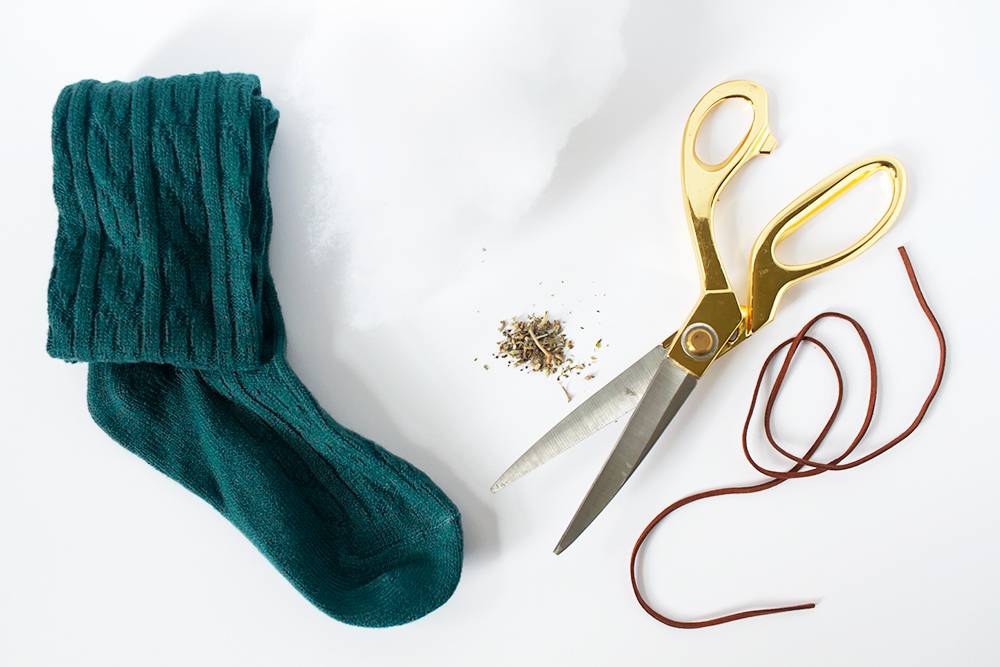
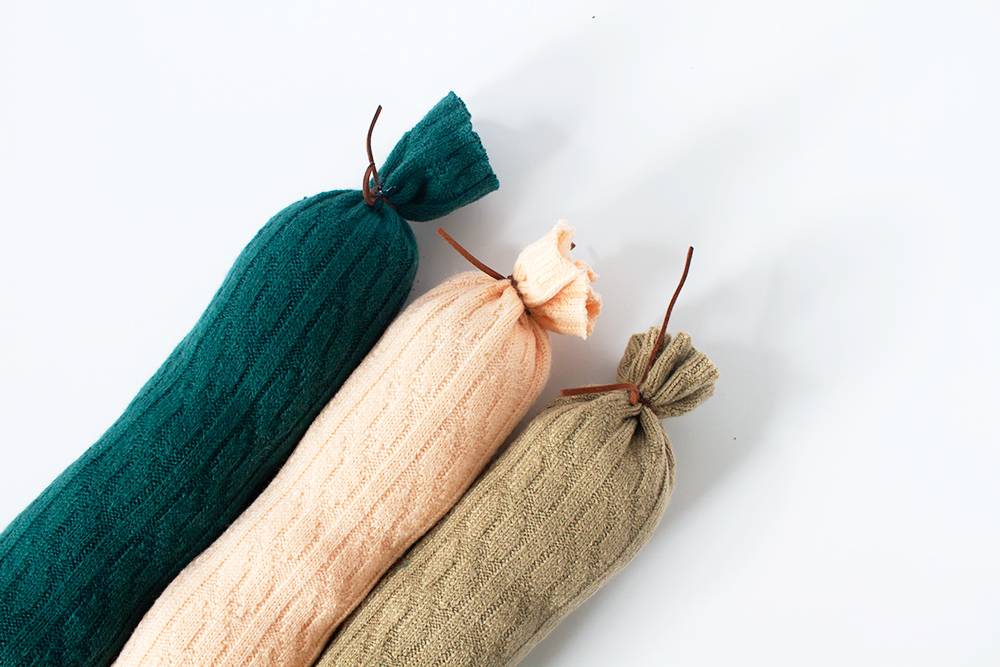
Have you ever noticed how cats love to kick their “prey” with their hind legs as they are playing? This toy is extra long so your cat can kick away! The catnip filling makes it a guaranteed hit with your fur babies. All you need to make this easy homemade cat toy is a knee-length sock, dried catnip, and fiber fill, so it’s an inexpensive cat toy, too.
Materials
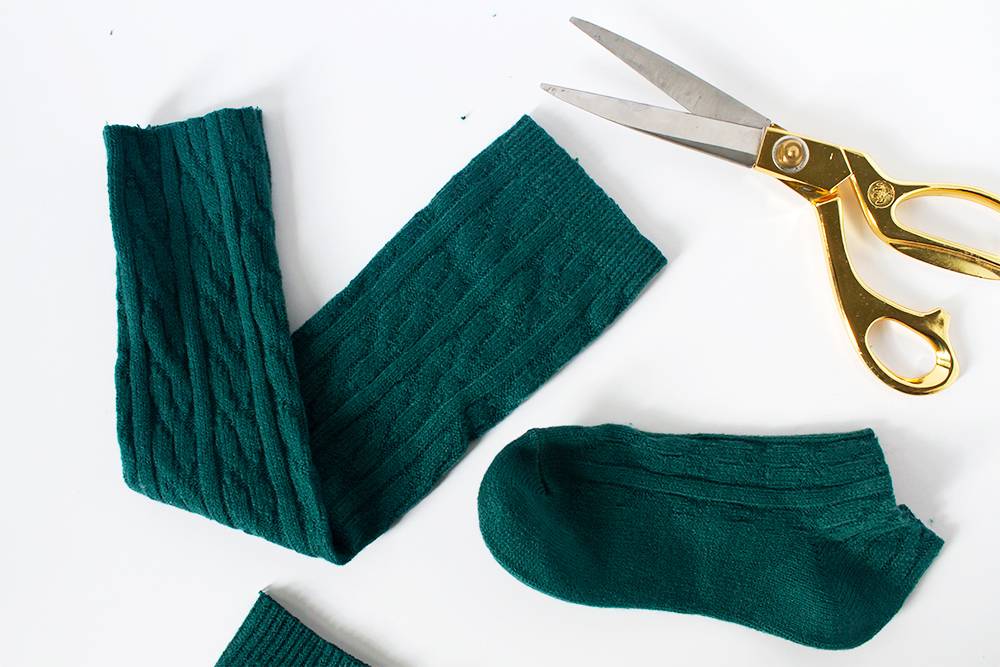
Step 1
Cut the foot off of a knee-length sock, and part of the cuff if necessary (you want the final toy to be slightly shorter than the length of your cat’s body).
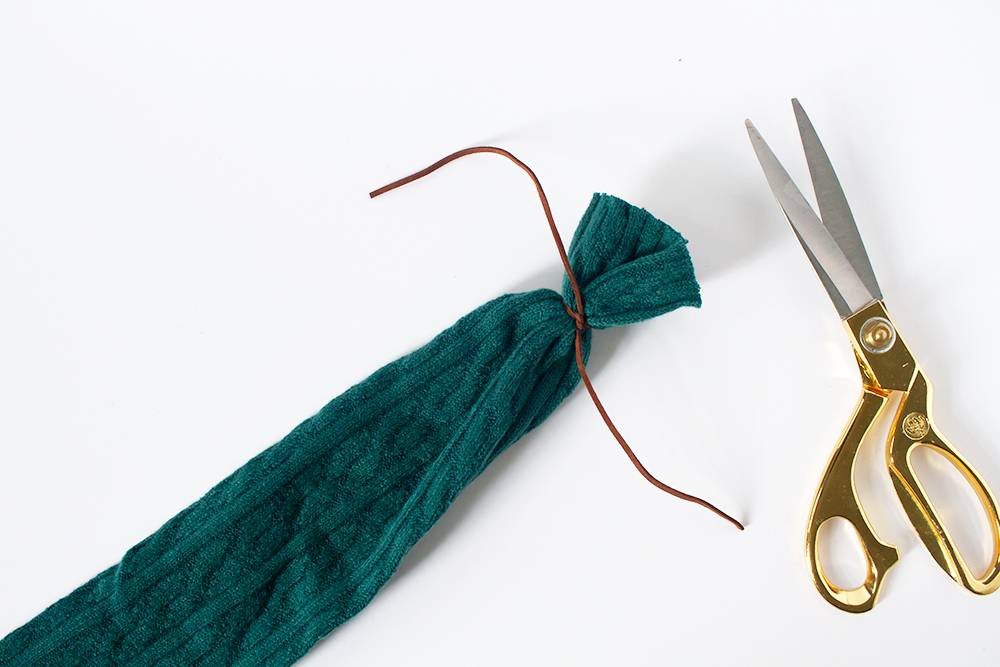
Step 2
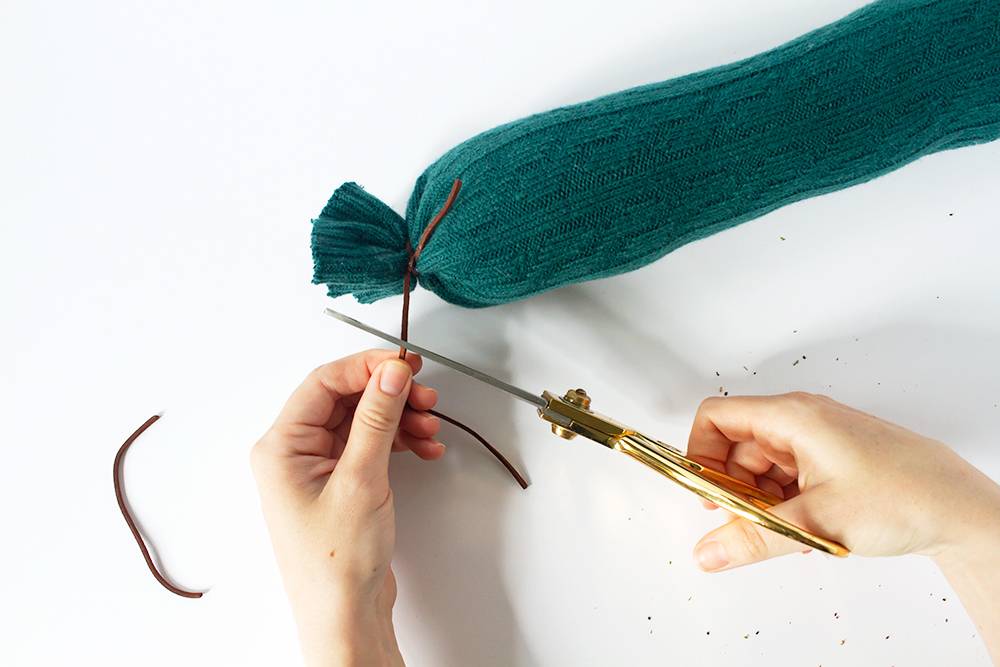
Tightly tie off one end of the sock with a double knot. For extra security, you can add a small dab of E6000 to the underside of the knot.
Step 3
Stuff the sock with fiber fill and catnip. I found the easiest way to distribute the catnip evenly throughout the sock was to spread out a bunch of fiber fill and sprinkle catnip on top of it. Then, push the fiber fill bunch into the sock. Continue until the sock is completely stuffed.
Be generous with the catnip — you want kitty to smell it through all the fabric, and dried catnip will lose some potency out of its sealed container.
Step 4
To finish the homemade catnip sock, tie off the end as before, and add a dab of glue under the knot.
This is a great way to use old socks that are too worn for your feet. Your cat will love pouncing on and kicking her cuddly new loot!
How to Make a Modern Cat Wand Toy with Wood and Leather
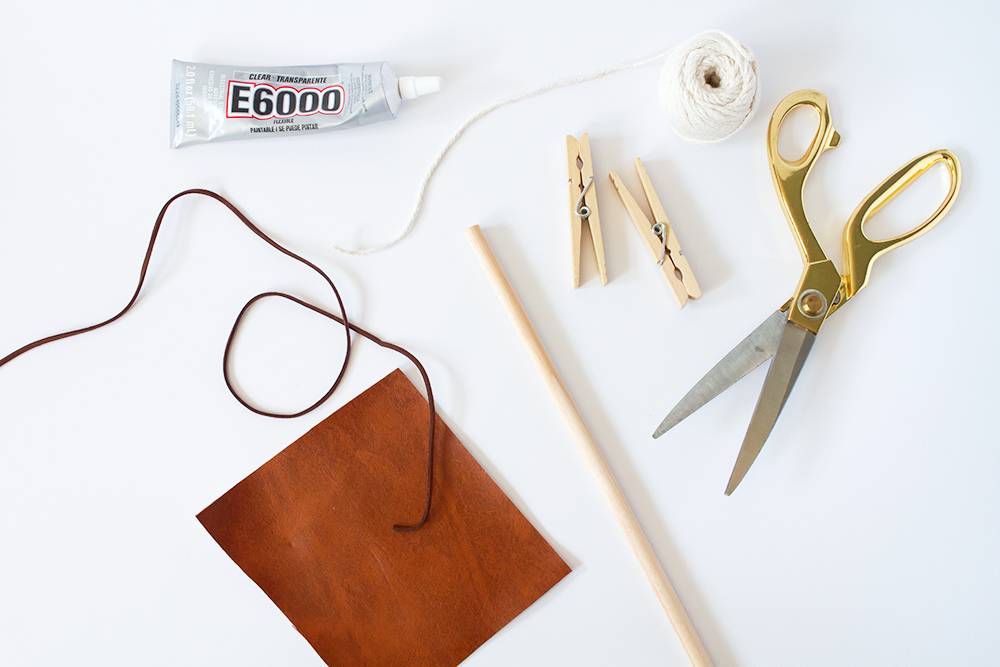
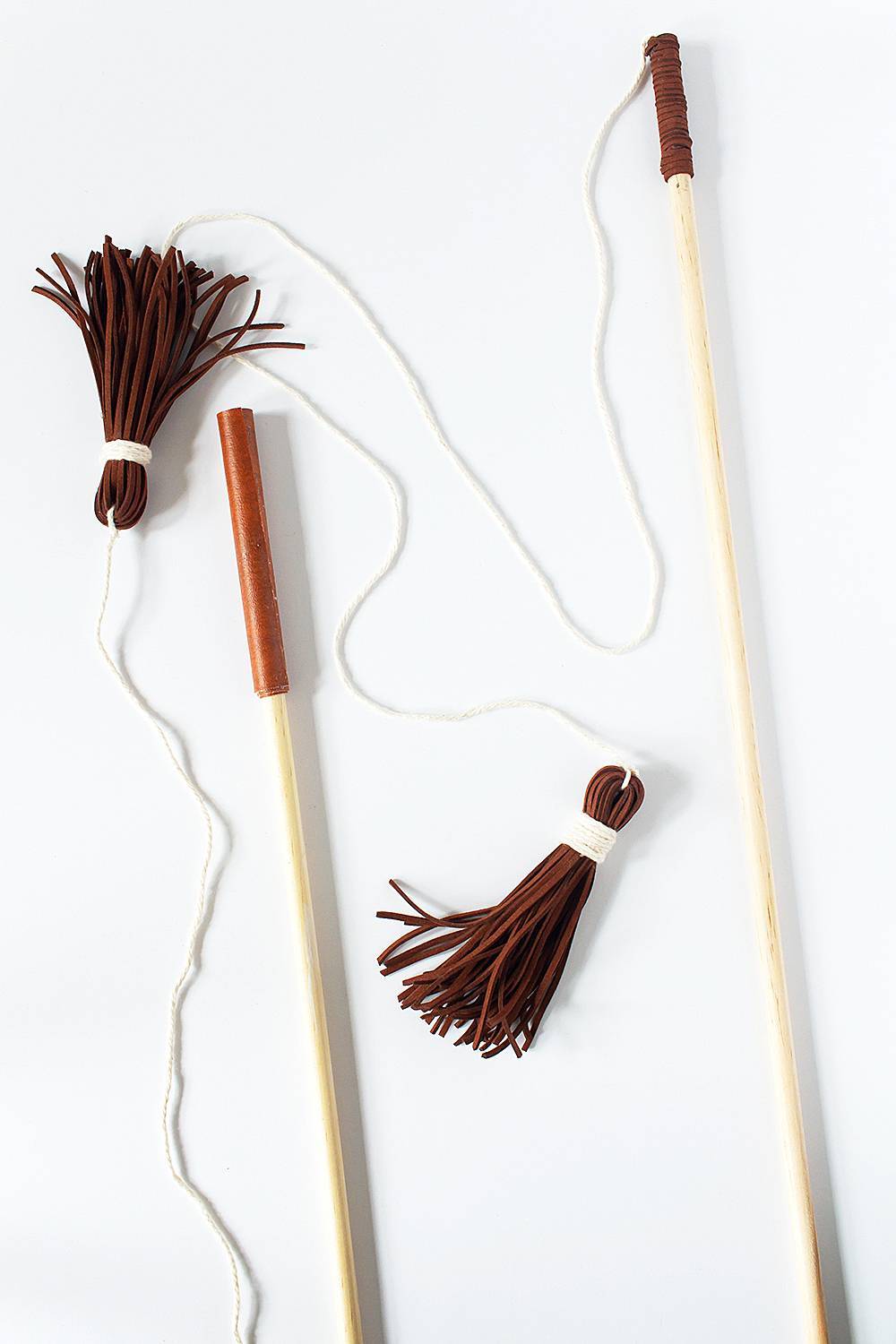
The classic wand toy gets a modern upgrade with the help of faux leather fabric in this simple DIY. Just grab a dowel, string, and glue, and you’re on your way to making another fun homemade cat toy for your cat to bat around!
materials
Step 1
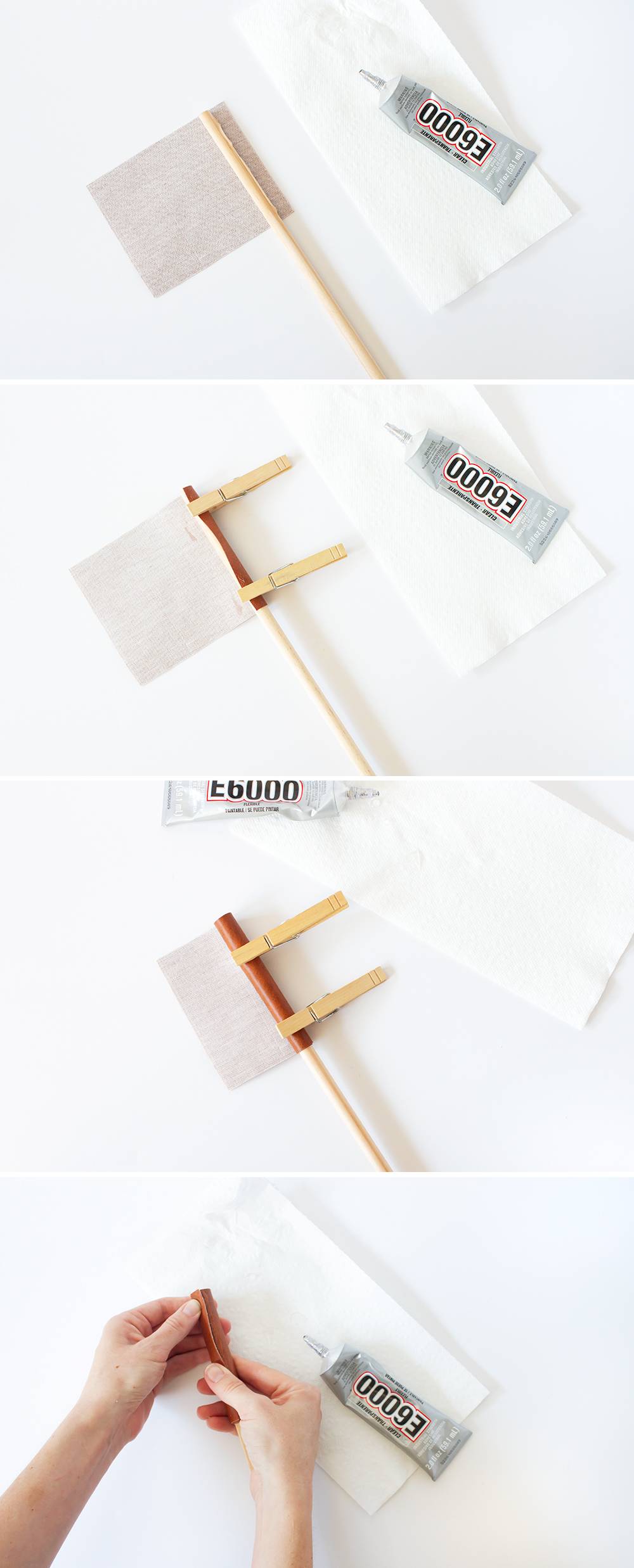
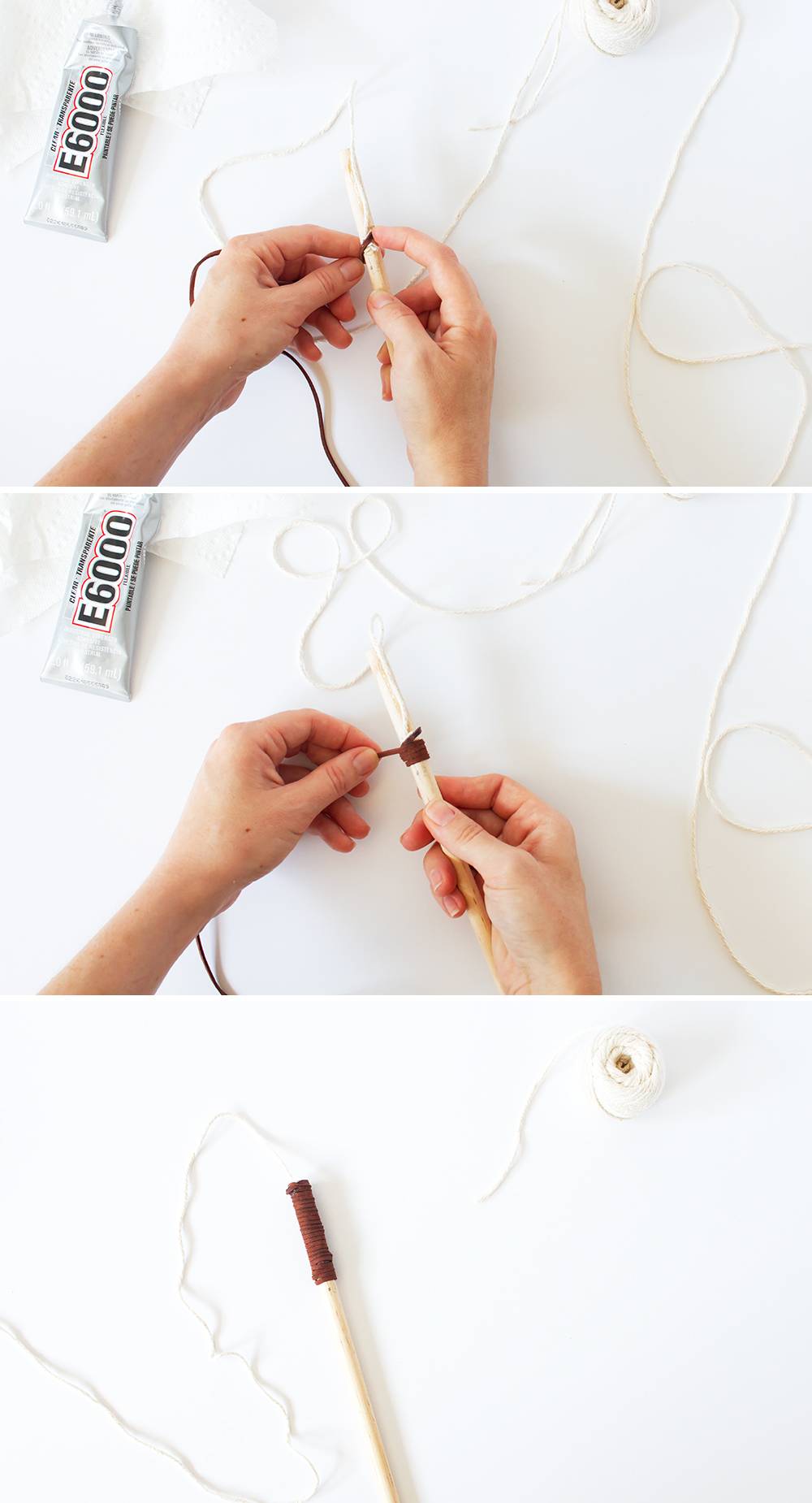
Cut a piece of faux leather fabric about the width of your hand. This will make the “grip.” Wrap the fabric around one end of the dowel and secure with glue.
You will need to wrap the fabric tightly around the dowel, and apply a line of glue every few turns.
Clothespins or binder clips can help hold the fabric in place while you allow the glue to dry for a few minutes before continuing.
Step 2
When the faux leather grip has dried, flip the dowel over so you are working with the other end.
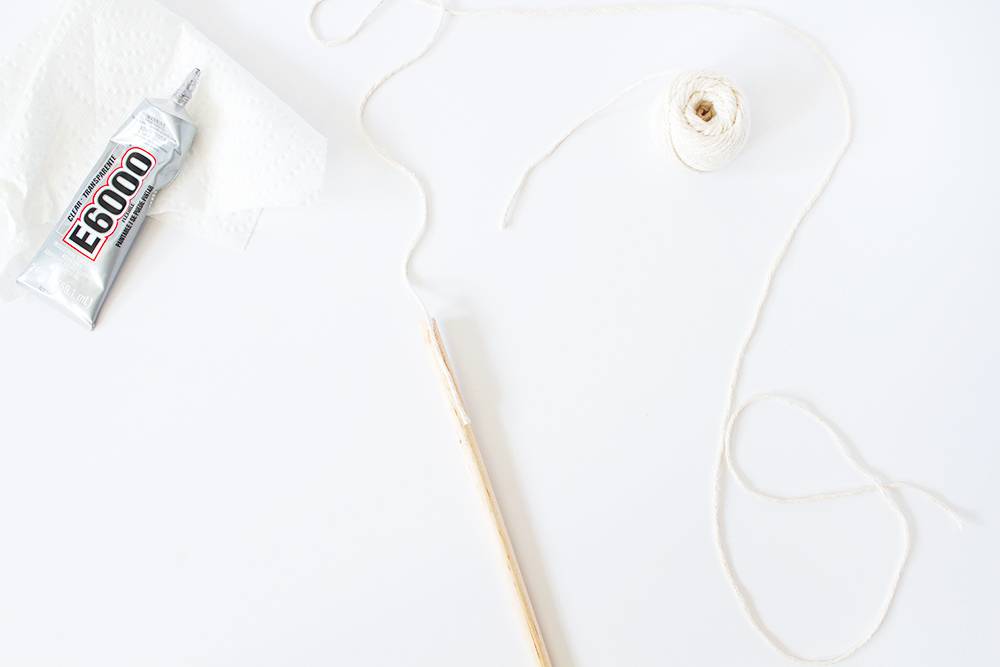
Cut off a piece of cotton string a little longer than two feet, and glue one end of the string to the dowel.
Step 3
Now cut an 8″ length of faux leather lace to wrap this end of the dowel.
Glue the end of the lace to the dowel, then wrap the cord tightly and evenly around the dowel, applying more glue every few turns. Trim the end of the lace and hold in place with another dab of glue.
Step 4
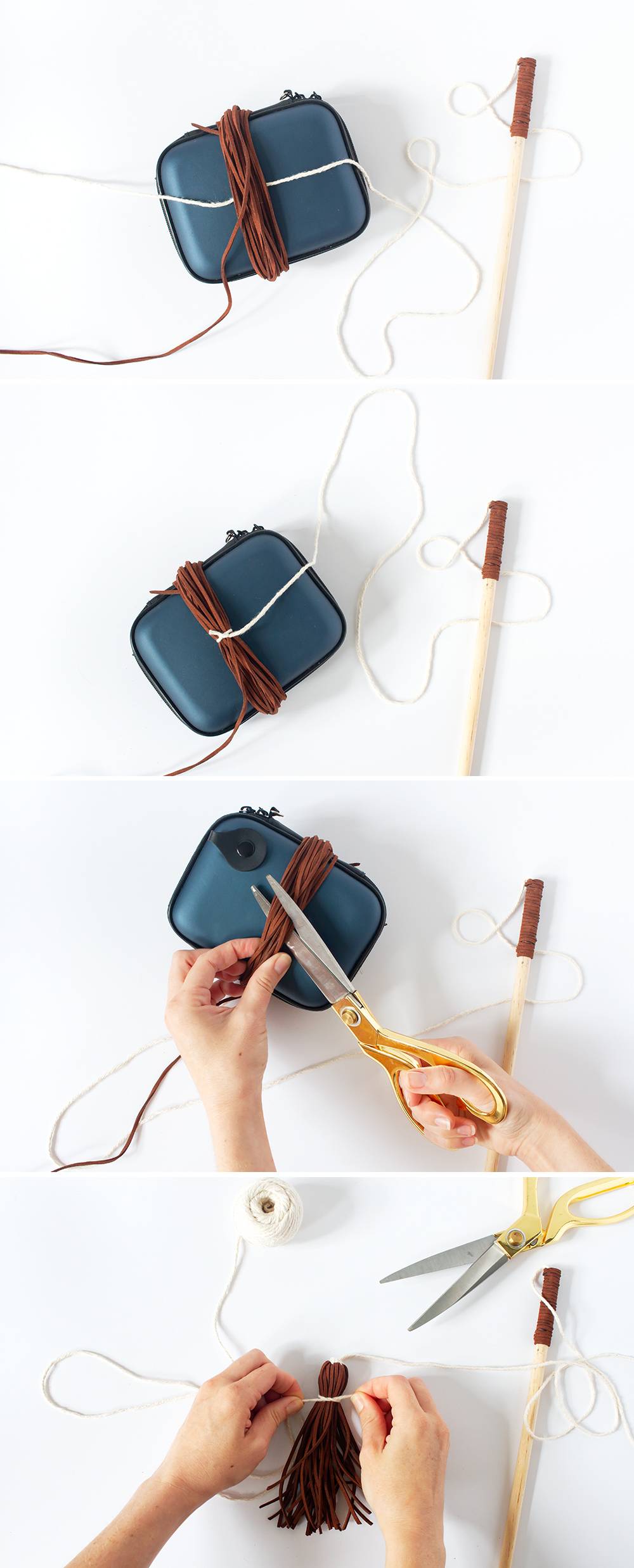
Next, make the tassel toy. Find an object that is approximately the length of the final tassels. The object can be anything; pictured here is the case for my external hard drive, which is a little larger than my hand.
Place the end of the cotton string on the object, with a tail of about 4″. This will be used to attach the tassel to the wand.
Wrap the leather lace around the object roughly 20 times. More will make a fluffier tassel, less will make a thinner tassel.
Tightly tie the end of the cotton string around the lace threads with a double knot.
Turn over the object, and cut through the lace threads right in the middle.
Gather all the tassel pieces so they are hanging down in the same direction. Then tie tightly with another piece of cotton string.
Step 5
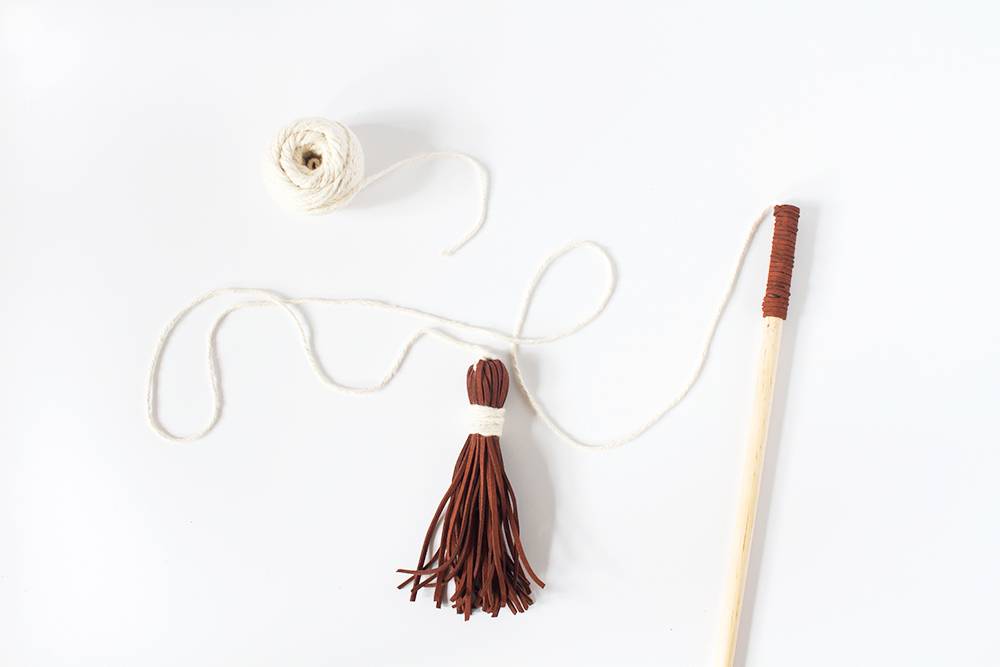
Finish the toy by wrapping the string around the “head” of the tassel several times. Tuck the end under the loops, and secure with a dot of glue.
Finished! You just made another easy DIY cat toy for your cat.
Pin this DIY for later!
Now that you know how to make homemade cat toys, let’s talk more about how to actually PLAY with your cat!
What do cats like to play with?
Maybe you’ve just come home with a new feline addition to your family, or you’d like to help your current kitty companion shed that extra pound by playing with her more. Learning a little about how cats like to play will get you two having fun play sessions in no time!
What types of toys do cats like?
In the animal kingdom, play is all about practice. For predatory animals like cats, this means practicing the hunt. Kittens learn how to hunt by observing their parents and play stalking and attacking each other.
Our house cats don’t need to hunt since their food comes from a can. But, they don’t know that! Cats still have strong hunting instincts, and they love to play to hone their skills.
This means, cats like toys that resemble “prey.” Depending on your cat’s personal preference, she may like chasing birds, mice, insects, or all three.
To find out which type of prey your cat prefers to chase, try playing with her using a toy that moves or sounds like a bird. The wand toy above is great to use here. See how she reacts when you move the toy like a bird. Then, try a toy that moves like a mouse, and one that moves like an insect. Does she react more strongly to one or the other?
If you’ve never done this before and aren’t sure what to do, watch some nature shows of big cats hunting and notice how the prey moves, and how the cats respond! Try to make your cat’s toys come to life as different prey. Your kitty will love “hunting” the toys.
Puzzle toys are also wonderful to get your cat interested in playing. While this type of toy doesn’t move, your cat has to use his senses to work out how to access the treats. This is just like trying to hunt for a small animal that has hidden itself.
What toys do cats hate?
There are many household objects that make fun, free cat toys, like crumpled pieces of paper, boxes, and toilet paper tubes.
But, did you know that cats hate tin foil? They despise the sound it makes and the texture under their paws.
The same goes for sticky surfaces, like double-sided sticky tape. (Incidentally, this means that both of these items can make great training tools!)
You’ll also want to avoid trying to play with your cat with toys that make loud sounds. And some cats have more individual preferences. My senior cat, Champ, loved crumpled paper, but was afraid of pretty much everything else!
Why do cats like boxes?
Every cat owner knows there are times when the packaging is better than the gift, at least according to the cat! As far as animal behaviorists have been able to work out, cats like boxes for a few reasons:
A cardboard box makes a great hideout. Cats feel safe in small spaces that are hidden, yet provide an exit for escape.
Cats like to avoid conflict, and for multi-cat households, boxes can be a “do not disturb” signal to the others.
Boxes made of cardboard are insulating, and cats prefer a warmer average temperature than we do. (Also why kitty loves to sleep on your laptop!)
Do indoor cats need special toys?
Cats that go outdoors tend to have shorter lifespans on average than cats that live indoors: 2-5 years compared to 13-17! But, outdoor cats get a LOT more exercise and mental stimulation than indoor cats.
To make up for this, indoor cats should have a rich home environment, including toys that satisfy their need to hunt. Check out the bottom of this post for some great examples.
What kinds of toys are safe for cats?
Keeping cats out of trouble can be a little like…well, herding cats. Those notoriously curious felines are prone to get into anything and everything. Let’s talk about how to keep your kitties safe during playtime.
Toys that are not safe for your cat:
Pieces of string, balls of yarn, ribbon, and rubber bands: Even though cats LOVE the simple pleasure of swatting and chasing strings, it is not safe to allow cats to play with any loose strings or similar objects. And they should never play with string (including wand toys) unattended. Cats will frequently swallow strings, which can become entangled in their intestines and lead to complicated (and expensive) surgery. Always store any cat toys that have strings on them away when playtime is over.
Plastic bags, packing peanuts, and bubble wrap: These items can be very appealing to cats because of the crinkly sound and texture, but as with young children, there is a danger of suffocation and swallowing.
Toys containing small loose filling, like plastic beads: That rattling sound is so enticing to your cat, but of course, his desire to capture and rip apart his “prey” makes this an unsafe choice. Swallowing lots of tiny beads? That’s a vet visit you want to avoid!
In general, avoid leaving your cat alone with anything that is small enough to be swallowed, has parts that can easily be torn off, or can get her tangled up.
Your hand is not a toy: This one is to keep you safe! It can be fun to wave your fingers in your cat’s face, especially when she is a kitten, but this will only teach her to pounce on and bite you. And because cats lick their own bums, their mouths are an actual cesspool of germs. Cat bites are no joke, avoid them!
These toys ARE safe for your cat:
Plush toys: As long as they are sturdy enough to withstand being chewed on without being ripped open, small and large plushies are great kitten toys. Adult cats enjoy plush toys too–some cats even like to cuddle and sleep with them!
Catnip: Catnip affects all cats differently. Some are crazy about it, others ignore it completely. Some cats like to eat the fresh or dried catnip leaves, some prefer to sniff it and roll around in it. Catnip can cause your cat to be drowsy, OR to turn into an off-the-wall cat maniac! Regardless, both fresh and dried catnip are safe for your kitties. Don’t give them more than a tablespoon or two though, as too much of a good thing can cause vomiting.
Catnip-filled toys: Since catnip is safe for kitties to eat, it is perfectly fine to give cats catnip toys, even if they end up torn apart.
Balls: Make sure they are large enough that your curious cat can’t swallow them. Try tossing a few ping pong balls into a bathtub for a cheap and easy way to entertain your cat! Sturdy plastic shower curtain rings are also fun to bat around.
Mouse toys, crinkle toys, and other pet store toys: Yes! Just watch out for the “no-nos” above.
Paper, paper bags, and boxes: Crumpled up pieces of paper can be a greatsource of entertainment. And we all know how much cats enjoy stalking paper bags! Be sure to remove the handles on the bag first, so your cat doesn’t get stuck in them. And cardboard boxes are a given — even if it doesn’t fits, it sits.
A note on licking and chewing paper and plastic: It’s normal for cats to do this when they are playing, but if your cat is excessively seeking out every single thing made of paper or plastic just so she can lick and suck the item, it could be a sign of a nutritional deficiency or other medical condition. Get a checkup with her veterinarian to be safe!
Laser toys: Looking directly into a laser beam for a long time can be dangerous to the retina, for both humans and cats. But, most cheap laser pointers that you buy at pet stores or office supply stores don’t have a strong enough laser to cause damage if the cat accidentally looks at the beam for a moment. When playing with a laser toy, be careful that you are not shining it at kitty’s face, and stay away from automatic laser-shooting toys, since you can’t control where the beam is directed.
Feathers: Chewing on feathers satisfies a cat’s natural craving to HUNT, but swallowing them can lead to an intestinal blockage. As with other toys that might accidentally be swallowed, feathers are ok –under supervision!
How often should I play with my cat?
In my day job at a cat-only veterinary clinic, I’ve found that people often choose cats as pets because they believe cats are so independent that they don’t need much attention. And it’s true, cats ARE very independent. They are solitary hunters who can be very territorial, and famously have minds of their own.
But, cats are still social mammals that crave affection and bonding just like we do. And, just like us, they need exercise, variety, and mental stimulation! So how often should you play with your cat?
The feline experts at Cat Behavior Associates recommend one to two 15-minute interactive play sessions with you a day. Each play session should end with allowing your cat to “catch” the toy, and getting a treat reward, so she can feel like a successful hunter!
I know, we are all busy, and that sounds like a lot. If you’re not there yet, try working in a few minutes of playtime with your cat every night before you go to bed. It will be fun for both of you, and will help her get rid of excess energy so she doesn’t wake you up mewling at 4am.
While not a replacement for “live” playtime with you, automatic toys can help supplement these play sessions for the extra lively cat. Give these toys a try:
Electronic Cat Toys
SmartyKat Hot Pursuit: My personal favorite! Know a cat that loves to attack your feet under the covers? Who doesn’t! This toy mimics that movement perfectly. It even got my timid senior kitty to overcome his fear of toys!
If you are providing your kitty with regular interactive play, window perches, and other stimulation, but still find that he is keeping you up at all hours tearing through the house, consider leash-training him for outdoor play sessions!
I’m not a germophobe, but every now and then I notice my cat Jax use the litter box, and then immediately start swatting his favorite catnip mouse around. EW.
Cats really care about having a clean environment, but they do clean themselves with their tongues, and then carry their toys in their mouths. Let’s give their toys a quick clean once in a while for everyone’s sake.
How to clean cat toys:
Plush toys: Toss them in the washing machine with a scent-free detergent (cats have a strong sense of smell!). It’s best to place the toys in a delicates bag so they don’t get too roughed up. Air dry or tumble dry low.
Rubber or plastic toys: Soak in hot soapy water for 20 minutes, then rinse and air dry.
Catnip-filled toys: Catnip will not survive a soaking, so it’s best to spot-clean with a lightly damp cloth. If the toy is refillable, you can empty out the catnip, wash the toy as above, and then fill with new catnip.
Toys with feathers: Feather toys also won’t make it through the wash, so you’ll have to spot-clean these as well.
Cat trees: Use a vacuum hose or lint roller to clean off cat hair, then use a damp soapy rag to spot-clean any soiled areas.
Speaking of soiled, the best cleaning product to clean up cat pee, vomit, or poop, is Nature’s Miracle! It is formulated with enzymes that break down the waste. It REALLY saved the day when my feral cat started a literal pissing contest in my home!
Cat beds: Vacuum or lint-roll periodically, and every now and then run them through a laundry cycle.
How to Make Even More DIY Cat Toys
Did making the three modern DIY cat toys above get you hooked? Check out these ideas too!
1. DIY Macaron Cat Toys: This is quite possibly the cutest homemade cat toy tutorial I’ve seen! And also, puts me in the mood for macarons…
7. DIY Cat Food Puzzle: If you’d rather skip the plumbing aisle in my tutorial above, you can use a cardboard box to make a DIY puzzle feeder for your cat.
8. DIY Egg Puzzle Feeder: A water bottle also makes a great cat food puzzle. In both cases, be careful not to leave sharp edges that can cut your cat’s paws.
9. Rainbow Flyer Kitty Toy: This is a DIY wand toy your cats and your kids are sure to love.
10. DIY T-shirt Cat Toy: Whip up a bunch of these free homemade cat toys using old t-shirts — so you can spend more money on your cat, as she demands.
DIY Cat Condos
Climbers, trees, teepees, and beds — these are the best of the best!
1. DIY Wood Cat Tent: This sweet homemade cat tent allows your cat to hide, rest, scratch, and look so hip all at once!
2. Wall-mounted Cat Hammock: This simple yet stylish DIY cat hammock stays tucked out of the way by being mounted on the wall.
3. DIY Cat Shelves: Nearly invisible thanks to paint that matches the wall color, this wall-mounted option looks sleek and functions as perfect vertical space for your cat to survey his kingdom.
4. Faux Cactus Cat House: There’s no tutorial posted for this cute faux cactus cat condo, but the picture is pretty clear! Just make sure to sand the cut edges of the pot so kitty doesn’t cut herself.
5. DIY Mid Century Pet Bed: You can adapt the plans for this dog bed to fit your cat…or give your cat a dog-sized bed, I’m sure she’ll love the extra space to sprawl.
8. DIY Pallet Cat Condo: You can turn old pallets into a DIY cat condo with this clever tutorial.
9. IKEA Hack Cat Condo: Another IKEA hack! This blogger turned two LACK tables into a multi-level cat chill zone.
10. DIY Ladder Cat Tree: This is my favorite DIY ladder cat tree — don’t you love the eclectic colors?
11. Free DIY Cat Tent: You’ll love the cost of this DIY cat tent: absolutely free. See how to turn scarves and branches into an elegant, boho cat hideout.
DIY Cat Scratching Posts
1. DIY Cat Scratching Post in Colorblock: Beautiful AND functional, this scratching post is the perfect place for cats to reach up and scraaaaatch. Scratching is an important part of play, too, to allow cats to establish their territories.
3. Minimal DIY Cat Scratcher: Not all cats like vertical scratchers; it’s good to have a horizontal option too! This DIY scratcher fits the bill and looks chic doing it.
4. DIY Doormat Cat Scratcher: This idea couldn’t be easier: a cat scratcher made from a coir doormat!
To buy, or DIY? That’s always the question for us makers. If you’re looking fore more time to play with your feline family members, consider going with store-bought toys.
I showed you my favorite electronic cat toys above. Now, give these other options a try.
Interactive Cat Toys
Interactive cat toys allow you and your cat to play together. These are toys that you bring to life for your cat during your play sessions. From my experience with my own cats, and what I’ve learned working in a cat hospital, these are my favorites:
This wand toy is an absolute MUST for cat households. Even if you think your cat doesn’t like chasing birds after testing his prey preference, it’s worth giving Da Bird a go. It truly is the best cat wand toy on the market.
When you twirl the wand in the air, the feathers make a “whoosh,” just like bird wings in flight. Every cat I’ve used this toy with has leaped and even somersaulted to try to catch it!
Another personal favorite. I mean of course, personal favorite of Jax. The Cat Dancer is a cheap but amazing cat toy that bounces around at the slightest hand motion, fluttering erratically like a moth. You’ll be amazed at how little effort it takes to get the laziest cat on her feet with this toy.
Chewy Cat Toys
Cats love to rip and gnaw and BITE their prey. These toys encourage cats that like to chew to direct that energy to the right place, rather than your shoes.
While not a toy exactly, this feeder treats a chewing-related issue: eating too fast. To get her dry food dinner, your cat will have to grab the kibble with her paws, forcing her to eat more slowly. No more post-meal vomiting!
How beautiful is this sleek and modern cat tree? I like that it doesn’t have any carpet fibers for my cat to shred and scatter, and cats generally prefer sisal for scratching. The tree is small and space-saving, provides a perch with a rim the cat can snuggle against, multiple levels, and a little hiding hole. This one is on my shopping list for Jax!
For those who have more floor space, this cat condo has it all: plenty of scratching posts, perches on multiple levels, and even an integrated puzzle toy!
Cats are excellent time-sharers, but when you have a large fur family, it’s best to provide everyone with a perch. That’s why this cat tree is a great option for multi-cat households.
Cat Videos for Cats
We’ve all seen cats gazing out the window, watching for birds, squirrels, and rival cats. But some cats also enjoy watching these things on TV! For these kitties, you might want to consider playing some cat videos just for cats when you’re away.
Is it ok for cats to watch TV?
It is perfectly fine for your cat to watch TV. It won’t damage his eyes or rot his brain.
There are two caveats though:
Cat TV is NOT a replacement for playing with your cat. He still needs mental stimulation, exercise, and socialization, just like you do.
Your cat may try to pounce at or swipe the TV. Make sure it is properly secured, because kitty can’t tell the difference between the bird outside the window and the one on the screen!
Ok now that we’ve covered that, let’s look at some fun videos to entertain your cat!
The cat hospital where I work sometimes plays this CD to help mellow out stressed cats. It’s been scientifically proven to be calming to cats!
Ok cat-crazy people. You’re armed with a whole host of ideas on how to keep your cat entertained. Now we want to hear your tips! What DIY cat toys have you made before? How does your cat like to play? And what’s the funniest thing your cat has ever done? Tell us your stories below!
Those Swedes sure do love to organize. Flip through any edition of the IKEA catalog, and the first impression you’ll likely get is: a place for everything, and everything in its place. But don’t our cluttered, modern, go-go-go lifestyles make it seem impossible to live up to this standard? Most especially in that most dreaded place in our homes — the closet. Chances are, if you’re a Curbly reader, you love organization just as much as we do. And you may need a little help figuring out how to make your closet system work for you. That’s why today we are talking all about how to design the closet of your dreams using IKEA closets.
We’ll go over the entire range of IKEA closets, plus real-life examples of how they are used, hacks, tips for installing an IKEA closet, organizers, and more.
Let’s whip those IKEA closets in shape!
Closet Systems from IKEA
IKEA makes it easy to stay organized with their large range of closets. From wardrobes; to children’s closets; to totally customizable, open clothes storage systems; and more organizing accessories than you can count, they’ve got everything you need to turn your closet into your favorite part of your home.
Let’s start with their simplest system first: wardrobes.
IKEA Wardrobes
Possibly the biggest conundrum a renter or homeowner can face when struggling with storage is: no built-in closets. The worst! Thankfully, IKEA has lots of options if you’re looking to buy an inexpensive, fuss-free wardrobe to create, or add to, your clothes storage.
White and classic with a traditional build, this wardrobe features two mirrored doors, a clothes rail, shelf, and one drawer. The ledge on top prevents items from being pushed off when you’re grabbing things in a hurry.
Best bang for your buck: BRIMNES, $129
With two doors for hanging clothes, a full-height section for shelves, and a mirror, the BRIMNES provides the most clothing storage space in its budget. And it comes in black, too.
If you need something temporary, or to store off-season clothes in a spare room, the BREIM is super affordable at only 30 bucks!
Freestanding IKEA Closets
Sometimes a wardrobe is just too bulky for your room. Enter the freestanding closet system! A mix of open and closed storage is the key to keeping this type of closet organized and beautiful. That way you can display the pretty things, and hide the clutter.
Naturally, there is a wide range of modular IKEA closets to choose from:
Forgive the upcoming gushing, it’s just that I’m a little in love with IKEA’s ELVARLI line. Those clean, minimal lines all in white just make my organization-loving heart race.
The ELVARLI was designed to be completely customizable, so while you can choose one of the pre-made options from the website, you can also build your own using the ELVARLI planning tool. I’ll go into more detail on IKEA’s handy planners below. For now, just know that the sky is the limit! (Or your budget. Your budget is the limit).
Think you’re too messy to make open storage work for you? Take a look at how much clothing Igor from Happy Interior Blog stuffed onto his ELVARLI:
The ALGOT series is one of IKEA’s most modular storage systems. Think of it as the ELVARLI’s more affordable, and more flexible, predecessor. Once you’ve attached the upright brackets to the wall, the shelves can be easily rearranged using the pop-in brackets, without tools. It’s very inexpensive, too; the configuration below costs only $152.50, and look how much clothing you can store!
IKEA’s ALGOT closet is a fabulous solution for small closets because of how much you can store in just a simple setup.
The ALGOT system is great for children’s closets, too!
Related to the ALGOT system, the ANTONIUS wire frames and baskets can be used in addition to an ALGOT closet, or as an entirely separate closet organizer, as in this storage idea from Personally Andrea.
Those homemade chalkboard labels started out as wall plate covers!
If you’ve never heard of PAX…you are in for a treat.
The PAX is IKEA’s luxury closet line that starts at budget prices. And as always, it’s completely modular and customizable. We are talking OPTIONS. So many, in fact, that it can be a bit overwhelming to shop for a PAX system. So let’s break it down!
What are IKEA PAX wardrobes?
The PAX is a customizable closet system that can be used to organize an existing closet, as a stand-alone closed wardrobe, or as an open clothes storage solution (like in that stunning example above).
How do you design and install a PAX closet?
Okay, so you’ve decided you want to organize your life with a PAX closet system. Now what? Here are some key things you need to know to get started:
Now that we’ve covered the very basic basics, let’s design an IKEA PAX closet!
IKEA loves making things easy for us. That’s why the brilliant minds behind the home furnishing giant created online planning tools for its storage systems. So we, too, could have a place for everything, and everything in its place.
You can access IKEA’s PAX planner two ways: click “Customize this combination” on any PAX product page, or navigate to “Planning Tools” in IKEA’s footer.
You can find the ALGOT and ELVARLI Planning Tools on the main tool page, too!
Once you’ve launched the planner, you can choose an existing combination to customize, or “Create Pax from scratch” to design your own custom PAX closet.
Image: IKEA
Don’t forget to create an account so you can save your design!
The most fun part about designing your own closet is choosing interior closet organizers. These are the nitty-gritty organizing details that make me drool (yeah, I’m an organizing freak. You know you are too).
IKEA’s KOMPLEMENT series has every kind of closet organizer you can imagine to maximize storage space in your PAX.
But, my absolute favorite thing about IKEA’s planners is that once you are finished with your design, the tool will generate a shopping list and sort all the items by where they are located in the store. PURE. GENIUS.
Image: IKEA
Assembling and Installing IKEA Closets
So how hard is it to assemble your own IKEA closet system? Well, that depends a little on your level of patience. If there’s one negative association IKEA has, it’s that putting together furniture can be a pain in the [insert your favorite expletive here].
But remember, IKEA designs their furniture so that it can be assembled by absolute beginners, with a bare minimum of tools. So it’s really not THAT hard! In general, if you can follow directions, and know how to hang a picture with a nail and hammer, you can assemble an IKEA closet or wardrobe.
From my experience as a life-long IKEA fan, and frequent assembler of IKEA furniture, here is my advice on how to install all types of IKEA closets as painlessly as possible:
Don’t go it alone! Large items, like the PAX, ALGOT, or ELVARLI systems, require two people.
Triple check your shopping list before you leave the store to make sure you have ALL the parts.
When you get home, organize the boxes in the order that you will need them, with the first items (usually, the largest) easily accessible.
FOLLOW THE INSTRUCTIONS TO THE LETTER. I know that seems redundant to say, but often when something goes wrong, it’s because a step was missed.
We love IKEA hacks around here! Here are some gorgeous PAX closet hacks to inspire your own closet makeover.
How to make a PAX wardrobe look built-in:
Image: Braun + Adams
This hack is not for the faint-hearted — a custom PAX installed under roof eaves!
This PAX wardrobe was raised onto a custom wooden platform and finished with floating shelves. The chunky knobs add a stunning touch!
A wallpapered back, plus framing added to the doors, make this PAX look like a totally different piece.
Or simplify this idea with squares of paper added to one of IKEA’s PAX door options:
This idea works for drawers, too!
Alternative IKEA Closet Hacks
So you’ve seen how to use an ELVARLI, ALGOT, or PAX system to organize your bedroom closet. But if you are really out to DIY, check out these other ways you can use IKEA products to build a custom closet.
KALLAX closet hack:
BILLY bookcase closet:
IKEA RAST wardrobe hack:
Are you ready to make your own IKEA closets? Which system do you think you would pick? And which closet in your house is the biggest disaster zone right now? We’d love to hear what you think of our IKEA closet design guide!
Stylish tufting can make any chair look and feel more comfortable. In this post, we’ve collected our favorite tufted chairs for every room – from tufted lounge chairs for living spaces, to comfortable tufted dining chairs for cozy dinners, to smart tufted office chairs that emphasize softness and support. This compilation also highlights the different ways that tufting can look, from the chic modern minimalism of biscuit tufting to the classic elegance of button-tufted designs. We’ve even included a few channel-tufted options for those who crave a glamorous aesthetic. Which style is your personal favorite?
Everybody knows that first impressions are everything, and that’s true for our homes too. If the front of your house doesn’t look great, people will assume the inside doesn’t either. To get you inspired to spruce up your home’s curb appeal, here’s an epic roundup of gorgeous exteriors organized by style.