by Furnishly | Mar 11, 2022 | Design Inspiration, Style
We independently select these products—if you buy from one of our links, we may earn a commission.
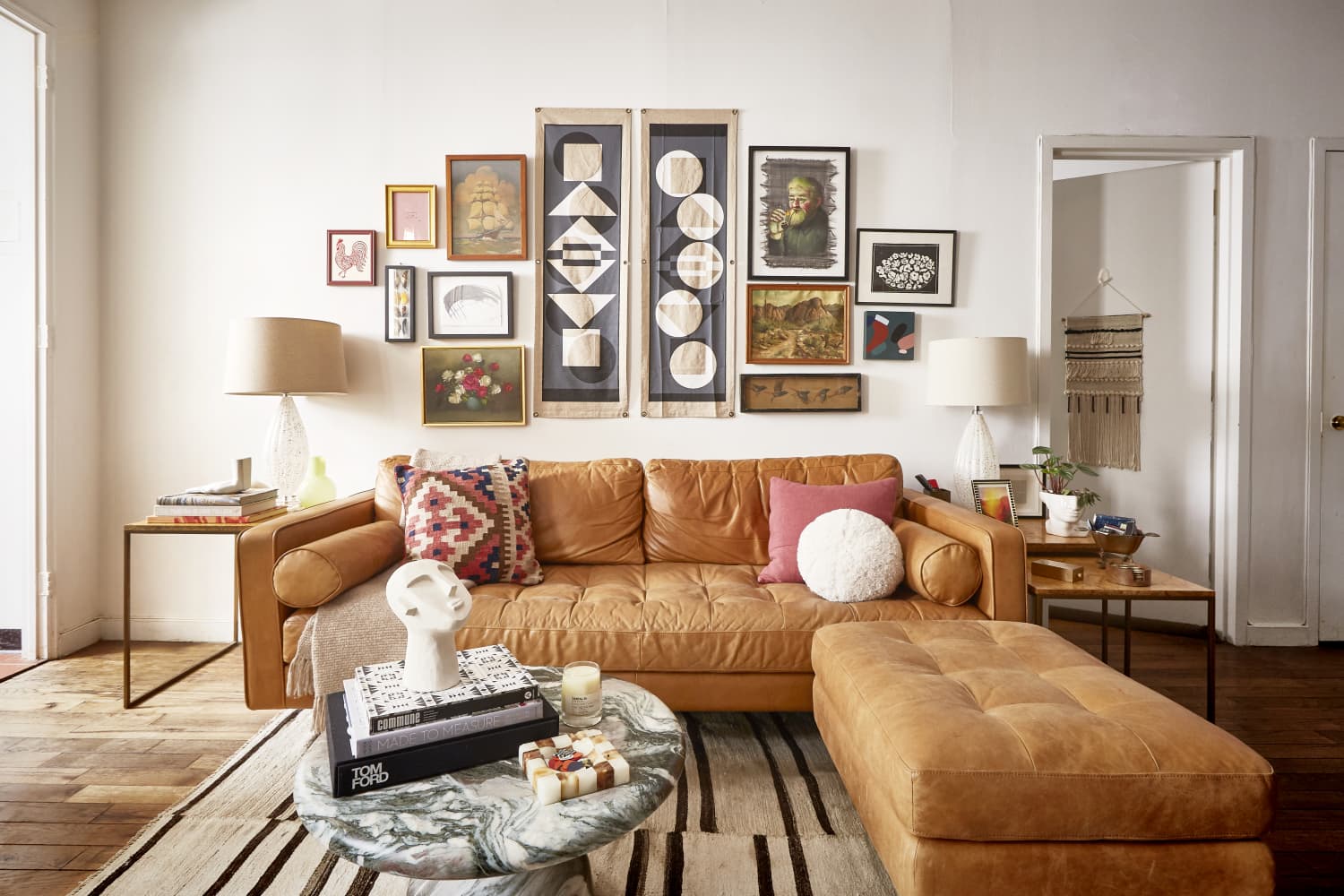
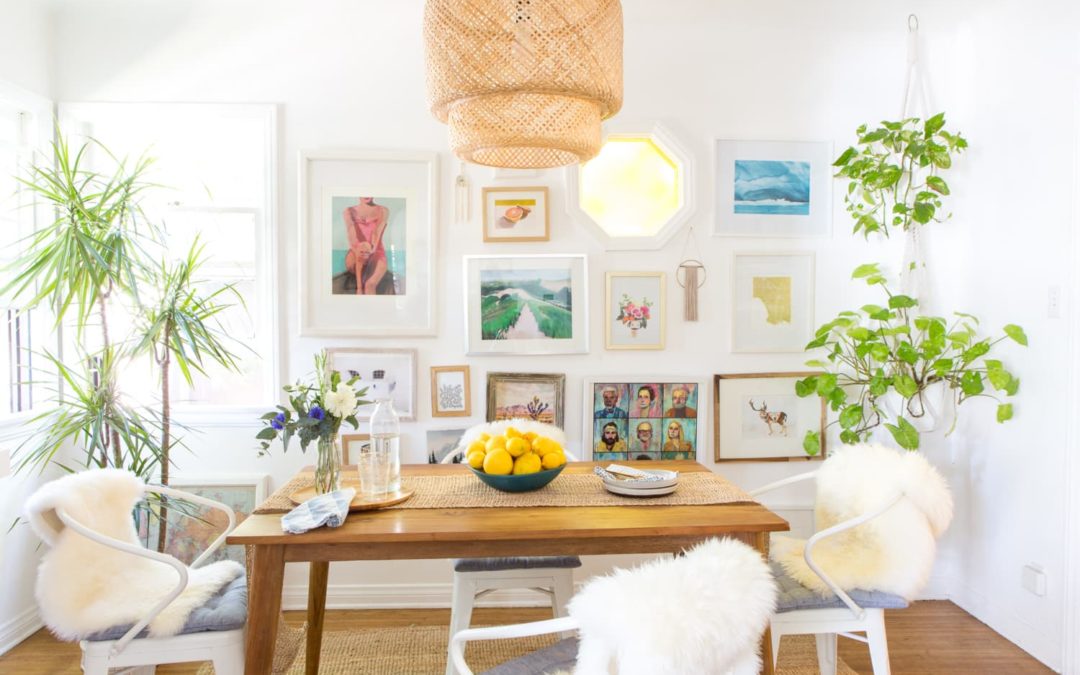
Whenever I look at the gallery wall in my living room, I’m constantly reminded of how much artwork brings me joy. I took studio art throughout high school and majored in art history in college (along with media studies), and I’ve slowly been collecting pieces to fill my walls with over the past ten years or so. To that end, I loved the above shot of my salon-style arrangement from my apartment house tour last year, but I’d be lying if I said the inner perfectionist in me wasn’t a little annoyed over the fact that the frames are most definitely askew. It’s more noticeable on the right side, and I swore I straightened them before the shot. This is a real home — not a staged one — and, I guess, things just sometimes have a mind of their own and shift.
I’ve made my fair share of mistakes hanging art; when you get in up close on this wall, you can see a few holes that didn’t quite work, and I’m still searching for the right anchor piece to replace those two geometric textiles in the middle of the arrangement. Perpetually crooked frames, though? That has to be fixable, I thought after seeing this photo. Turns out the answer is yes, and had I not been doing a million other things to my apartment for its close up last summer, I would have discovered — and implemented! — the solution sooner: The Museum Putty, which costs less than $7 a package and is available on Amazon Prime.
Maybe you remember putting up posters or magazine tear sheets on your walls as a teenager or in your dorm room with Fun-Tak, that blue sticky stuff? Museum Putty’s basically the adult version of that; it functions the same way, securely anchoring a picture or canvas in place. Generally, Museum Putty is a little bit stronger and promises not to damage walls or chip nicer frames. Even better, this putty comes in a neutral white-gray color, so I won’t spot it out of the corner of my eye when I enter my living room and am looking at the pieces from their sides.
To activate the putty, which can also be used to hold collectibles or vases in place on a shelf or table (and is utilized in earthquake zones for this exact protection), all you have to do is pull a piece off the block, mold it into a ball, and press that evenly into a corner on the back of your frame. That ball then makes contact with the wall, and voila, no more shifting once you’ve gotten your piece level and pressed it in. I used four pieces on each frame total (one in each corner), but you could probably get away with just reinforcing two opposite diagonal corners. Removal is as simple as gently twisting the putty off of the surface you put it on, and it can even be reused on another piece after this.
Now that I have this wonder product, I feel like it’s something everyone should get to keep in their toolbox. That way, you can straighten pieces as you’re hanging them and never have to worry about wonky frames again!
Danielle Blundell
Home Editor
Danielle Blundell is AT’s Home Director and covers decorating and design. She loves homes, heels, the history of art, and hockey—but not necessarily always in that order.
Follow Danielle
by Furnishly | Mar 2, 2022 | Design Inspiration, Style
We independently select these products—if you buy from one of our links, we may earn a commission.
There’s a lot of advice about creating gallery walls, from where to source your art to renter-friendly ways of hanging pieces. What some people really need to hear (and may even be too embarrassed to ask about) though is how to fix a gallery wall. If you’re super-lucky, you’ll find perfect pieces that’ll make you happy every time you see them, and you’ll hang them correctly on your first try. For most people, however, the experience is the opposite.
As an interior designer, Lisa Galano, principal of Lisa Galano Design Consultancy, has had years of experience creating beautiful spaces featuring well-styled gallery walls; as an art consultant, Eli Cheatham, founder of EMC Spaces, spends her time sourcing truly unique, show-stopping pieces. According to them, plenty of reasons could be the culprit behind your gallery wall unhappiness, but these three issues below bubble up most often — and thankfully, they can be fixed with a little bit of extra effort.
You didn’t take enough time sourcing artwork.
“Too often, people approach their gallery wall as a design component to be checked off their list as quickly as possible,” Cheatham says. Think about how long it took you to obtain the pieces you’ve put up on your wall already or currently own. Did you pick out pieces deliberately when shopping, sight-seeing, or traveling — or did you scoop up anything you saw with dimensions that would fit the blank spots you had on your wall? Similar to that latter scenario, building your gallery wall too quickly means you miss out on the fun of collecting pieces that truly speak to you. “Give yourself time for treasure hunts and ‘arting’ adventures,” Cheatham suggests. “You’ll not only enjoy the process of creating your gallery walls far more, but you’ll add so much depth both visually and emotionally.”
Being patient about how you source art doesn’t mean you have to go entirely without things on your walls for long stretches of time. If you have a few prints or canvases that you do like, you can install a temporary arrangement on your walls. You can also buy (or borrow from a friend or family member) a few budget-friendly things to use as placeholders for those perfect pieces you haven’t found just yet. Think posters, prints in thrifted frames, handmade art, inexpensive textiles — look for something that’s about the size of what you might want someday. That way, you can get used to regularly seeing something with those dimensions, and you’ll train your eye to know what scale to look for when you are out “arting.”
You didn’t plan your layout properly.
The best gallery walls are the ones that look professionally installed, with every piece in a well-thought-out spot. That said, the final arrangement most people arrive on doesn’t happen magically without any planning or measuring. In other words, your gallery wall may not have the look you were going for because you didn’t consider your layout before actually hanging things on the wall. “The spacing of the pieces and establishing visual balance is a really important factor,” Galano says. “You want the art to feel cohesive and symbiotic, while retaining its individuality.” One way to emphasize that individually is with frame selection; unless you’re going for a truly uniform look, it’s often best to vary the matte sizes and frame finishes you’re including in your composition. Pick things that will complement the color palette, media, and size of each piece, and try not to place similar frame styles right next to one other in your larger configuration.
Another pro tip Galano uses when styling for herself and her clients is to start with less space between each work and move to more of a border in between pieces as you fine-tune the final, overall arrangement. Cut paper templates of your pieces out of kraft paper and play around with their placement using a ruler or a tape measure; use those templates to transpose your final layout onto the wall, long before pulling out your hammer and nails. You can also hang a smaller-scale arrangement, say, over a sofa, leaving room in the layout on both sides of the pieces for additional works down the road. Remember: Even if you have great art, the finished product can fall short if the works aren’t arranged properly, or worse — they’re crooked! Fortunately, there’s a cheap fix for wonky frames and canvases: museum putty, a wax-like, gummy substance that holds pieces in place without damaging walls or frames.
You don’t love every piece you decided to hang.
The simplest yet most important reason you may not love your gallery wall is that you don’t love the art you hung. “Always remember that if you don’t love a piece enough to display on its own, then it will fall short in a gallery wall,” Cheatham says. It might be tempting to hang pieces that you “kind of like,” but both experts agree you should resist the impulse to fill holes with things that just good enough (unless you’re deliberately using something very budget-friendly as a temporary placeholder, as explained above). “Ask yourself questions about why you are attracted to a specific style, color, or medium then build from that,” Galano says of the art curating process. “A mistake in gallery walls I’ve witnessed is when people lose focus of the content and are too concerned about the look.”
Chances are you decided to build a gallery wall because you saw one you loved and wanted to recreate that same feeling inside your own home. You deserve to have a wall of pieces that truly speak to your aesthetic, even if it take a little more time to get there. Honestly, Cheatham has the best outlook on this challenge, and don’t forget it. “Something special can always be found with patience,” she says.
Savannah West
Home Assistant Editor
Savannah is a master binge-watcher and home cook. When she’s not testing new recipes or re-watching Gossip Girl, you can find her on Facetime with her grandma. Savannah is a news producer turned lifestyle blogger and professional homebody. She has a bachelors in journalism from Clark Atlanta University, a certification in Digital Storytelling and is earning her Master’s degree from Harvard University. Savannah believes every day is a good day and there’s nothing good food can’t fix.
Follow Savannah

by Furnishly | Jan 21, 2022 | Design Inspiration, Lighting, Style
Olivia Harvey
Contributor
Olivia Harvey is a freelance writer and award-winning scriptwriter from outside Boston, Massachusetts. She’s a big fan of scented candles, getting dressed up, and the 2005 film adaptation of Pride and Prejudice starring Keira Knightley. You can make sure she’s doing okay via Instagram and/or Twitter.
Follow Olivia
by Furnishly | Dec 16, 2021 | Design Inspiration, Style
We independently select these products—if you buy from one of our links, we may earn a commission.
Last year on the apartment hunt, my boyfriend and I were lucky enough to find a place with a large private outdoor deck (a huge plus considering the pandemic!) and a finished basement to serve as an office/second living room/home gym. All the extra space was high on our priority list, but sadly there wasn’t any of the pre-war charm and original details that I was also wishing for (finding an apartment in NYC that has everything you want is near impossible).
The living room, specifically, was feeling like a sad white box, and no one wants to feel like they’re living in a sad white box. To add interest and character to the space, I talked myself into going all out to create a gallery wall that would span the entirety of the largest wall in the room — starting at the very top of the wall — an ambitious task for sure. The benefit to starting your gallery wall close to the top of your ceiling though is that it makes spaces with lower ceilings seem taller since the art draws the eye up.
As I began to gather the art I had been collecting over the years and mocking up the layout of the gallery wall on the floor in front of my sofa (my preferred method — I’m not much of a measurer when it comes to gallery walls, I like to just piece everything together like a puzzle as I go), I felt like something was missing. At first I couldn’t put my finger on it, but then I realized even though I had varying colors, sizes, and styles of frames and artwork that were all working together, I was missing the different shapes and textures of pieces to make the wall truly feel thoughtfully curated. I also needed something to visually break up all of the frames’ squares and rectangles.
So I began my own treasure hunt — pulling from what I already had elsewhere in my home as accents and scavenging thrift stores and Etsy — to find the perfect pieces to add to my gallery wall. Yes, it did take months before I finally found and hung everything, but it was worth the wait. My biggest tip when it comes to a large-scale gallery wall is to take your time collecting and to really think about what you want to include, and some featured items don’t have to be art at all. Broaden your horizons with what you choose to display, and don’t hang in a hurry because it will show.
Here are some of my favorite ideas (some I did, some I want to do) of things to add to your own gallery wall that aren’t traditional framed art. Add just one or two of these things (or more if you like), and I promise your walls will start to look like a museum but in a curated — not precious — way.
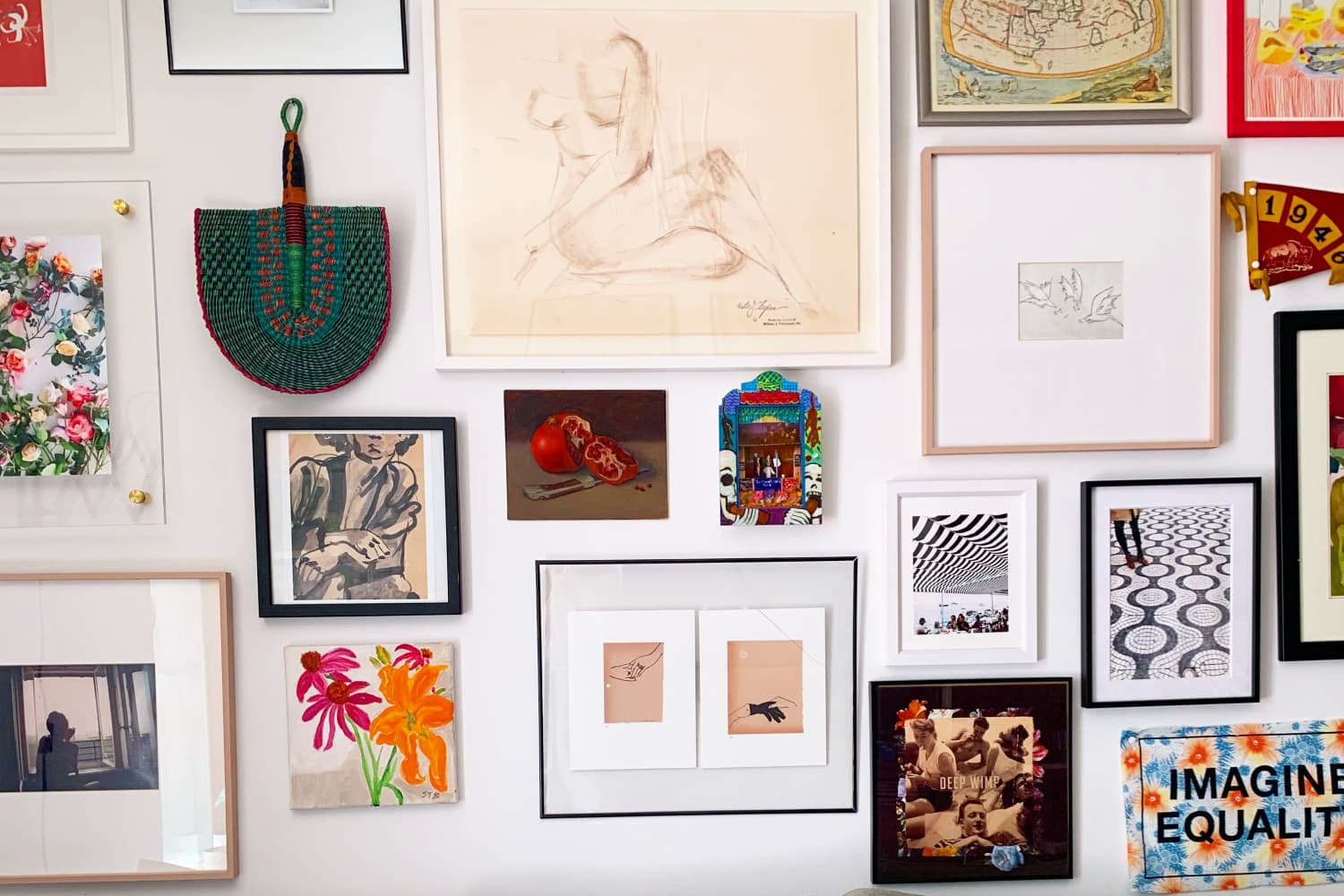
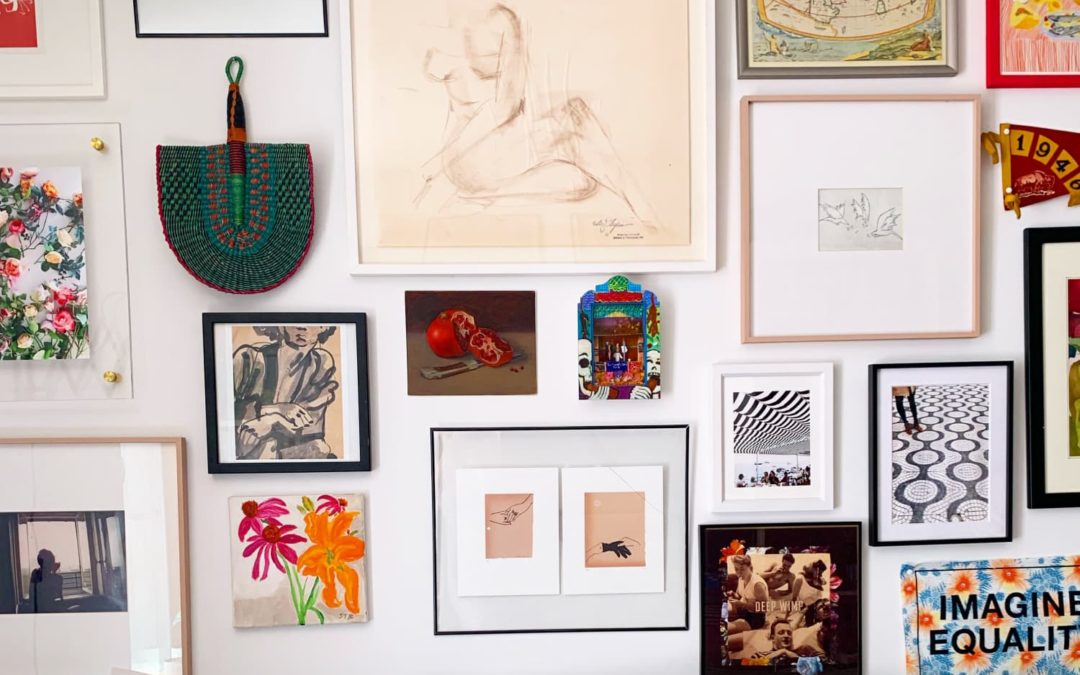
A textural object, like the Bolga fan I used here, helps to break up all the glass and adds interest when mixed in with square and rectangular frames. Mini rattan pieces (like a petite basket) could also work, as long it’s compact enough to be hung.
Ever browsed at a thrift store and come across a piece of jewelry or accessory that’s so out there, cool, and just so wild you know you’d never wear it but still want it? Is that just me? I found this huge bow a couple of years ago, and I love that it adds some personality and weirdness to my gallery wall. This display idea could work well with an over-the-top piece of costume jewelry, too!
I added an accordion sconce to the wall that’s adjacent to my gallery wall; it felt just a little too large to mix into the wall itself. That said, I love when a smaller sconce is mixed in seamlessly with art. Even candle sconces (that never get lit… for safety reasons) can introduce a different shape to a gallery wall and will totally hang in an arrangement decoratively.
This one’s a classic gallery wall add: The triangular shape of an old school felted pennant breaks up boxy frame shapes, and it’s a good way to appease the sports fan in your household, too. I got this one on Etsy for my partner a couple of years ago; he’s a huge Buffalo sports fan (Go Bills! Go Sabres!). This vintage pennant was a good way to subtly mix in his interests.
Something tucked behind (or in front of) a frame
I’m always a fan of tucking in a postcard, photo booth strip, or another flat object into the frame of a mirror or piece of art. This simple move adds a more a casual, collected feel to your gallery wall. My friend gifted me this bookmark from Octeveo, and I loved it so much I wanted to display it instead of hiding it in a book. Give your favorite flat object pride of place in a prominent spot on your gallery wall, and you’ll be able to enjoy it everyday!
A mini shelf with a plant or bud vase
Plant life always perks up a space, and that goes for your gallery wall, too. This one’s on my to-do list! Grab a mini shelf (I have a vintage pedestal one I plan to paint with a striped pattern) and a small potted plant or bud vase with fresh flowers, and voila! Just make sure you take the plant off the shelf when you water it so you don’t accidentally bump it, which makes a mess. Another way to get this look is with a stag fern mounted to a piece of wood.
An ornament you love or that has sentimental value
One thing I love about my gallery wall is that so much of the artwork is by friends and family. My friend Kate is such a talented artist and gave me this beautiful ornament she hand-painted a couple of years ago, and I couldn’t bear to keep it packed away with the rest of my holiday decor. So I added a pretty ribbon and hung it on the wall here. Having smaller objects helps to offset lots of larger frames; just be sure to add a couple of other pieces around the same size so these objects have “friends” and don’t seem obscure when you step back and look at the arrangement as a whole.
This is also on my to-do list, but mirrors are another classic, non-traditional gallery wall add. Pretty much any medium to small mirror works, depending on the scale of your wall and what else you have hung. Look for something with an interesting shape or frame, but you could also go frameless, too.
Adding a shadow box works because it mimics the shape and idea of a traditional frame but holds 3D objects. There are two options here, as far as I’m concerned: a traditional Mexican nicho (like the one I have here, another gift from a friend) for interesting color and texture, or, if you want to go more simple, grab an acrylic display box (I like these since they have mounting holes) and add something unexpected. Maybe it’s a cool toy you had as a kid or your collection of vintage dice. Remember: Almost anything can be display-worthy if it’s special to you, and any of these additions will make your gallery wall so much more personal and unique.
by Furnishly | Dec 5, 2021 | Design Inspiration, Style
There was an era not too long ago where gallery walls were everywhere — I call it the design blogger effect. You couldn’t open a lifestyle blog or scroll through Instagram, or enter an Anthropologie and not see a gallery wall. And there’s a good reason for it; they’re a great way to fill up large walls without having to splurge on huge pieces of art, which can be cost-prohibitive to many. When done right, they can be a beautiful statement, a way to add personality to your space, and an effortless design layer that makes the whole room come alive.
But the design blogger effect meant that they all started to look similar, and I found myself craving new, creative takes on the timeless look (and I really mean timeless — take a spin through any art museum and you’ll see that gallery walls are classic). I totally believe gallery walls have a place in design always, and I’m happy to say there is something similar (yet different!) out there for anyone who’s feeling fatigued by the traditional gallery wall. Enter: Mirror walls.
The principles are much the same. A collection of pieces — sub mirrors for art — arranged graphically on an empty wall as a way to add visual interest and draw the eye. However, because mirrors are a tad more understated (typically), the end result is a bit quieter, more of a design whisper than a scream.
Mirror walls are also a great solution for tiny houses or apartments, lending the illusion of more space and instantly adding an airy quality to any room (great if you have low ceilings). No windows or natural light? No problem — a gallery wall of mirrors will solve that for you, visually tricking the eye into believing there are windows in the space and bouncing around what natural (or artificial) light you do have to make everything a bit brighter.
Like traditional gallery walls, mirror gallery walls can quickly go “wrong” if they don’t feel thoughtful and considered. While you don’t necessarily have to stick to the same color, shape, or material within your mirror selection, everything should definitely fall within the same design category in order to feel cohesive (like a collection of antique wooded mirrors, or a slew of Art Deco-inspired designs). The good news: Because mirrors are so ubiquitous (and not as intimately personal as art), you can easily create a mirror gallery wall on a budget shopping local flea markets, Facebook Marketplace, and more, making them a great alternative to spending thousands on unique art and bespoke framing.
If the idea of seeing yourself reflected back 20 times over every time you walk down a hallway haunts you, no worries — stick to traditional gallery walls or just throw in one mirror or two for a little variety!