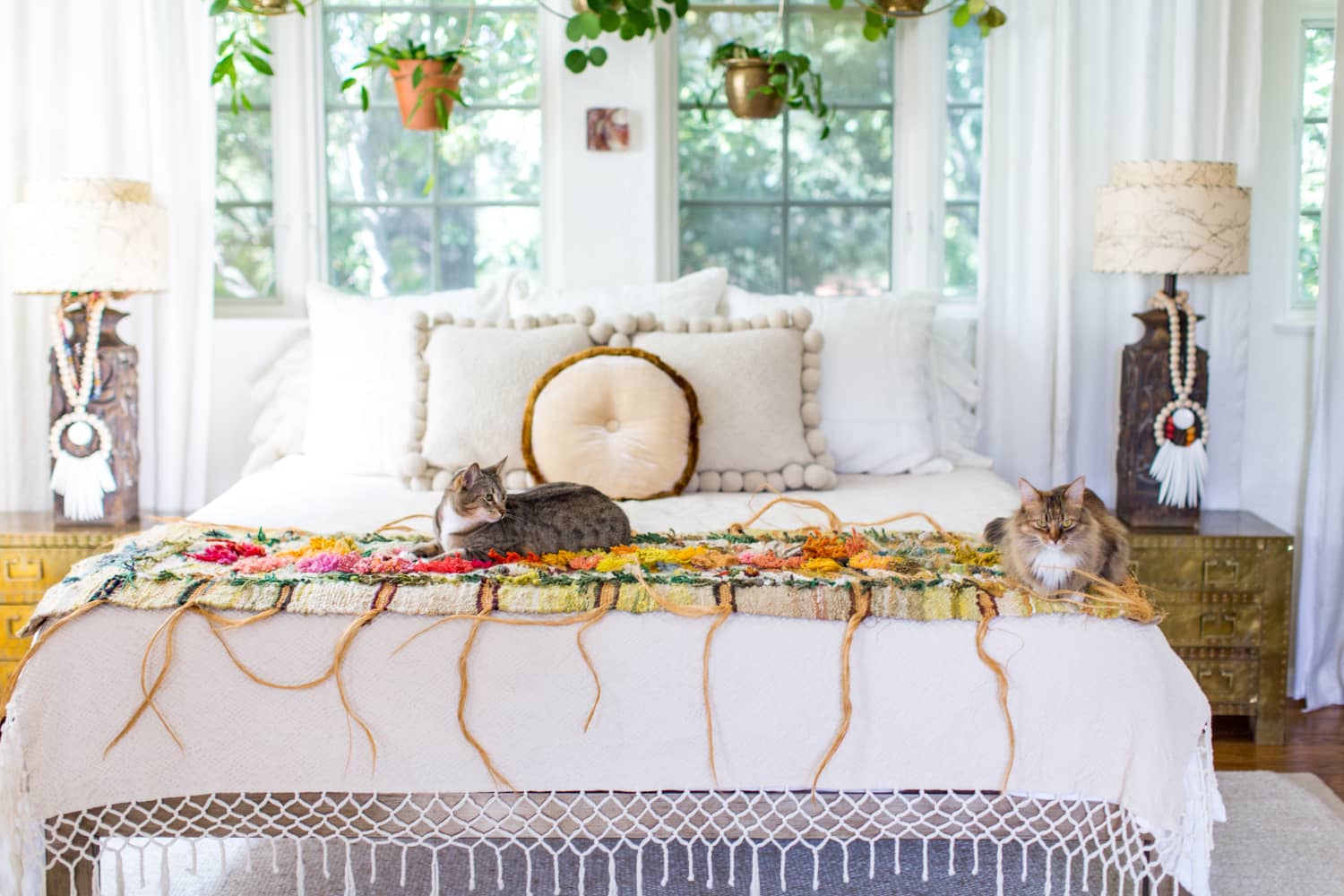
As a cat lover who has never owned a dog, I have a little bit of envy when I see a canine at an outdoor restaurant or spot a pooch happily hanging its head out of a car window. Although I know my kitties adore me and crave my companionship, in their minds, that only takes place in one location: home.
Currently, my husband and I have five cats. We’ve fostered more than 150 felines over the past eight years, so five “foster fails” seems reasonable, right? Admittedly, that’s a lot of kitties to think about when we’re away, and because I work from home, not having a human around when we travel is a bit stressful for them. However, over the years, I’ve perfected my routine and enlisted some help — human and electronic — to set everyone up for success. Here are four things I’d recommend when leaving your cats at home while you travel.
One of the best things I ever did was purchase a timed pet feeder. Automated feeding eliminates the need to have mealtimes, especially when my brood wants to eat in the middle of the night. However, a great side benefit is that the feeder still regulates my cats’ portions while we are away. I’ve also invested in an automatic water fountain and self-cleaning litter box, making my daily life easier and giving me confidence when traveling.
If you’re using anything electronic, though, get your animals used to it well before going away. At first, my cats were petrified of the timed feeder and incredibly leery of the automatic litter box. “It’s important to test run these products for at least a week or so beforehand to ensure they work and your cat understands them,” recommends Josh Snead, who is the CEO of Rainwalk Pets. Additionally, many automated pet devices connect to WiFi or have an accompanying app so that owners see if food is running low or if the device is malfunctioning. Setting things up before leaving on your vacation can help you experiment with how to read and reset your electronics from afar.
Eliminate safety hazards.
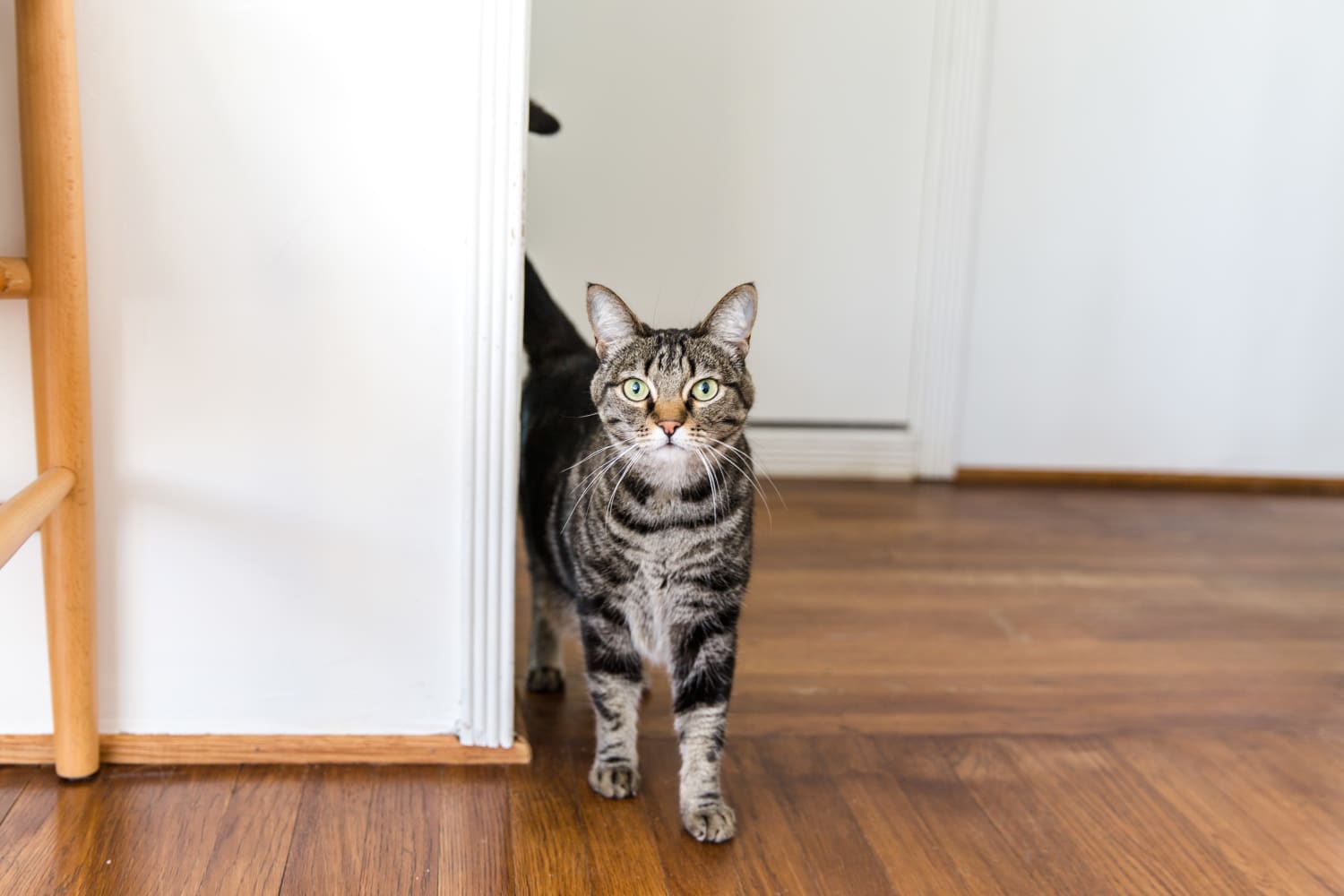
Cats are curious creatures. When I’m home I can keep an eye on their antics, and I want to leave with complete confidence that they can’t get into trouble — or at least lessen the temptation — while I’m gone. I’ve found it effective to close doors to unnecessary rooms, limiting where they can roam. This makes it easier for our pet sitter to easily lay eyes on all five felines, especially because one is shy and doesn’t always voluntarily appear. My sitter can quickly take an inventory to ensure they’re all safe.
Also, take note of potential pitfalls for your particular cats. For example, if they like knocking things off the counter, check that you don’t have breakables close to the edge of a table or surface. Some kitties also like to chew cords, climb furniture, or play with potentially hazardous items, such as bread ties and hair elastics. Doing your best to minimize these situations before embarking will give you peace of mind while you’re away.
Have someone check on them.
Most cats can be left alone for a few days or a long weekend if you provide enough food and water. However, if you’re gone for any longer, hire a pet sitter or have a trusted friend check in on them as often as they’re willing. Although cats are pretty self-sufficient, they could get sick or injured, and the last thing you want when you come home from vacation is to take your pet to the emergency clinic. I hire a pet sitter to come and play with my cats for 30 minutes, refill their food and water, and scoop the litter box.
Samantha Bell, who is a cat expert at the nonprofit Best Friends Animal Society, agrees that a pet professional is the way to go, although it’s best to familiarize them with your home and cats before your trip. “Make sure to meet with the sitter before their first visit so you can introduce them to your cats and show them where all the supplies are,” says Bell, adding that you should always let your neighbors know you’ll be gone and that a pet sitter has access to your house.
Unfortunately, things can happen, even when you’re home, so it’s best to have extra assurance when going out of town. Leave a key with a trusted neighbor in case your pet sitter can’t make it or you receive an alert that one of your automatic devices is going haywire.
One time, one of us (not me!) left the wrong key in the mailbox, so I’ve learned from experience to test the key beforehand — thankfully, a family friend was able to help out. Leave contact information for your regular veterinarian and local after-hours clinic in a prominent place in case your cat needs immediate attention. Also, pets can go without food longer than they can be without water, so I place extra water bowls around the house in case my return trip gets delayed. Although boredom isn’t an emergency, I also leave a few new toys for my kitties to discover, play with, and keep themselves entertained while they lack their standard dose of human interaction until we get home.
We independently select these products—if you buy from one of our links, we may earn a commission.
I LOVE cats… my cat, my neighbor’s cat, stray cats I see walking around New Orleans. And I LOVE themed spaces — like bars, restaurants, bathrooms, and more — so when this professional project came across my virtual desk, I immediately knew I’d be declaring my intent to move into this cat sanctuary designed to look like a suburban house from the 1970s.
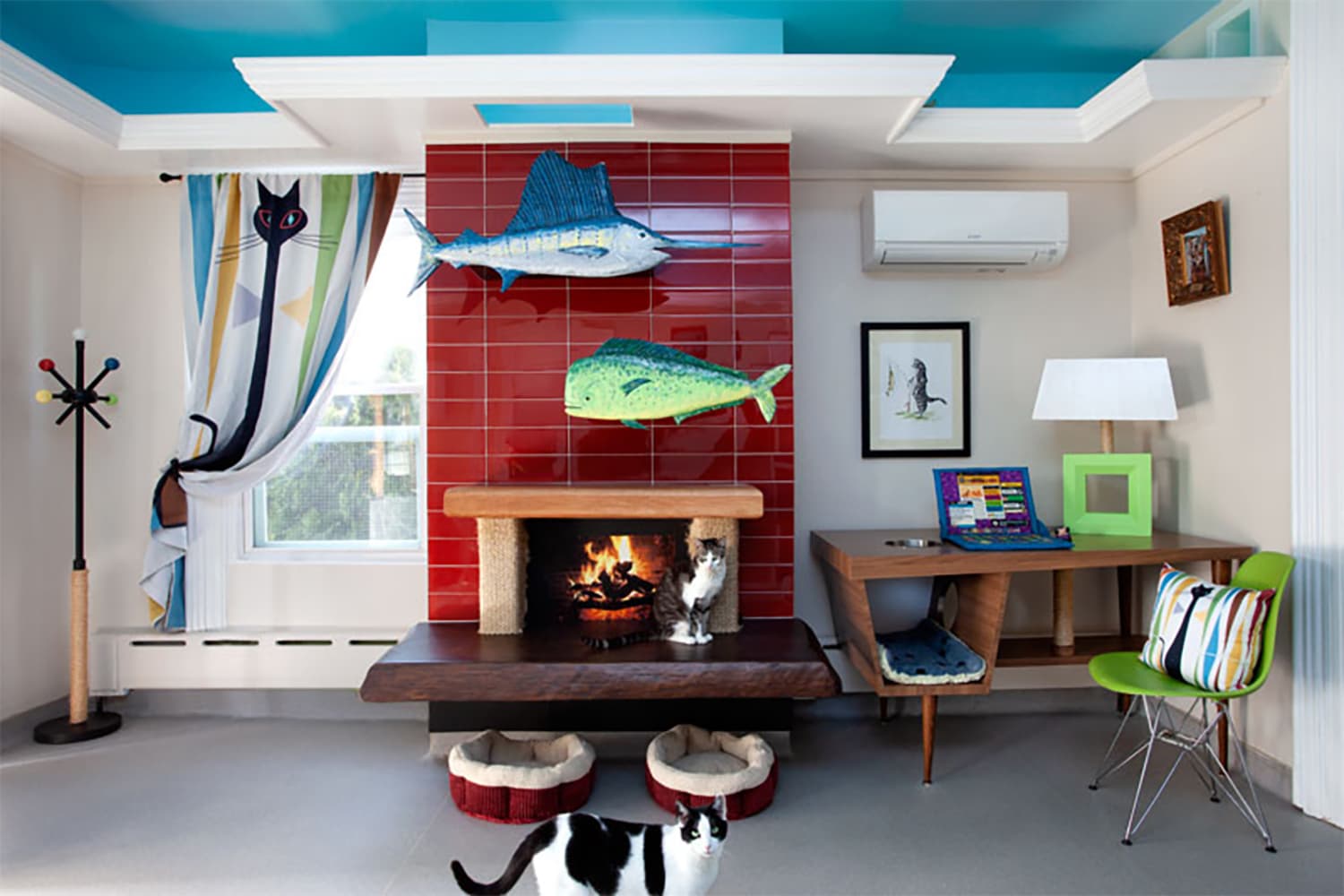
This project was submitted by Mario Arbore, an architect based in Melbourne, Florida, who also designs and builds specialty cat furnishings under the name of Square Paws. “We recently completed an interior remodeling project at the Patricia H. Ladew Foundation’s cat sanctuary in Oyster Bay, New York,” Mario writes. The sanctuary has a long history, going back as far as the 1970s, and Square Paws’ design for the remodel paid homage to the space’s past with snappy mid-century-inspired designs.
“Our design intent was to create a more neutral color environment on the walls and use their signature blue and green colors in combination with natural wood finishes and newly added warm orange and red colors as accents in the spaces,” writes Mario.
“Allegorically, we were taking a cue from the media flack that Pat Ladew received in the ’70s when she bought the property as a sanctuary for stray and homeless cats, and we fashioned these spaces as suburban rooms as if the resident cats fully own the house. Our inspiration was mid-century modern in all our faux furnishings and appliances,” Mario writes.
Thankfully, there is a lot more information about this amazing home’s design on the cat sanctuary’s website for people like me who need to know absolutely every detail of this incredible space: “In the newly designed living room, Square Paws envisioned the house to be a ‘living museum,’ not unlike the nearby Sagamore Hill but alive with cats as the ‘homeowners,’ yet frozen in a 1960s/1970s moment in time. In Square Paw’s fictional scenario, the papa-cat is an Oyster Bay fisherman and therefore the living room has a fisherman theme. The indoor catwalk has been extended to cover 150 linear feet for the cats to explore the house from above.”
“The rec room is modeled after a 1970s style basement where the ‘pawties’ happened. It’s a cozy room for the cats to wait for their potential new families to come. The room features TV where they can watch their favorite programs, as well as their own catio to enjoy some fresh air,” reads the cat sanctuary’s website.
There’s even a room (pictured below) that has a a replica of the exterior of the house that Pat Ladew purchased in 1975. Insert crying cat emoji!
This submission’s responses and photos were edited for length/size and clarity.And I’m of course joking… I won’t ACTUALLY be moving into this cat sanctuary. But I’d certainly like to visit one day.
Adrienne loves architecture, design, cats, science fiction and watching Star Trek. In the past 10 years she’s called home: a van, a former downtown store in small town Texas and a studio apartment rumored to have once been owned by Willie Nelson.
We independently select these products—if you buy from one of our links, we may earn a commission.
My cat Louie knows the second I whip out the HERTZKO Self-Cleaning Slicker Brush, which I like to think is because he’s a genius, but is likely because of the click sound it makes when I eject the bristles and get it ready for grooming. It’s got a button on the back at the top of the handle that pulls and locks the bristles in, making the brush surface smooth and safer for storing and handling. When you’re ready, just push again and the bristles are ejected and locked in brush mode, if you will. This also means that when you’re done grooming or need to clean out the brush for more, you simply push the button and as all the bristles are pulled in, the fur is left on the outside to be easily swept up and thrown away.
As much as I love quality time with Lou, the digging into the sharp bristles to remove all that hair after brushing was a complete pain to me. After collecting brush after regular cat brush, each of which would end up with a seemingly unremovable layer of cat hair at the base of the bristles, I decided to find another solution. Now, I only have one brush, my cat has his routine with a tool he trusts (and loves!), and I get excited for brush time again , especially since the self-cleaning mechanism of the HERTZKO is beyond satisfying to use.
Louie and I have the brush in the original style which has wire bristles without the buffer balls at the ends, but it also comes in a sensitive skin version which is also excellent for dogs and isn’t quite as scratchy. Whichever you choose, this brush is the one pet care tool I find myself recommending — and my cat begs to use — over and over.
If you have pets, you’ve likely had some Christmas tree disasters.
But can you really blame our furry friends? All those climbable branches, swattable glittery baubles, and scented chewable branches are just too much to resist!
Not to mention the wonderfully crackly ribbons and wrapping paper, just begging to be ripped open before Christmas. It’s a wonder that cats and dogs can contain themselves at all!
Many an animal lover has given up on Christmas trees until their pets grow out of their curiosity, but here are some things you can try that can discourage your pets:
Scented Repellents: Before decorating your tree, spray it with a scent or flavor that repels pets. Examples include bitter apple, clove oil, citrus oil, and vinegar — experiment to see what your pet hates (just make sure you don’t hate it too!) You can also sprinkle dried orange peels around the base of your tree. Avoid hot pepper — it can get into your pet’s eyes and cause severe pain. You may need to reapply the repellents as they wear off, just don’t spray anything wet onto your lights, or you might have more twinkle than you hoped for!
Paw Repellents: Surround the base of your tree with something your pets don’t like to walk on. Aluminum foil is a classic cat repellent (they usually hate to walk on crackly things), and you can also purchase spiky mats that are unpleasant to animal paws. This is a good way to recycle those plastic mats that go under office chairs — turn them spiky-side-up and hide them under your tree skirt.
Climb Blockers: Attach dark mesh or plant netting on the underside of your tree to keep your pets from climbing into the branches. You can also use netting to protect wrapped gifts or the tree itself when you’re away. To discourage climbing and scratching, wrap the base of your tree in double-sided tape.
Training Sessions: With some diligence, you can train your pet to stay away from the tree. For safety’s sake, stay away from squirt guns, but you can try clickers, compressed air, or noisemakers to discourage unwanted behavior.
Go High Tech: If all else fails, try a motion-activated repellent that uses compressed air to train your pet to stay away.
Aside from keeping your pets in another room, there is no surefire way to keep them away from Christmas trees. Be sure to keep your pets as safe as possible by following these tips:
Tuck lights and cords deep within the tree — make sure there are no electrical wires dangling from the branches. Also, tape down any cords running across the floor.
Use the bottom third of your tree for sturdy, shatterproof ornaments (and bells!) that won’t hurt your pet if they do pull them off.
Don’t use additives in your tree water. You don’t need them anyway, and your pets may drink the water.
Use a fishing line to tie your tree to the wall so that it won’t topple over.
Make the tree inaccessible to pets when you’re not home to supervise. Close doors or use door gates to keep them away from danger. It’s up to you to intervene if your pet gets curious!
Tinsel, Angel Hair and Ribbon: These items can pose choking and strangling hazards for your pets.
Plants and Floral Arrangements: Poinsettias, hollies and mistletoe can cause gastrointestinal upset and illness. Lilies can be deadly if eaten. Even so-called “nontoxic” plants can upset your pet’s tummy, and floral arrangements may be sprayed with preservatives.
Potpourri, Scented Oils and Candles: can be harmful if ingested and dangerous if spilled.
Candy and Human Treats: Common ingredients such as chocolate, raisins, alcohol and xylitol can be toxic to dogs and cats, not to mention the hazards of candy wrappers!
We independently select these products—if you buy from one of our links, we may earn a commission.
Calling all pet parents and friends: Come, sit, and stay! Now is the perfect time to pamper yourself and your beloved companion. From doggy water bottles and leashes to cat mugs and plush beds, we’ve gathered our favorite tail-wagging, purr-inducing gifts for pets and their owners. Whether you’re a cat person, a dog person, or you love them both, this list is full of products that will point you in the right gifting direction, no leash required. After all, while our canine and feline friends are simple to please — food, water, a warm bed, playtime, and lots of snuggles usually do the trick — that doesn’t mean they don’t appreciate the finer things in life. Our pets show us unconditional love day after day, and that kind of loyalty deserves presents! Keep reading for our favorite gifts for pets and the people who love them.