“Yelp” for Landlords: Search These Sites Before You Move In

“Yelp” for Landlords: Search These Sites Before You Move In
We independently select these products—if you buy from one of our links, we may earn a commission.

Apartment hunting is tough. On top of moving costs,  finding a place to live, and setting up utilities, you have to worry about whether or not your landlord is actually trustworthy. If there’s ever a true need for some honest reviews, it’s landlord reviews! Are we right, or are we right? 

For decades now, landlord review sites have been popping up all over the internet, offering reviews and insights from tenants across the globe. But they’re often gone before they get up and running; proof that a landlord rating isn’t quite an exact science. Of course, you have to take any review with a grain of salt. One person’s experience isn’t likely to be exactly the same as another’s, especially when it comes to moving to a new city. 

To help make apartment searching a bit easier, we’ve listed some of the most popular landlord review sites on the web for your consideration. Kind of like Yelp for landlords, these sites we’ve listed here can be a great resource when apartment searching. And while we can’t promise the perfect landlord, we can guarantee you’ll at least have a heads up on a crummy one.

The first site of its kind, Rate My Landlord allows you to search through their online database of landlords starting with a name, company, city, or zip code. Designed as a “reference check for landlords,” the site offers ratings, comments, and other miscellany about the landlord in question, as well as forums for discussing tenant-related issues. It’s completely free to join and encourages you to sign up for specific landlord alerts, so you can be immediately notified of a new landlord review or rating. The only thing Rate My Landlord asks is that “If you’re angry at your landlord then please wait a while before you rate them. Ratings or comments added while you’re upset won’t benefit anyone.” Fair enough (and probably true).

Arguably the MVP of the landlord-review sites, Whose Your Landlord is part apartment search engine, part landlord rating site, and part blog. Offering an array of awesome search tools ranging from neighborhood insights to renter photos of apartments, Whose Your Landlord lets you search by either landlord or property, with breakdowns on everything from landlord responsiveness to pest control. Additionally, the site doubles as a tenant-friendly blog, full of helpful how-to’s for apartment hunting, as well as renter resources such as moving tips and roommate advice. Whose Your Landlord might very well be the one-stop website for finding your next apartment.

Better for finding an apartment than a landlord review, ApartmentRatings.com has a long history and a comprehensive database of information. And since an apartment is only as good as the landlord who answers your call about a clogged toilet at 2AM, we think ApartmentRatings deserves at least a mention on our list of landlord review sites. 

Re-edited from a post originally published 1.4.2018 – LS

Caroline Biggs

Contributor

Caroline is a writer living in New York City. When she’s not covering art, interiors, and celebrity lifestyles, she’s usually buying sneakers, eating cupcakes, or hanging with her rescue bunnies, Daisy and Daffodil.

Here’s What Author Casey McQuiston Learned from Renting an Apartment in New York

Here’s What Author Casey McQuiston Learned from Renting an Apartment in New York

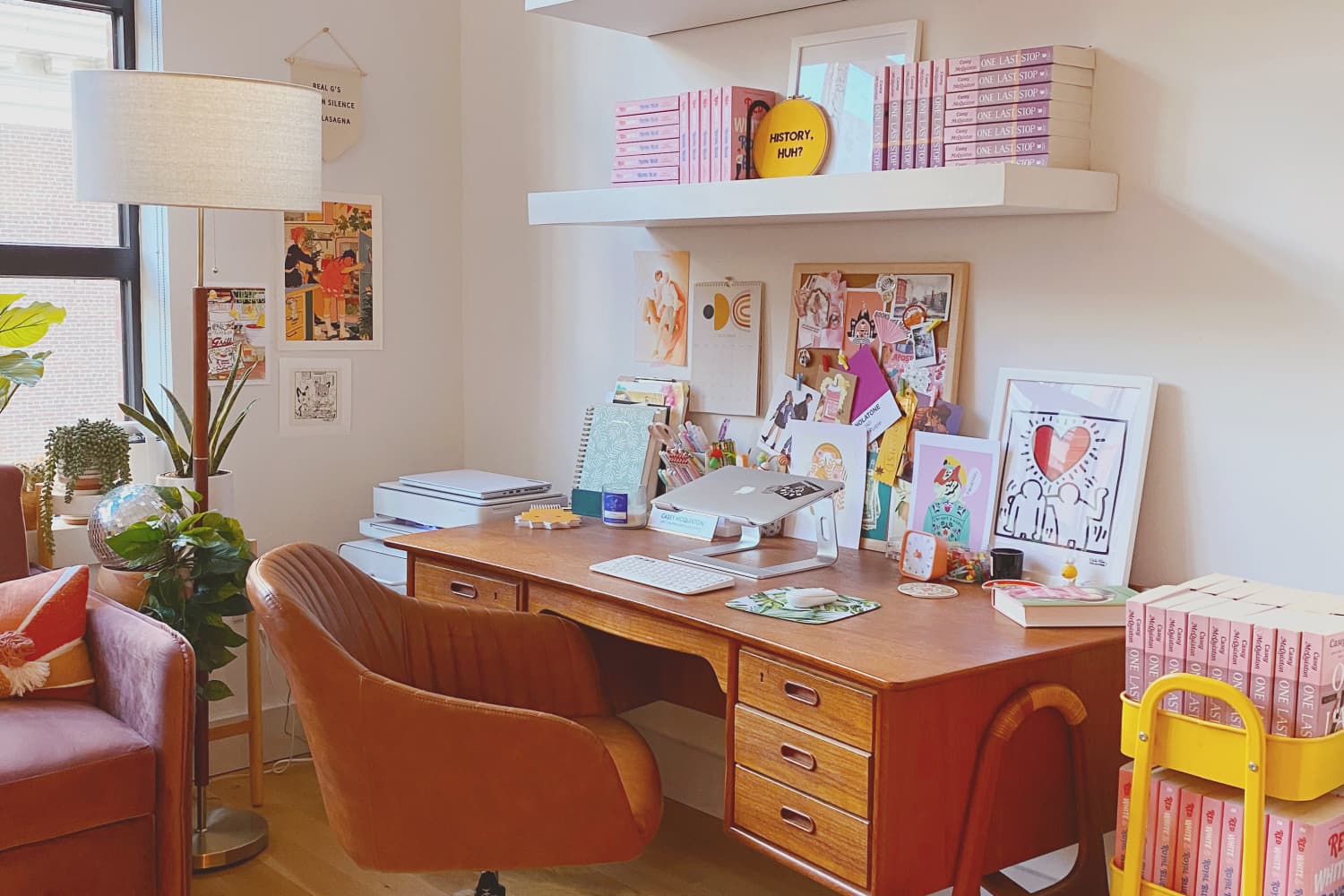
In 2019, writer Casey McQuiston flew to New York City countless times to visit friends and research Flatbush, a neighborhood in Brooklyn. It serves as the primary setting of “One Last Stop,” McQuiston’s second novel. The author plops the reader into a quirk-filled apartment with uneven floors, narrow rooms, and plenty of charming characters who live there and turn that space into a home.

But when McQuiston finally packed up their belongings in Fort Collins, Colorado, and moved into a Brooklyn apartment of their own, they did so sight unseen… six weeks before the COVID-19 pandemic hit New York in March 2020. McQuiston observed shelter-in-place guidelines and stayed at home as she worked on her debut young adult novel — but the  space she was calling home didn’t feel like one just yet.

Now nearly two years later, the author has published “One Last Stop” to rave reviews and space on the New York Times bestseller list, unveiled the release date for “I Kissed Shara Wheeler,” and finally settled into a new home in the neighboring borough of Queens. Apartment Therapy spoke with McQuiston about their writing process, what a cross-country moving experience taught them about their needs and lifestyle, and how their relationship to home has evolved in writing and creating one of their own. 

Apartment Therapy: Congratulations on “I Kissed Shara Wheeler”! You shared that you wrote the novel throughout the pandemic. How did working only from home impact your writing process? 

Casey McQuiston: It’s funny, because I have been working from home for a while. I’m a full-time author now; I was used to not having an office to go into to work or anything like that. But I was also used to going to breweries. I would go to coffee shops, bakeries, and cafés. I loved to take my laptop somewhere and write, and get out of the house. Changing up my environment really helps me loosen up the creative flow when I’m stuck and not feel so confined, so it was definitely an adjustment to literally only be able to write at home.

It took me probably eight or nine months to actually commit to being like, “Okay, this is how I have to work now, so let me invest in building out an office and a workspace that’s functional for me,” instead of sitting in my bed every day, on my laptop, which is not a good situation. I think it took me a while to really commit to having boundaries in different parts of my space, so that I had an area that was my workspace. Now, I have a rule like I do not work in my bedroom. That’s only for rest, you know? So it was definitely a bit of a challenge.

AT: I think a lot of people can probably relate to needing a specific space for work and work alone. How was writing this book different from your previous writing process?

​​CM: Yeah, if I’m just in a rut with drafting or if I’m working on a scene and I know that it’s not working, and I need to make a big change, but I can’t figure out what it is, a lot of times, just being in a different space, or even the walk to get to a different space is really, really helpful in helping me creatively shift gears. 

I live in New York. It’s not like my apartment has a tremendous amount of square footage. I’m looking around what space I have, and I’m trying to figure out, “How do I creatively reset in a space this small and inside these four walls?” It was hard! It was a lot of, “Okay, I guess I’ll try writing at the dinner table now. And I’m gonna write this scene standing up at the kitchen counter. And I’m gonna sit on the couch and do it this way.” It was definitely harder to have those moments of feeling like I was able to get some physical space from the mental space I was in last time I was working on the scene. 

And so, yeah, with this book [“I Kissed Shara Wheeler”], it was definitely a lot harder in so many ways. It’s so hard to be creative during the pandemic, but especially in that way.

AT: How did you get creative with your environment working from home?

CM: Music is definitely a huge part of it. I make so many playlists when I’m working on something. I’ll make playlists for all of the main characters to help me get to know them better. If I want to feel sad, longing, or angst, well, here comes Phoebe Bridgers. I personally am very sensitive to the environment that I’m writing in, so if I can create an environment that feels like what I’m trying to write, that’s really helpful. 

Sometimes I’ll watercolor. I’ll do like a watercolor portrait of what the character feels like to me. I got a bulletin board for my office and sometimes I’ll physically print out pictures from the internet, cut them out, and make little collages. It really takes me back to the days of scrapbooking Orlando Bloom on all of my notebooks in seventh grade.

AT: I wanted to ask a little bit more about your moves as well. You said that you somewhat moved to your first New York apartment sight unseen. Can you share what that experience was like for you?

CM: Well, it’s funny because the apartment I live in now I also moved into basically sight unseen; I was going to look at apartments with [my broker], and then I ended up on a 14-day COVID quarantine after exposure, so I couldn’t come look at any apartments. I was like, “Oh my god, again! I’m gonna have to commit to something I haven’t seen, and I’m in the city!” But the first time around it was definitely scary. 

I have a lot of friends in New York. I had done a lot of research. I spent a lot of time in Brooklyn, and I had a really firm idea of where I wanted to live, but not really any idea of how to go through the process of securing the apartment. A friend of mine referred me to a friend of hers who was a broker. She would send me videos, she would go view the apartments without me, and let me know what she thought. 

I think it’s really important to have a bad first renting experience in New York. I think it builds character. My first apartment in New York was just like, one of those places. You ever see people talk about, like, the landlord-special painting, where they just paint over stuff? I remember cleaning the baseboards, and there were hairs that had been painted over. There was also a mysterious brown splatter on the ceiling in the kitchen, and the ceilings were too high for me to clean it off. It was all these little things. You see pictures and you see videos, and you can even FaceTime and see it in real time, but there’s all these small things about an apartment that you really don’t know until you get in there physically, especially with an older apartment, or an apartment in a smaller building. You really, really can’t know until you get there. 

AT: In both “Red, White, and Royal Blue” and “One Last Stop,” home is more than a place — and that idea even serves as a refrain, too. In part, it’s what drives characters’ motivations, actions, desires and informs their mistakes and character traits. What does home mean to you?

CM: I think it is a concept that I’m really, really drawn to exploring, from so many different, literal, and metaphorical angles in my writing. I think maybe part of it comes from how I moved around a lot in my 20s. I did the math, and I think I’ve moved an average of once a year, for an entire decade of my life. I like the apartment I live in now. I just renewed my lease, and that’s the first time I’ve ever renewed a lease. And I’m 30. 

Homes tended to be kind of a concept for a long time. I think to me, home is a feeling of belonging, it’s a feeling of being warm and safe, and wrapped up and held. And if it can’t be a physical place, it could be a person. It could be people, it could be friends, it could be family. It could be sometimes even things that have really deep significance to you. And I think that, ultimately, home is where you can relax and, and just be unself-conscious and be completely safe and accepted and just where you belong. 

I think I’m drawn to that in my writing because it’s something that I was seeking in a very literal, physical way for my entire 20s. And I feel like I’ve finally felt that now, in my physical world, here in this apartment, at 30 years old. [Laughs].

AT: Is there something in particular that’s informing why you feel ready to start planting roots?

CM: I honestly think it’s financial security. All I ever wanted to do in my life was be an author. I always knew I wouldn’t be able to rest or relax until I had done it. And I think now, having found what I’m supposed to be doing and found myself in this place where I get to do what I’ve always known I was supposed to do every day. And I actually finally have financial security from doing it. Now I’m finally able to plant these roots, and to feel like okay, here I am, this is where I want to be.

AT: I remember reading in the acknowledgments of “One Last Stop,” you wrote that you love August’s “dreams of a home.” Did you ever dream of a home, and if so, what did it look like?

CM: I couldn’t even tell you how many Pinterest boards I made in the last 10 years of: If I bought a house, this is what the kitchen would look like, this is what the living room would look like, and this is like all the custom things I would have done. I was always dreaming of that, because I’ve always loved spaces. When I was out of college and I couldn’t find work and I was waiting tables, one of the things I would do to cheer myself up was on my way home from work, I would stop at Dollar Tree, take $5 from my tips, and I would be like, “I’m allowed to buy any five things I want for my apartment today.” 

I’ve always longed for a creation of a physical home that was my own. I think all of that has finally come together in this space that I have because, I have a little jar, here in my living room that I got when I was living in that apartment, and next to it is like a tiny, tiny little Norwegian carved boat that I got on a trip to Norway a few years ago, and everything that I have, I feel like it’s a mixture of where I am now and where I’ve been. 

AT: When it comes to the protagonists in both your novels, they both are living in East Coast metropolitan areas, coming from the South. I saw on Instagram that you feature numerous pieces of or from Louisiana in your apartment. Why are you drawn to showcasing pieces that remind you of your home state?

CM: There are so many things about me that are created specifically by being from the South and I love those things about me. Not a lot of people in New York are from Louisiana specifically, so I was like, “Everybody come over, I’m gonna make you gumbo.” As soon as I started deciding what kind of art pieces that I wanted to fill my house with, I defaulted to let me find something that’s Louisiana-themed, or let me find something that’s from a Louisiana company. I have over my little console table I have four framed prints of Louisiana swamp animals. 

It’s just comforting, especially when I can’t be home, especially the last couple years when it’s been so hard to go home. It feels like a reminder of coming full circle of where I’m from and feeling all of the different things that mean to be from Louisiana. It represents a lot to be of my own personal growth and my own roots. I joke all the time that I have one personality trait and it’s being from Louisiana. 

AT: Why do you love Louisiana so much, and how does it represent your growth?

CM: I think was hard for me as a queer person in the conservative, Deep South. There were a lot of times that I felt that all of the trappings of the South were associated with an environment that didn’t always feel welcoming to me. And so those aesthetics weren’t always something I wanted to have around me and they weren’t always something that did feel comforting to look at and surround myself with.

As I got older, and I came into myself more, I got a deeper understanding of myself, the South, and my family’s background, and all of these things. I felt like I could decide what these aesthetics meant, and to me, they mean strength and accepting and loving myself. They mean deciding that I belong, and deciding that these are also my aesthetics that I get to use and I get to be surrounded by and it makes me feel at home. 

AT: That’s beautiful. Is there anything people find surprising about your apartment?

CM: In terms of decor, it’s probably my chicken wall. When you walk into my apartment, there’s a little dining area, right to the left. There’s one small wall there. I decided to get some peel and stick wallpaper and I covered that entire wall with these incredible leaves and leaf patterns but it has these big roosters all over it so I call it my chicken wall. And it’s just very much like, you don’t expect to see a chicken wall when you walk in, and you turn your head there’s chickens. 

AT: Does where you live now feel like a home?

CM: I definitely still have work to do. I think I kind of held back in some ways for the first year of my lease because I’ve been burned so many times in living situations that go bad. I wanted to make sure I’m going to live here for more than a year before I go the whole hog. 

I just renewed my lease and I immediately was like, “Okay, I need to finish my bedroom,” because it has not felt finished since so I moved in. The main part of my apartment felt like a home but then my bedroom just kind of felt like it wasn’t fully me yet. I’ve done a lot of work in the last couple of weeks. I bought a new little secondhand piece with little drawers, and I bought a little record player for it. And of all of these little things to make it feel a little more like me and like home. 

But I definitely feel like now, this is somewhere I want to live for a long time. I love this place. I really love Queens. I live in this part of Queens that has so much food. As soon as I stepped foot in Queens for the first time, I was like, “Oh, this is the feeling I’ve been waiting for like this is home to me.” I do finally feel like I have found a home for myself. I have that and it’s one that I’ve created. It’s one that feels really like a long term for me.

Andie Kanaras

Contributor

Andie Kanaras is a freelance culture writer based in NJ. She loves candles, reality tv, and pasta.

Follow Andie
10 Modular Furniture Pieces That Move as Easily as You Do

10 Modular Furniture Pieces That Move as Easily as You Do

We independently select these products—if you buy from one of our links, we may earn a commission.

Let’s be honest: The stress of moving doesn’t stop when you’ve forked over a deposit and packed up your old home. Unless your new space has identical measurements as your old one, you’ll have to scheme up an entirely different layout — and purchase new products to match. Ugh. The good news is it doesn’t have to be that way. In reality, there are plenty of modular furniture pieces that can grow or shrink as your space does.  If you ask us, the concept of modular furniture is pretty brilliant. It’s an easy way to keep your design style consistent as you move from place to place, plus you don’t have to think about buying or selling anything. The best part? They’re also designed to make moving a breeze. Never purchased modular furniture before? We’re here to help! Whether you’re looking for easy-to-move couches, storage units, or dining chairs, check out our 10 favorite finds below.

Sarah M. Vazquez also contributed to reporting. 

Kelsey Mulvey

Contributor

Kelsey Mulvey is a lifestyle editor and writer. She has written for publications like Wall Street Journal, Business Insider, Wallpaper.com, New York Magazine, and more.

Follow Kelsey
These Are the Best (and Worst) States For Renters With Pets in 2021

These Are the Best (and Worst) States For Renters With Pets in 2021

When it comes to choosing somewhere to live, renters with pets will know the struggles that come with finding an apartment that’s suitable for their furry friends. Once you find a place that accepts pets into the building, there are other factors that are needed to be taken into consideration—like making sure there’s enough space, and any extra pet fees.

In a recent study, All About Cats has revealed the best (and worst) pet-friendly states in 2021, looking at the top populated cities in each state, and recording the percentage of rentals that allow tenants to bring along their fur babies.

With 59.87% of properties accepting pets, Illinois comes in at number one. If you’re a pet parent who’s looking to move to another part of the country, Chicago may be a good place to start your search.

Taking the silver medal is Mississippi, with over 50% of rentals accepting pets (52.28%). Third on the list and coming up closely behind is New York, which boasts 47.89% pet-friendly rentals. In New York City alone, there are plenty of pet-friendly cafes, including the iconic Boris and Horton, and not to mention all the green spaces for walkies.

Other states that are ideal for renters with furry friends include Georgia (47.00%), North Carolina (45.06%), Tennessee (41.51%), and Indiana (39.22%).

The research also revealed the states that aren’t as pet-friendly as we’d hope. With 6.09% of landlords accept tenants with pets, a home in Hawaii with pets could be a pipe dream. Somewhat unsurprising, Alaska has the second-lowest rate of pet-friendly rentals, as just 9.30% of properties in the state are available to pet owners.

Other low-scoring states include West Virginia (9.47%), Montana (9.47%), and New Jersey (9.52%).

While these ratings are good to take into account if you’re looking to relocate with your pet, they aren’t meant to discourage pet lovers who are looking to, or already live, in these states. The search for a paw-fect pet-friendly apartment may just prove a little more difficult!

4 Reasons Why I Quit Being a Landlord

4 Reasons Why I Quit Being a Landlord

My husband and I became landlords by accident. We bought a rowhouse in Washington, D.C., back in 2014 — one he’d been living in with friends for several years. When I moved there with him, I suggested we rent out the four-bedroom house and live in a smaller (read: 600 square foot) apartment. 

While there are plenty of landlords who put profit ahead of people, that wasn’t our game. I figured renting out the house would be the fiscally responsible thing to do, since we didn’t need all that space in the moment and it could help pay our mortgage while we built equity. So, we moved into a new place about a mile and a half away and self-managed the rental property, setting the rate, finding tenants, attending to maintenance issues, and mowing the lawn. 

After taxes and upkeep costs, we did end up making some income off the property — income I’m grateful for. But, after four years, we decided to quit being landlords. Here are four reasons why. 

The real estate market is irresistibly hot.

We knew the rowhouse wouldn’t be our forever home. We also knew we might not see a market this hot anytime soon. Selling during a seller’s market was a no-brainer.

And if we truly wanted to sell, time was of the essence, especially as real estate agents warn that the market may cool in coming months. “We’ve seen massive appreciation [in home prices] across the board over the past 18 months,” explains John Coleman, a real estate agent in D.C. “With inflation, we’re predicting that interest rates will adjust sooner rather than later. Rising interest rates, even at just half a percent, affect buyer affordability and lower a seller’s ability to get top dollar.”

To get the highest possible sale price for our rental home, we needed to list while interest rates were low. That plan worked. We sold for over the listing price — a listing price we couldn’t have imagined would be realistic just a year ago.

Property taxes became cost prohibitive.

Our neighborhood became increasingly trendy over the past several years, and property taxes rose accordingly. One month after a new tenant signed a year-long lease in May 2020, our monthly payment rose by over $600 — a number that, if we’d known was coming, would have significantly impacted the monthly rent equation. Subtract the taxes we paid on rental income and the difference was barely worth the work we put into managing the property. 

Some Old House Problems were likely on the way.

Our house was nearly 100 years old. It had been renovated roughly a decade ago and, beyond one leaking bathroom — a $10,000 fix — we hadn’t dealt with major issues. But we knew they were coming. The price tag of replacing a roof, a fence, or even front porch columns could easily add up. The rental income would not cover those expenses, nor would write-offs make the bills any less painful. With these repairs on the horizon at some point in the coming years, it seemed time to cut our losses.

Negotiating with tenants in a pandemic felt icky.

In March 2020, two of our tenants moved home and asked to break their leases. Given the sense of impending doom that was hanging in the air, what we were supposed to say? “No, you have to keep paying rent in D.C. while living in another state indefinitely?” 

Finding the balance between human relationships and business agreements is difficult, and we weren’t prepared — or willing — to drop the hammer. In the end, it made more sense to give new buyers, a newlywed couple who I imagine is excited to start their life in the home, a chance at owning the place, rather than risk an uncertain rental market — and world.