The Arbor House (visualized by Reflectmood) has this calm, grounded energy that comes from being surrounded by nature. This home is where clean lines meet warm textures; where sunlight pours through floor-to-ceiling windows. The design celebrates simplicity but never at the expense of comfort. From the layered wood tones to the carefully chosen art pieces, Arbor House is a stylish retreat that proves living close to nature can also feel beautifully refined!
This living space immediately draws you in. The design balances warmth and modern elegance, starting with the oversized sectional sofas that practically invite you to sink in and stay awhile. Their soft, textured upholstery adds coziness.
The layout is smart, too; each angle is designed to create a sense of flow. The statement artwork and sculptural pieces act as bold focal points, grounding the neutral tones with personality. Notice how the wood paneling and stone finishes add layers of natural texture? They soften the sleekness of the space.
Lighting plays a huge role here as well. The dramatic arc floor lamp doesn’t just provide function; it frames the seating area like a piece of art. Large windows flood the room with natural light, which bounces off the light-toned walls and floors. This makes the space feel expansive and airy.
The bed takes center stage in this bedroom with its deep navy tones layered in soft textures. Flanking it on either side, sleek round nightstands keep the look clean and minimal, while the warm wood wall paneling adds warmth.
What really makes this space sing, though, is the thoughtful layering of elements. The artwork above the bed brings in a bold pop of personality, while the floor-to-ceiling windows flood the room with natural light. Just beside them, a simple chaise lounge becomes the perfect corner to stretch out with a book or enjoy the view of the trees outside. A tall plant and a brass floor lamp complete the setup, adding that lived-in touch.
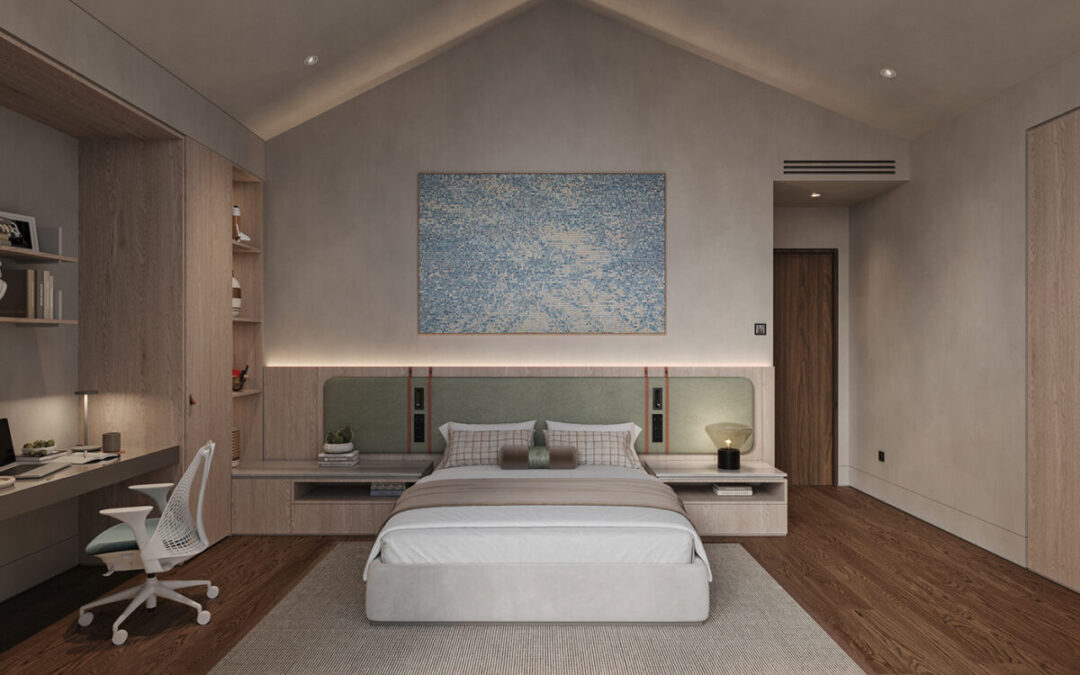
This bedroom feels calm and collected, yet full of character. The muted palette of soft greys, greens, and natural wood creates a soothing backdrop; the textured headboard with leather accents adds craftsmanship. Built-in shelves and a sleek desk make the space practical without sacrificing style. The artwork above the bed ties everything together with a gentle splash of color.
These bathrooms carry the same refined minimalism as the rest of Arbor House. The first features sleek marble with subtle veining, paired with soft lighting and simple round wall accents that add personality without clutter. The second brings warmth with wood finishes and a striking stone vanity, elevated by ambient lighting.
Welcome to The Sakura Home, a 134 m² apartment in the heart of Warsaw, Poland, where every detail feels like a breath of fresh air. Designed and visualized by Shushan Vardanian, this home is a serene retreat above the city, where minimalist luxury and nature-inspired calm come together. The apartment tells a story of simplicity elevated into elegance. Think clean lines, airy openness, and a touch of Japanese-inspired tranquility. The kind of design that makes you want to slow down, breathe deeply, and just be.
The first thing you’ll notice in the living room is how effortlessly calm it feels. The palette is soft and grounding; think creamy whites, warm wood tones, and just enough contrast from the sleek black accents to keep things modern.
The low-profile modular sofa invites you to sink in, its clean lines echoing the home’s minimalist philosophy. In front, a bold black coffee table sits like a sculptural anchor. To the side, an acrylic chair adds a touch of futuristic elegance, but without disturbing the visual flow.
But the real statement here? The delicate cherry blossom tree tucked into the corner. This blurs the line between indoors and out. It’s a subtle nod to nature, adding softness and soul to the refined minimalism.
The kitchen in The Sakura Home is anything but ordinary. It’s a statement piece. At the heart of the space stands a striking island, wrapped in a glowing gradient of amber and gold. It’s sleek, modern, and almost sculptural, setting the tone for the entire apartment.
Minimalism is the guiding principle here. The cabinetry, finished in deep matte tones, melts seamlessly into the wall. Overhead, slim linear pendants float with effortless elegance. The contrast between the bold island and the subtle backdrop creates a perfect balance.
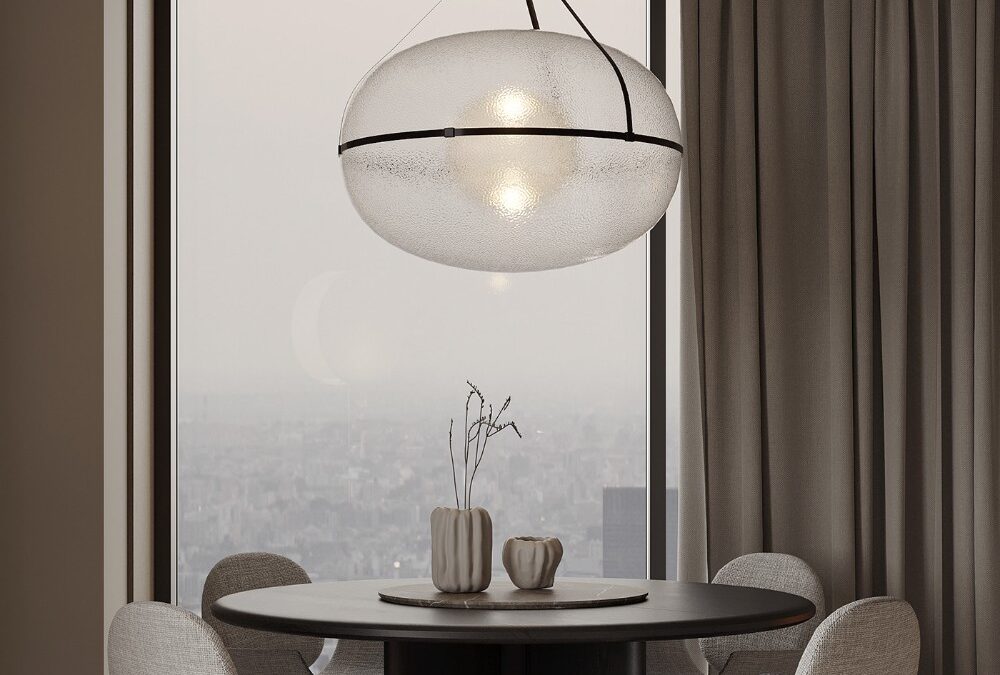
The dining area of the Sakura Home is all about understated elegance. A round, dark table anchors the space. This is paired with sculptural chairs that feel as comfortable as they look. Above, a glowing pendant light hovers like a piece of art—soft, organic, and perfectly in tune with the calm atmosphere. With floor-to-ceiling windows framing the Warsaw skyline, meals here are about slowing down, connecting, and savoring the moment.
Biomorphic forms and patterns used in the Design by Nature Collection by Front for Moroso
This week for my Pinterest TV episode, I am talking about how you can take inspiration from organic shapes and natural patterns and incorporate this into your home decor. In biophilic design terms, these would be referred to as natural analogues.
Natural Analogues
Natural analogues are organic, non-living and indirect evocations of nature. For example, these could be the objects, materials, colours, shapes, and patterns found in nature being turned into artwork, ornaments, furniture, décor or textiles in our homes and public spaces.
In my last Pinterest TV episode, we looked at biophilic design materials which are basically natural materials such as wood, cork, rattan, seagrass, stone, bamboo, and linen. We looked at how these materials can be used, without being too processed or altered, to create an indirect material connection to nature.
In the latest Pinterest TV episode and in this post, I would like to look at ways that we can use biomorphic forms and patterns in our home interior design to further enhance that indirect connection to nature. This may mean taking inspiration from stones, shells, feathers and leaves etc and creating representational artwork, furniture, lighting and architectural features with a more organic feel to them rather than taking inspiration from geometric shapes and hard lines.
Biomorphic Forms & Patterns
Biomorphic Forms and Patterns are basically symbolic references to contoured, patterned, textured or numerical arrangements that we see in nature. The objective is to use design elements within the built environment that allow users to make connections to nature. We want to use biomorphic forms and patterns in a way that creates a more visually preferred environment that enhances cognitive performance while helping reduce stress. A space that uses biomorphic forms and patterns well will feel interesting and comfortable. It will capture and hold your attention and will likely make you feel quite contemplative.
Science has suggested that incorporating biomorphic forms and patterns into the built environment will help to reduce stress levels. This is probably due to the fact that it causes us to shift our focus and concentrate more. We know that humans have a visual preference for organic shapes and natural patterns, but the scientific case to explain why has not yet been fully explored.
The Golden Ratio
The Golden Ratio, also known as the Fibonacci Series, appears to be a fundamental characteristic of the Universe and has intrigued scientists, mathematicians, artists and designers for centuries. This simple numerical pattern where each number is the sum of the two numbers that precede it (0, 1, 1, 2, 3, 5, 8, 13, 21, 34, 55 etc) can be seen in nature from the micro-scale to the macro-scale. Flower petals, seed heads and pine cones to tree branches, seashells, hurricanes and entire galaxies seem to align with the golden ratio.
Examples of Biomorphic Forms & Patterns
Pebbles
You never see hard lines and right angles in nature. In nature, everything is softer and more organic. Stones and pebbles are rounded and smooth. We are seeing this influence coming through strongly in interior design trends now. There is a huge move towards organic shapes and soft curves that mimic those we see in nature. Furniture in particular is becoming strongly influenced by organic shapes as we are seeing a lot of curved furniture pieces right now.
‘Curve Appeal‘ is one of the big interior design trends featured in Pinterest Predicts for 2022 with searches for curved sofas, walls, bars and kitchen islands all seeing major increases this year.
Village at Home Shore Pebble Table Lamp in Taupe from Leekes
Barnacles
Barnacles are sticky little crustaceans related to crabs, lobsters, and shrimps. They live on sturdy and often moving objects such as rocks, pilings, and buoys, boat and ship hulls and even whales. They secrete a fast-curing cement that is among the most powerful natural glues known to man. They feed on microscopic organisms in the sea and they are now inspiring our homewares.
The texture and the shape are probably a big part of the appeal when it comes to taking inspiration from barnacles. We are seeing ceramics such as bowls and vases with a surface similar to that of barnacles as well as lighting that mimics these natural little creatures.
SOURCE LIST
Shells
Shells, and the Golden Ratio that they display, have been inspiring our architecture and interiors for thousands of years and now we are seeing a strong visual trend in interior design for shell-inspired homewares. Many of the items we are seeing now merely recreate the look of shells either in 3D or 2D form.
But when biomorphic forms and patterns are used to maximum effect we see products designed to leverage the golden ratio and the spiralling of shells. We are seeing this now in lighting, furniture and architectural details like staircases.
SOURCE LIST
Sand Dunes
I have noticed recently a big move towards taking inspiration from sand dunes and the rippled patterns that we see in the sand created by wind or water. There are lots of interior products at the moment using the striations as inspiration. We’re seeing rugs and carpets incorporating extra texture due to the ridges that are cut into the pile. We’re seeing the inspiration appear on wallcoverings and in artwork. It’s there in ceramics and even in furniture.
This is my absolute favourite mood board that I pulled together and I think that it also illustrates really nicely the trend we are seeing towards the desert decor trend that is currently en route into our homes as we speak. This trend focuses on comforting colours such as warm terracottas, spicey ochre shades, and burnt oranges along with umber and soft shades of brown. This is accompanied by texture in fabrics and furnishings and these soft undulating ripples that we are seeing here.
SOURCE LIST
Mossy Landscapes
On the other end of the spectrum from the dry and arid desert decor trend that we are seeing is homeware and interiors that are taking inspiration from mossy landscape and green forest environments. Curved furniture that looks like moss-covered rocks is making an appearance as well as rugs that are highly textured and shaggy and aim to replicate and mimic multitude of shades of green that can be found in nature.
We are also seeing moss playing a large role in the creation of living walls which can be a great way to create a visual and material connection to nature as well as a non-visual connection as moss is a wonderfully tactile natural material.
We talked about using wood as a natural material in our interiors and I mentioned how it is more effective if we can use it in an unprocessed state. the reason for this is because when we leave it raw we can really see the wood grain and the natural ring patterns in the wood.
We are seeing furniture with a more organic finish now such as tables with a live or living edge. this is to give it that softer more organic feel because as we said there are no straight lines in nature.
The concentric circles of tree rings are making more of an appearance in our interiors lately and we can see below that this pattern is showing up on furniture, flooring and wallcoverings.
SOURCE LIST
Sea Urchins
Another bit of sealife that is inspiring our home decor is the sea urchin. These spiny, globular little creatures live on the seabed and inhabit every depth zone.
Again their appeal is probably in their organic shape but also the texture that it can bring into the home. So we are seeing sea urchin-inspired accessories such as vases and simple motifs along with lighting and even door pulls.
SOURCE LIST
Leaves
Leaves are actually a staple when it comes to interiors inspiration. I don’t think that botanical prints and patterns ever go out of style. It is just such an easy way bring nature into the built environment and the benefits are just undisputable.
What makes leaves so special is the fractal patterns that we can identify. A fractal is a pattern of nature that repeats at different scales. We can find examples of this in the forest when we look at ferns, trees, roots, leaves, and the fungal mycelium.
SOURCE LIST
Honeycomb
And our final example today is honeycomb. Hexagons burst onto the interiors scene a few years ago and were everywhere from wall and floor tiles to interior accessories, soft furnishings, door hardware and everything in between.
They aren’t as strong a trend as they were but this is another example of how nature and natural patterns can be used to inspire our home environments and bring us all the mental and physical health and well being benefits associated with biophilic design.
There are so many benefits that can be reaped from including biomorphic forms and patterns in a space from reduced stress levels to increased feelings of well-being and improved levels of productivity.