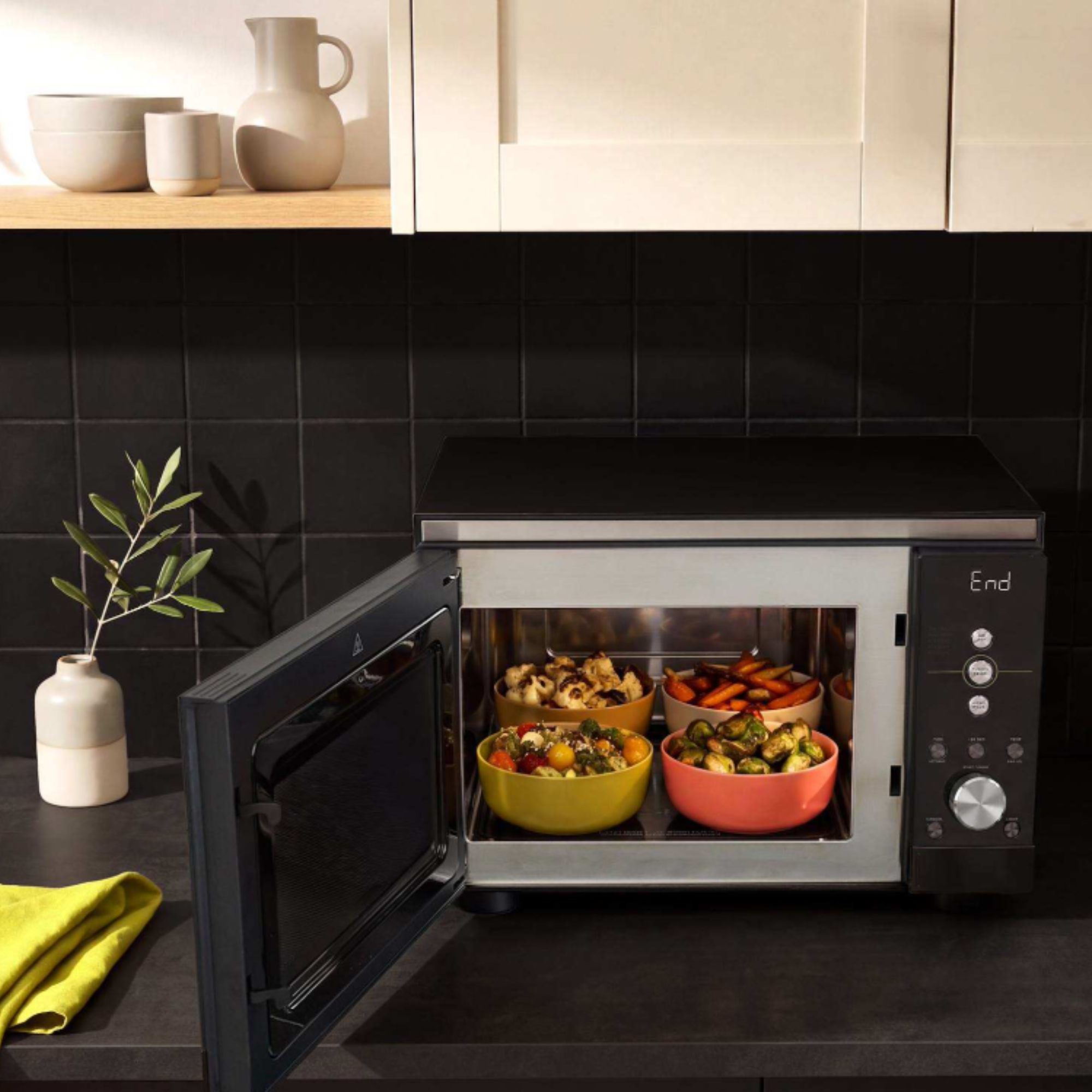
It’s the latest in a line of multi-hyphenate appliances which combine the two most convenient products in a kitchen: the speed of the best air fryers meeting the ease for reheating leftovers of the best microwaves.
Despite sounding great on paper, as Ideal Home’s Kitchen Appliances Editor, I’ve so far been disappointed in the microwave/air fryer hybrids we’ve tried so far. Here’s why I’m hoping this new iteration of the best Ninja air fryers is going to be the exception to the rule.
This is a flatbed microwave \u2013 which means it doesn't have a rotating plate element \u2013\u00a0in order to create more space and prove easier to clean. ","brand":"Ninja","name":"Crispi Microwave, Air Fryer & Oven","urlStyle":"","retailer":"","layout":"horizontal","linkText":"","noFollow":false,"noAffiliateTracking":false,"promoLabel":"","price":359.99,"salePrice":null,"currency":"GBP","linkLayout":"text","sponsored":false,"hawkProductNameMatchedCode":"","review":{"cons":[],"id":"","name":"","pros":[],"rating":0,"strapline":"","url":""},"id":"","externalId":"bc79091c9719be51370b6a9fc53671fb3d820363","lastCheckedPriceDate":"","link":{"url":"https:\/\/www.awin1.com\/awclick.php?awinmid=8059&awinaffid=103504&clickref=hawk-custom-tracking&p=https%3A%2F%2Fwww.sharkninja.co.uk%2Fninja-crispi-microwave-air-fryer-oven—silver%2FMW101UK.html%3Fdwvar_MW101UK_color%3DE5E5E5","merchantName":"SharkNinja UK","merchantId":13520,"merchantNetwork":"AW","merchantUrl":"sharkninja.co.uk"}}}}}” data-link=”https://www.awin1.com/awclick.php?awinmid=8059&awinaffid=103504&clickref=hawk-custom-tracking&p=https%3A%2F%2Fwww.sharkninja.co.uk%2Fninja-crispi-microwave-air-fryer-oven—silver%2FMW101UK.html%3Fdwvar_MW101UK_color%3DE5E5E5″ data-link-merchant=”SharkNinja UK” data-merchant-id=”13520″ data-merchant-name=”SharkNinja UK” data-merchant-network=”AW” data-merchant-url=”sharkninja.co.uk” data-model-brand=”Ninja” data-model-name=”Ninja Crispi Microwave, Air Fryer & Oven” data-name=”Horizontal Product Block merchantlink widget” data-render-type=”fte” data-show-fallback=”button” data-widget-type=”merchantlink” class=”ecom-root”>
This is a flatbed microwave – which means it doesn’t have a rotating plate element – in order to create more space and prove easier to clean.
If you own a Ninjaair fryer already, you’ll know that this is the brand to go for if you want to maximise cooking power. With temperatures up to 240°C, that certainly looks like an advantage that will carry over with this clever combination buy.
Though this is advertised as a 3-in-1 (air fryer, microwave, oven) there are actually a whopping 13 functions available on the interface of the appliance. Eight of those are for microwaving to your hearts content, and 5 of them will be very familiar to those who love their existing Ninja air fryer.
(Image credit: Ninja)
Those five settings are: Air Fry, Max Crisp, Air Roast, Air Bake and Air Broil (which is the American term for grill). I own the Ninja Double Stack and the high heat and power of the Max Crisp setting means it’s never out of use in my household.
Using the microwave and air fryer elements separately is one thing, but the setting that has me most intrigued is Fusion Crisp. This button allows you to whip up ‘fast meals with a crisp finish’.
Get the Ideal Home Newsletter
Sign up to our newsletter for style inspiration, real homes, project and garden advice and shopping know-how
Once pressed, your device will begin by microwaving your food and then move onto auto finishing with air frying. That should, in theory, allow you to ‘go from frozen to crispy in minutes’. If it works well, this should make this microwave air fryer the most time-efficient buy in your kitchen.
(Image credit: Ninja)
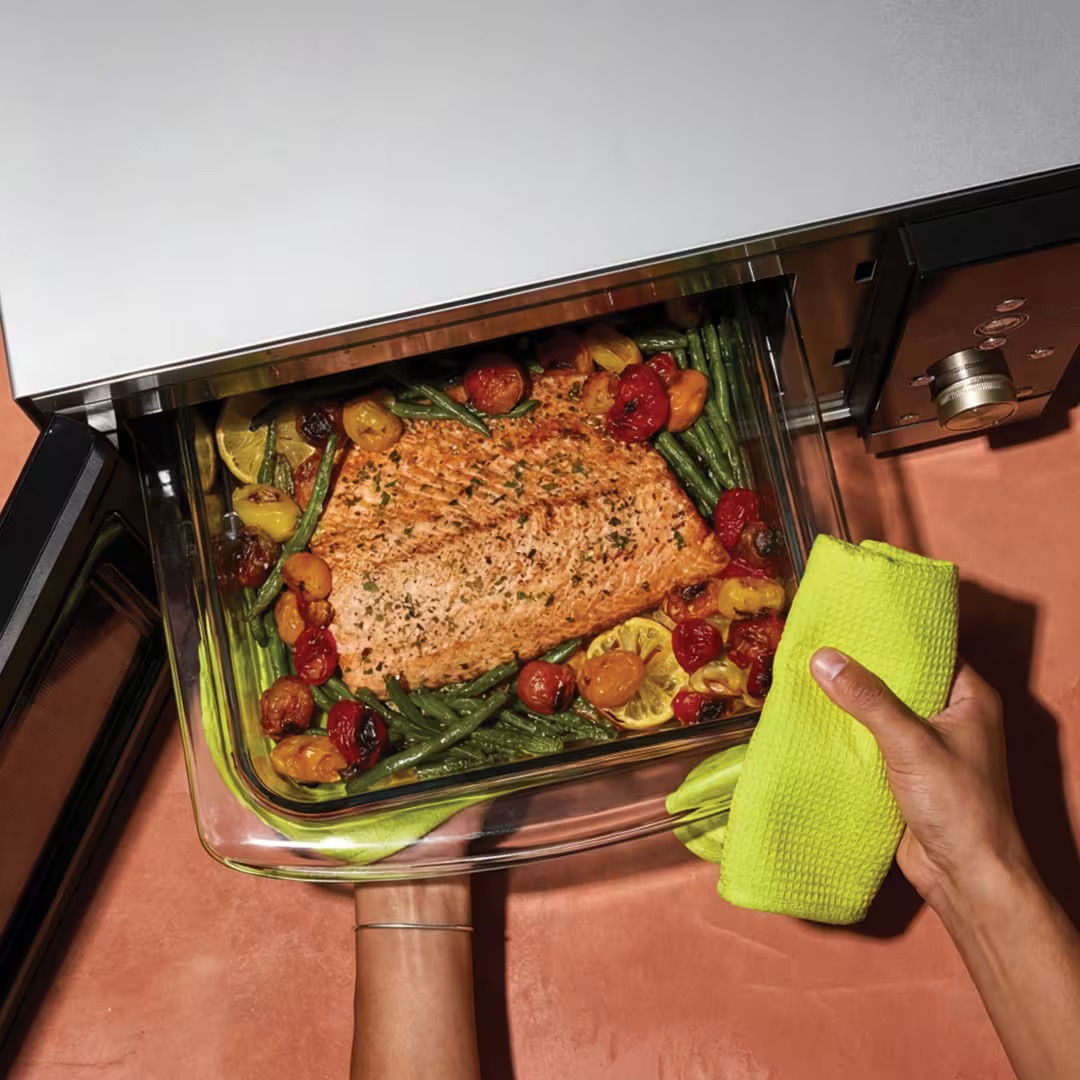
Another winning feature of the original Ninja Crispi is present within this new version too: the introduction of glassware to help with efficient meal prep. With a 5.2 litre capacity and a matching lid, it’s perfect for saving on washing up. Capacity-wise, it can fit a 3kg chicken, according to Ninja, making enough food for up to eight people at a time.
Simply cook in it within the Crispi and then pop any leftovers straight into the fridge when you’re finished. And though it doesn’t come as standard, it looks as if you’ll also be able to separately invest in a steamer lid too – perfect for veggies, rice, dumplings and more.
Though it was released today (the 2nd of September), Ninja will always send their products ahead of time to reviewers. At the time of writing, this 3-in-1 has already gleaned a 4.7 star rating from 160 user reviews, which is a promising sign.
Our review of this innovative new Ninja is currently in the works so that we can let you know whether it’s Ideal Home approved for your home. Could you see this type of appliance working in your kitchen?
If you thought IKEA was already affordable, I have good news, as the Swedish retailer has just permanently slashed the prices of some of its most popular products.
With cult products such as the KALLAX shelving unit, HEMNES daybed and the retro DIVYLINGE chair all seeing a reduction in price, here’s everything we know about IKEA’s New Lower Prices, and how it can save you money this autumn.
Latest Videos FromIdeal Home
IKEA’s New Lower Prices
(Image credit: Future PLC/Dominic Blackmore)
Officially launching on Friday 28 August this year, IKEA’S New Lower Prices are, as IKEA states, not a sale, but the new normal. They have rounded up everything from some of their most recognisable furniture designs to everyday essentials to make shopping from your home more affordable.
If you’ve been worried about rising energy costs, increasing food prices and the general cost of living, it is quite refreshing to see a brand committed to doing the opposite. New Lower Prices will be available both in stores and online. Here are some of the best deals I’ve spotted since the launch.
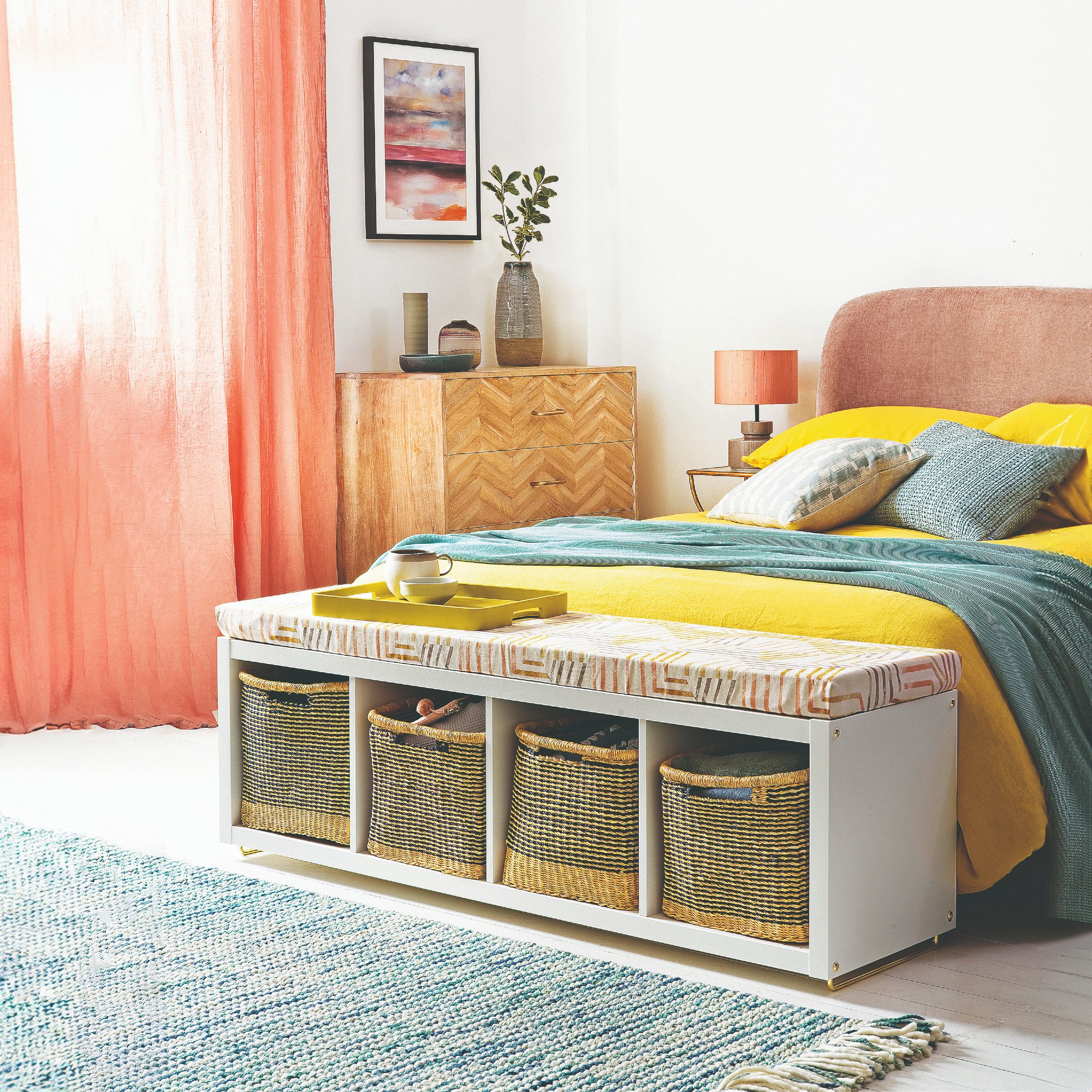
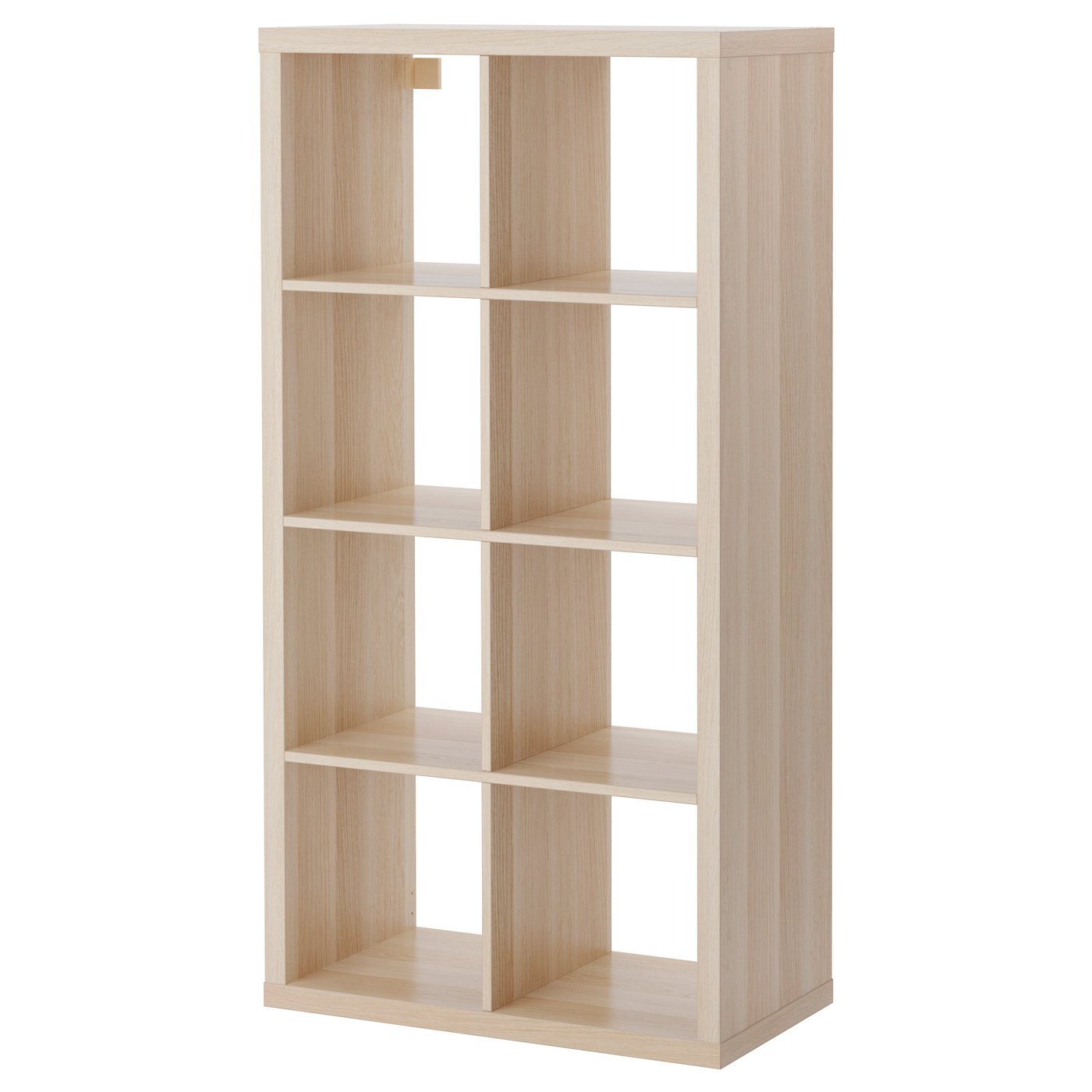
Kallax Shelving Unit
<aside data-article-category="all-rooms" data-block-layout="hero" data-block-type="featured-product" data-editorial-currency="GBP" data-editorial-merchant-name="Was £60, now £49" data-editorial-price="49" data-hawk-json="{"product":{"variants":{"Default":{"image":{"copyright":"","height":1400,"id":"JbLYUami9ZUuWRJgQD3JuD","mimeType":"image\/jpeg","mos":"https:\/\/cdn.mos.cms.futurecdn.net\/JbLYUami9ZUuWRJgQD3JuD.jpg","role":"","width":1400,"credit":"IKEA","alt":"Kallax Shelving Unit – White Stained Oak Effect 77×147 Cm","caption":""},"strapline":"
This cult KALLAX unit has been slashed by 18%. Its versatile design makes it an excellent storage solution for any home.","brand":"","name":"Kallax Shelving Unit ","urlStyle":"","layout":"hero","noFollow":true,"noAffiliateTracking":false,"promoLabel":"","price":49,"salePrice":null,"currency":"GBP","linkLayout":"text","sponsored":false,"hawkProductNameMatchedCode":"","review":{"cons":[],"id":"","name":"","pros":[],"rating":0,"strapline":"","url":""},"id":"","externalId":"9b9edf1d81bb194372bab4b13a45040dcbc7e884","lastCheckedPriceDate":"","link":{"url":"https:\/\/go.redirectingat.com?id=92X1623319&xcust=hawk-custom-tracking&xs=1&url=https%3A%2F%2Fwww.ikea.com%2Fgb%2Fen%2Fp%2Fkallax-shelving-unit-white-stained-oak-effect-00324518&sref=https%3A%2F%2Fwww.idealhome.co.uk%2Fall-rooms%2Fikea-new-lower-prices-2026","linkText":"Was \u00a360, now \u00a349","editorialMerchantName":"Was \u00a360, now \u00a349","merchantName":"ikea.com"}}}}}” data-link=”https://go.redirectingat.com?id=92X1623319&xcust=hawk-custom-tracking&xs=1&url=https%3A%2F%2Fwww.ikea.com%2Fgb%2Fen%2Fp%2Fkallax-shelving-unit-white-stained-oak-effect-00324518&sref=https%3A%2F%2Fwww.idealhome.co.uk%2Fall-rooms%2Fikea-new-lower-prices-2026″ data-link-merchant=”ikea.com” data-link-text=”Was £60, now £49″ data-merchant-name=”ikea.com” data-model-name=”Kallax Shelving Unit” data-name=”Product Block merchantlink widget” data-render-type=”fte” data-show-fallback=”button” data-widget-type=”merchantlink” class=”ecom-root”>
This cult KALLAX unit has been slashed by 18%. Its versatile design makes it an excellent storage solution for any home.
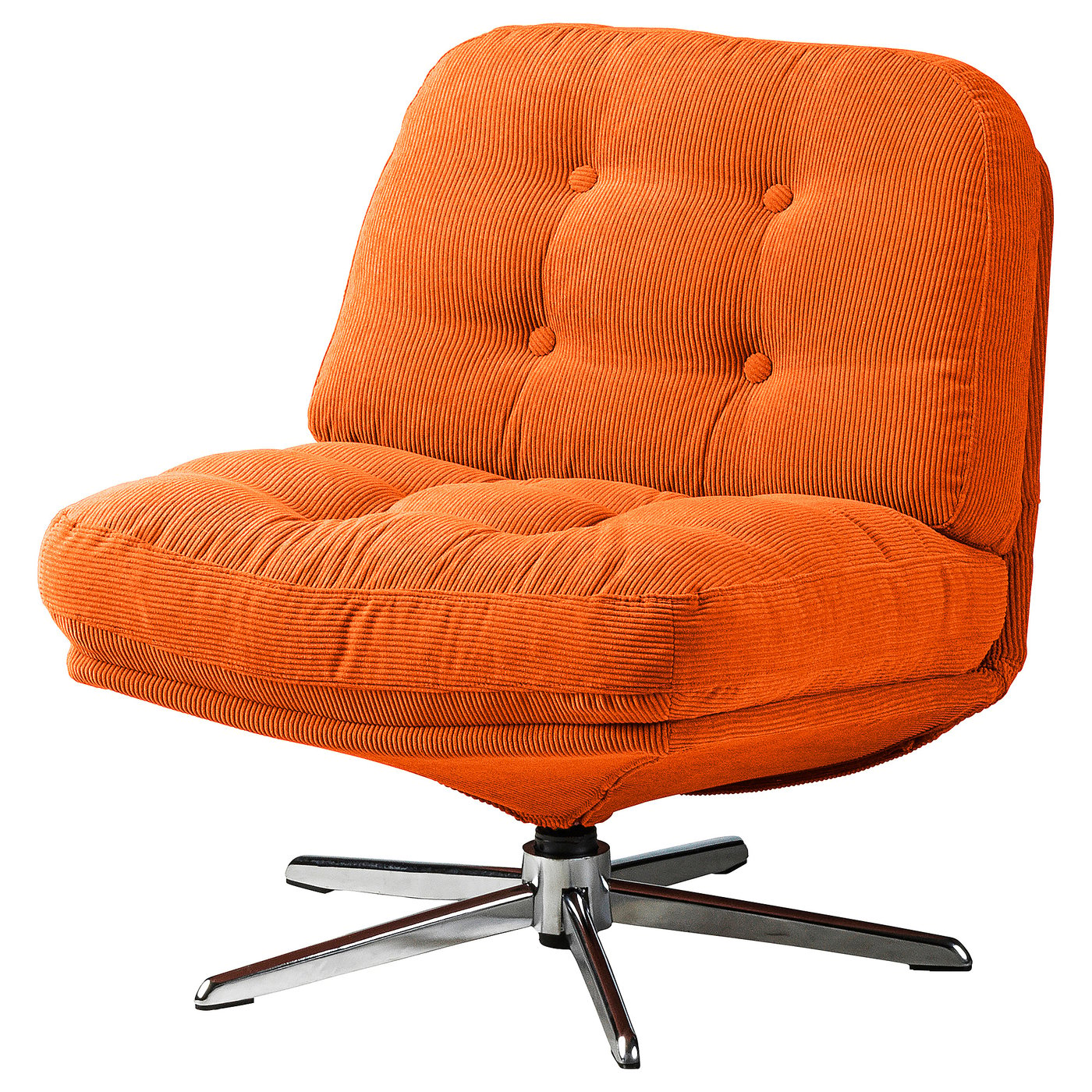
Dyvlinge Swivel Easy Chair – Kelinge Orange
<aside data-article-category="all-rooms" data-block-layout="hero" data-block-type="featured-product" data-editorial-currency="GBP" data-editorial-merchant-name="Was £199, now £129 at IKEA" data-editorial-price="199" data-hawk-json="{"product":{"variants":{"Default":{"image":{"copyright":"","height":1400,"id":"AguTmzoRfbdtYawwFtp4vD","mimeType":"image\/jpeg","mos":"https:\/\/cdn.mos.cms.futurecdn.net\/AguTmzoRfbdtYawwFtp4vD.jpg","role":"","width":1400,"credit":"IKEA","alt":"Dyvlinge Swivel Easy Chair – Kelinge Orange","caption":""},"strapline":"
If you love the look of this gorgeous, retro chair, you will have to head into a store to claim the offer.","brand":"","name":"Dyvlinge Swivel Easy Chair – Kelinge Orange","urlStyle":"","layout":"hero","noFollow":true,"noAffiliateTracking":false,"promoLabel":"","price":199,"salePrice":null,"currency":"GBP","linkLayout":"text","sponsored":false,"hawkProductNameMatchedCode":"","review":{"cons":[],"id":"","name":"","pros":[],"rating":0,"strapline":"","url":""},"id":"","externalId":"5b42933d5590f6286b787d5f1e631c884a3c3b6a","lastCheckedPriceDate":"","link":{"url":"https:\/\/go.redirectingat.com?id=92X1623319&xcust=hawk-custom-tracking&xs=1&url=https%3A%2F%2Fwww.ikea.com%2Fgb%2Fen%2Fp%2Fdyvlinge-swivel-easy-chair-kelinge-orange-60581920%2F&sref=https%3A%2F%2Fwww.idealhome.co.uk%2Fall-rooms%2Fikea-new-lower-prices-2026","linkText":"Was \u00a3199, now \u00a3129 ","editorialMerchantName":"Was \u00a3199, now \u00a3129 at IKEA","merchantName":"ikea.com"}}}}}” data-link=”https://go.redirectingat.com?id=92X1623319&xcust=hawk-custom-tracking&xs=1&url=https%3A%2F%2Fwww.ikea.com%2Fgb%2Fen%2Fp%2Fdyvlinge-swivel-easy-chair-kelinge-orange-60581920%2F&sref=https%3A%2F%2Fwww.idealhome.co.uk%2Fall-rooms%2Fikea-new-lower-prices-2026″ data-link-merchant=”ikea.com” data-link-text=”Was £199, now £129 ” data-merchant-name=”ikea.com” data-model-name=”Dyvlinge Swivel Easy Chair – Kelinge Orange” data-name=”Product Block merchantlink widget” data-render-type=”fte” data-show-fallback=”button” data-widget-type=”merchantlink” class=”ecom-root”>
If you love the look of this gorgeous, retro chair, you will have to head into a store to claim the offer.
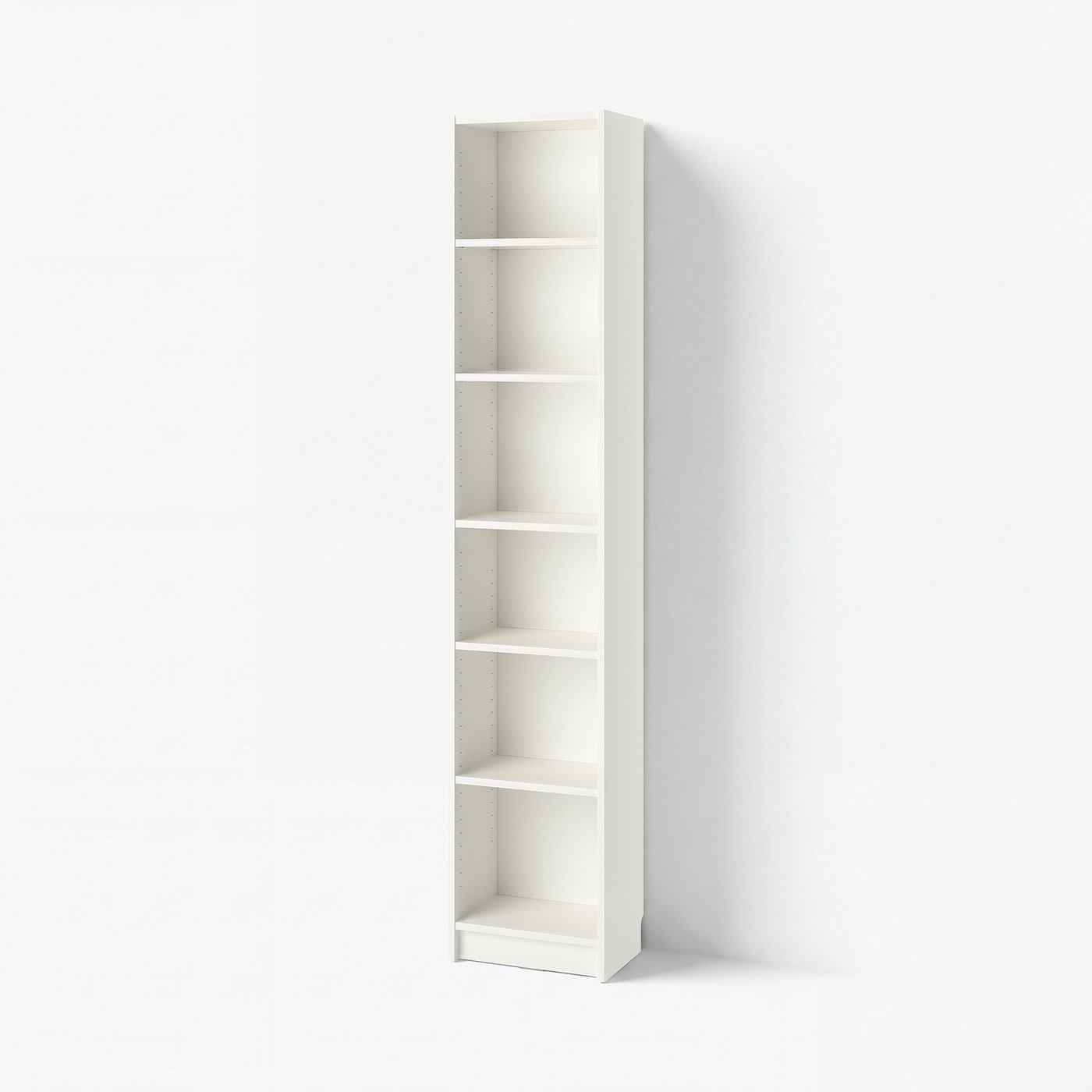
Billy Bookcase
<aside data-article-category="all-rooms" data-block-layout="hero" data-block-type="featured-product" data-editorial-currency="GBP" data-editorial-merchant-name="Was £35, now £25 at IKEA" data-editorial-price="35" data-hawk-json="{"product":{"variants":{"Default":{"image":{"copyright":"","height":1400,"id":"B4eQtGgxpwUxyvwDSK2PLD","mimeType":"image\/jpeg","mos":"https:\/\/cdn.mos.cms.futurecdn.net\/B4eQtGgxpwUxyvwDSK2PLD.jpg","role":"","width":1400,"credit":"IKEA","alt":"Billy Bookcase – White 40x28x202 Cm","caption":""},"strapline":"
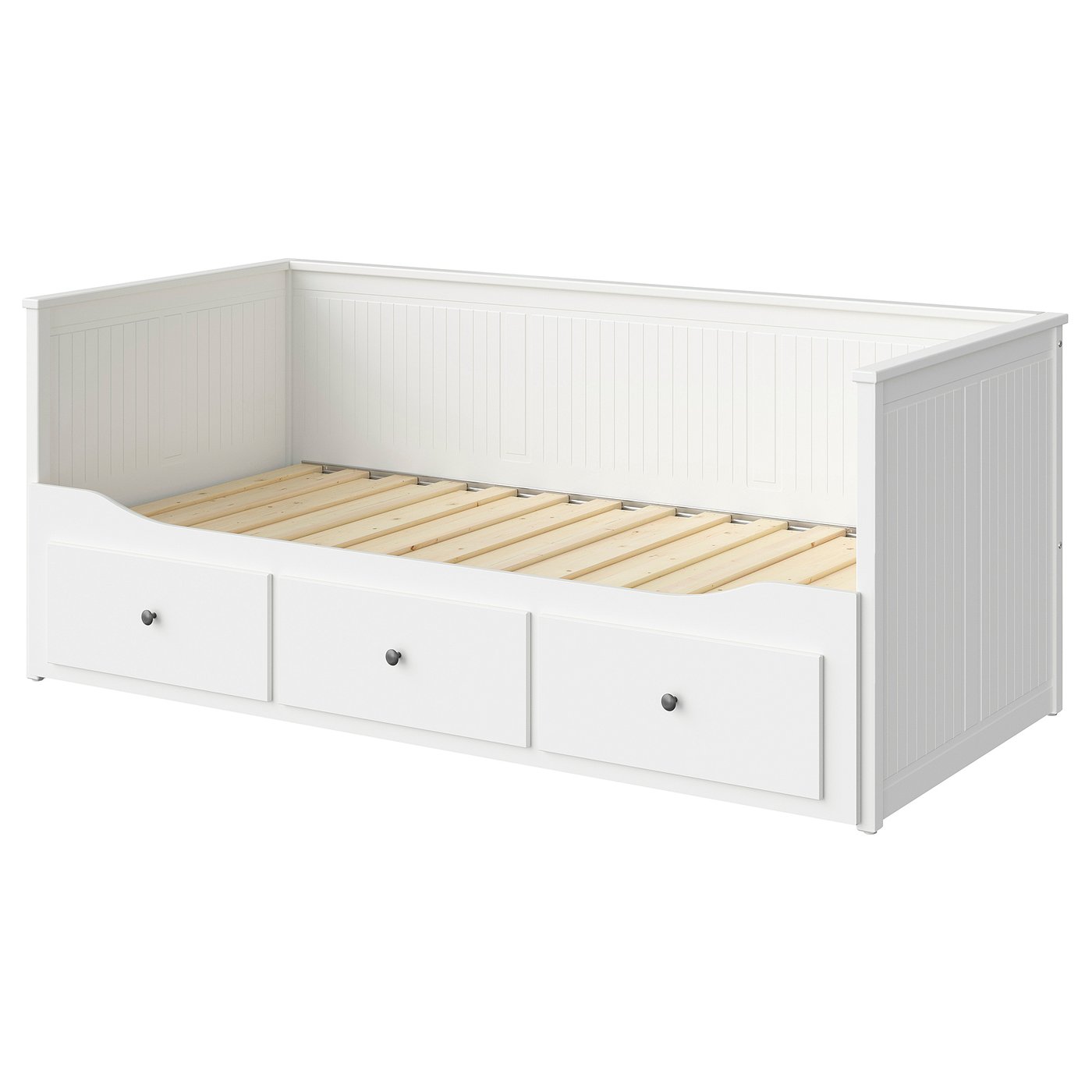
Hemnes Day-Bed Frame With 3 Drawers – White 80×200 Cm
<aside data-article-category="all-rooms" data-block-layout="hero" data-block-type="featured-product" data-editorial-currency="GBP" data-editorial-merchant-name="Was £329, now £279 at IKEA" data-editorial-price="279" data-hawk-json="{"product":{"variants":{"Default":{"image":{"copyright":"","height":1400,"id":"Mf5MBYzDn8ME8GwM6H4ePD","mimeType":"image\/jpeg","mos":"https:\/\/cdn.mos.cms.futurecdn.net\/Mf5MBYzDn8ME8GwM6H4ePD.jpg","role":"","width":1400,"credit":"IKEA","alt":"Hemnes Day-Bed Frame With 3 Drawers – White 80×200 Cm","caption":""},"strapline":"
A bed for under \u00a3300 is a great deal, and this classic has plenty of good reviews to back up its quality.","brand":"","name":"Hemnes Day-Bed Frame With 3 Drawers – White 80×200 Cm","urlStyle":"","layout":"hero","noFollow":true,"noAffiliateTracking":false,"promoLabel":"","price":279,"salePrice":null,"currency":"GBP","linkLayout":"text","sponsored":false,"hawkProductNameMatchedCode":"","review":{"cons":[],"id":"","name":"","pros":[],"rating":0,"strapline":"","url":""},"id":"","externalId":"292ccf381bea63c74f40f9f173901e8bb9d4788b","lastCheckedPriceDate":"","link":{"url":"https:\/\/go.redirectingat.com?id=92X1623319&xcust=hawk-custom-tracking&xs=1&url=https%3A%2F%2Fwww.ikea.com%2Fgb%2Fen%2Fp%2Fhemnes-day-bed-frame-with-3-drawers-white-90349326%2F&sref=https%3A%2F%2Fwww.idealhome.co.uk%2Fall-rooms%2Fikea-new-lower-prices-2026","linkText":"Was \u00a3329, now \u00a3279 ","editorialMerchantName":"Was \u00a3329, now \u00a3279 at IKEA","merchantName":"ikea.com"}}}}}” data-link=”https://go.redirectingat.com?id=92X1623319&xcust=hawk-custom-tracking&xs=1&url=https%3A%2F%2Fwww.ikea.com%2Fgb%2Fen%2Fp%2Fhemnes-day-bed-frame-with-3-drawers-white-90349326%2F&sref=https%3A%2F%2Fwww.idealhome.co.uk%2Fall-rooms%2Fikea-new-lower-prices-2026″ data-link-merchant=”ikea.com” data-link-text=”Was £329, now £279 ” data-merchant-name=”ikea.com” data-model-name=”Hemnes Day-Bed Frame With 3 Drawers – White 80×200 Cm” data-name=”Product Block merchantlink widget” data-render-type=”fte” data-show-fallback=”button” data-widget-type=”merchantlink” class=”ecom-root”>
A bed for under £300 is a great deal, and this classic has plenty of good reviews to back up its quality.
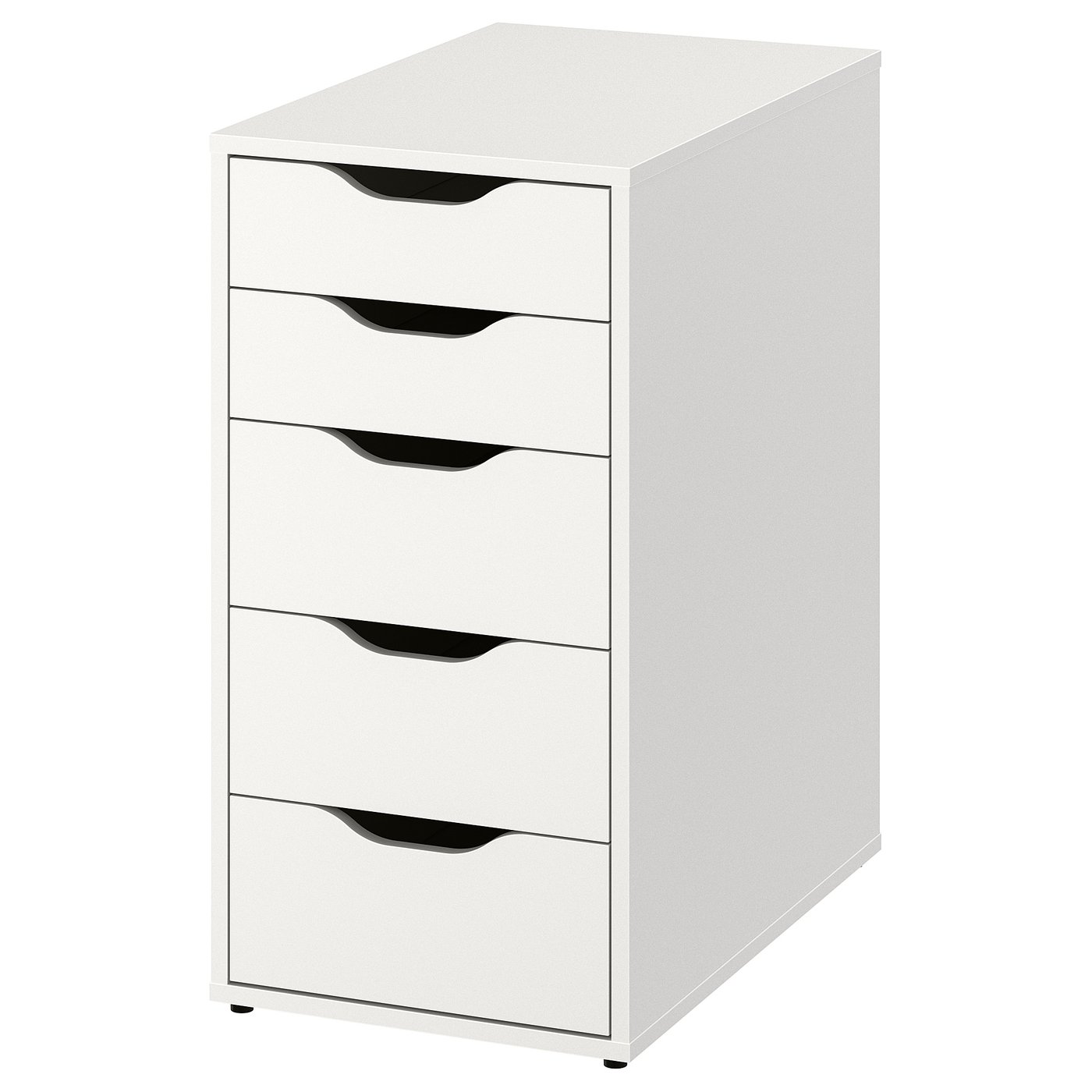
Alex Drawer Unit
<aside data-article-category="all-rooms" data-block-layout="hero" data-block-type="featured-product" data-editorial-currency="GBP" data-editorial-merchant-name="Was £70, now £55 at IKEA" data-editorial-price="55" data-hawk-json="{"product":{"variants":{"Default":{"image":{"copyright":"","height":1400,"id":"UyJTDPDc8q9QyEvBEEr7SD","mimeType":"image\/jpeg","mos":"https:\/\/cdn.mos.cms.futurecdn.net\/UyJTDPDc8q9QyEvBEEr7SD.jpg","role":"","width":1400,"credit":"IKEA","alt":"Alex Drawer Unit – White 36×70 Cm","caption":""},"strapline":"
Looking for new storage for your home office\/study area? These spacious drawers offer plenty of room to keep your work organised.","brand":"","name":"Alex Drawer Unit ","urlStyle":"","layout":"hero","noFollow":true,"noAffiliateTracking":false,"promoLabel":"","price":55,"salePrice":null,"currency":"GBP","linkLayout":"text","sponsored":false,"hawkProductNameMatchedCode":"","review":{"cons":[],"id":"","name":"","pros":[],"rating":0,"strapline":"","url":""},"id":"","externalId":"f07aff78a84015f506ce0021cd38756b998c7f50","lastCheckedPriceDate":"","link":{"url":"https:\/\/go.redirectingat.com?id=92X1623319&xcust=hawk-custom-tracking&xs=1&url=https%3A%2F%2Fwww.ikea.com%2Fgb%2Fen%2Fp%2Falex-drawer-unit-white-00473546%2F&sref=https%3A%2F%2Fwww.idealhome.co.uk%2Fall-rooms%2Fikea-new-lower-prices-2026","linkText":"Was \u00a370, now \u00a355 ","editorialMerchantName":"Was \u00a370, now \u00a355 at IKEA","merchantName":"ikea.com"}}}}}” data-link=”https://go.redirectingat.com?id=92X1623319&xcust=hawk-custom-tracking&xs=1&url=https%3A%2F%2Fwww.ikea.com%2Fgb%2Fen%2Fp%2Falex-drawer-unit-white-00473546%2F&sref=https%3A%2F%2Fwww.idealhome.co.uk%2Fall-rooms%2Fikea-new-lower-prices-2026″ data-link-merchant=”ikea.com” data-link-text=”Was £70, now £55 ” data-merchant-name=”ikea.com” data-model-name=”Alex Drawer Unit” data-name=”Product Block merchantlink widget” data-render-type=”fte” data-show-fallback=”button” data-widget-type=”merchantlink” class=”ecom-root”>
Looking for new storage for your home office/study area? These spacious drawers offer plenty of room to keep your work organised.
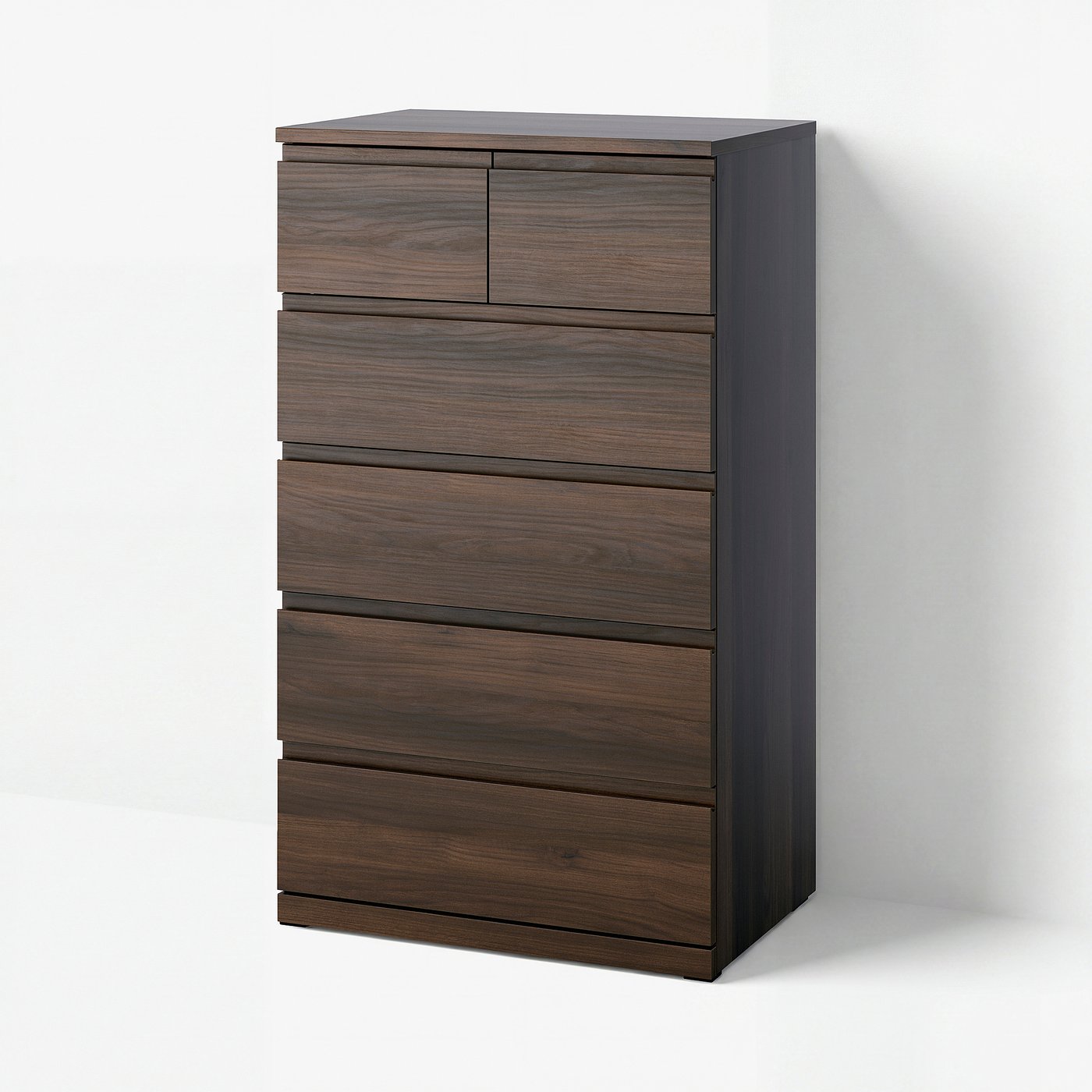
Storklinta Chest of 6 Drawers
<aside data-article-category="all-rooms" data-block-layout="hero" data-block-type="featured-product" data-editorial-currency="GBP" data-editorial-merchant-name="Was £129, now £119 at IKEA" data-editorial-price="119" data-hawk-json="{"product":{"variants":{"Default":{"image":{"copyright":"","height":1400,"id":"cynMaH2yLL7MFmiZcCkgCG","mimeType":"image\/jpeg","mos":"https:\/\/cdn.mos.cms.futurecdn.net\/cynMaH2yLL7MFmiZcCkgCG.jpg","role":"","width":1400,"credit":"IKEA","alt":"Storklinta Chest of 6 Drawers – Dark Brown\/oak Effect 70x50x120 Cm","caption":""},"strapline":"
IKEA drawers are definitely a staple in my home, and these ones are not only stylish, but great for keeping clothes organised.","brand":"","name":"Storklinta Chest of 6 Drawers ","urlStyle":"","layout":"hero","noFollow":true,"noAffiliateTracking":false,"promoLabel":"","price":119,"salePrice":null,"currency":"GBP","linkLayout":"text","sponsored":false,"hawkProductNameMatchedCode":"","review":{"cons":[],"id":"","name":"","pros":[],"rating":0,"strapline":"","url":""},"id":"","externalId":"acc6ef04efaa227a00be093293f7e05dfae4b5c8","lastCheckedPriceDate":"","link":{"url":"https:\/\/go.redirectingat.com?id=92X1623319&xcust=hawk-custom-tracking&xs=1&url=https%3A%2F%2Fwww.ikea.com%2Fgb%2Fen%2Fp%2Fstorklinta-chest-of-6-drawers-dark-brown-oak-effect-20627557&sref=https%3A%2F%2Fwww.idealhome.co.uk%2Fall-rooms%2Fikea-new-lower-prices-2026","linkText":"Was \u00a3129, now \u00a3119","editorialMerchantName":"Was \u00a3129, now \u00a3119 at IKEA","merchantName":"ikea.com"}}}}}” data-link=”https://go.redirectingat.com?id=92X1623319&xcust=hawk-custom-tracking&xs=1&url=https%3A%2F%2Fwww.ikea.com%2Fgb%2Fen%2Fp%2Fstorklinta-chest-of-6-drawers-dark-brown-oak-effect-20627557&sref=https%3A%2F%2Fwww.idealhome.co.uk%2Fall-rooms%2Fikea-new-lower-prices-2026″ data-link-merchant=”ikea.com” data-link-text=”Was £129, now £119″ data-merchant-name=”ikea.com” data-model-name=”Storklinta Chest of 6 Drawers” data-name=”Product Block merchantlink widget” data-render-type=”fte” data-show-fallback=”button” data-widget-type=”merchantlink” class=”ecom-root”>
IKEA drawers are definitely a staple in my home, and these ones are not only stylish, but great for keeping clothes organised.
Whether you’re giving your home an upgrade this autumn, sending a loved one off to university or moving home yourself, IKEA is helping to make furnishing a home more affordable. We can’t fault that.
Get the Ideal Home Newsletter
Sign up to our newsletter for style inspiration, real homes, project and garden advice and shopping know-how
We’re working on a big post about our finished renovation (which we last talked about on the blog here). But I’m dropping in to answer questions about the new flooring that we chose for our entire first floor (except for the tiled bathrooms). They’ve been one of the most-asked-about details of our reno on Instagram, where Sherry shared this reno as it rolled along in our Stories. So today we’ll cover the what, why, and how of our new flooring. It’s our first time using this particular material, and we have some thoughts.
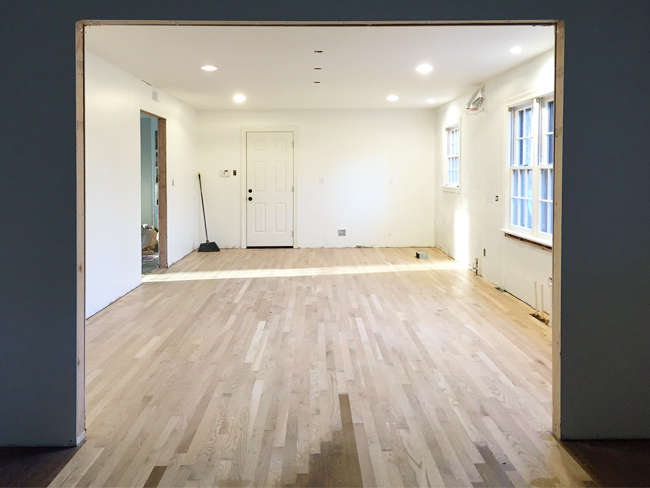
You know we love saving and refinishing original hardwood flooring – we did it in our first house, our third house, the beach house, and the duplex – and each time we were extremely happy with the results. So back in 2020 it felt like a no-brainer to enthusiastically refinish the floors here and hope for the best.
To cut to the chase: we definitely had higher hopes for these floors, but they held up so poorly. And after 6 years of living with them, it became clear that this renovation was a crucial moment to pivot instead of attempting to patch in matching flooring in all the spots where we removed walls or added square footage (remember we finished the covered porch to become our daughter’s room).
New Floor FAQs
Here are the specific questions we’ll cover today:
Why did you replace your floors?
What flooring did you use?
How and why did you pick it?
Do you like them?
Why Did You Replace Your Floors?
You might be like: what the heck is different about this house than all the other houses where you refinished the original floors? Well, you may remember we have heart pine hardwoods upstairs, which is a pretty common and durable flooring type. It’s what we had at the beach house & the duplex, and we loved it. But we just had regular yellow pine downstairs here, and not the super old, dense pine that’s extra strong. This was newer yellow pine from the 90s.
So reason number one is just that the original flooring was not nearly as durable as we hoped it would be. Feel free to google “heart pine floors vs regular pine floors” for more info about how much they differ, but the general consensus is that pine is a softwood, especially yellow pine like ours. It dings, scratches, and dents easily from high heels, pets, or dropped objects. Meanwhile heart pine resists wear far better due to its high resin content (which we only have upstairs).
Long story long, yellow pine from that era just isn’t as durable of a flooring material – especially in rooms with frequent foot traffic by multiple people & pets. Especially not for a house by the beach with a pool (sand + water + wet towels galore).
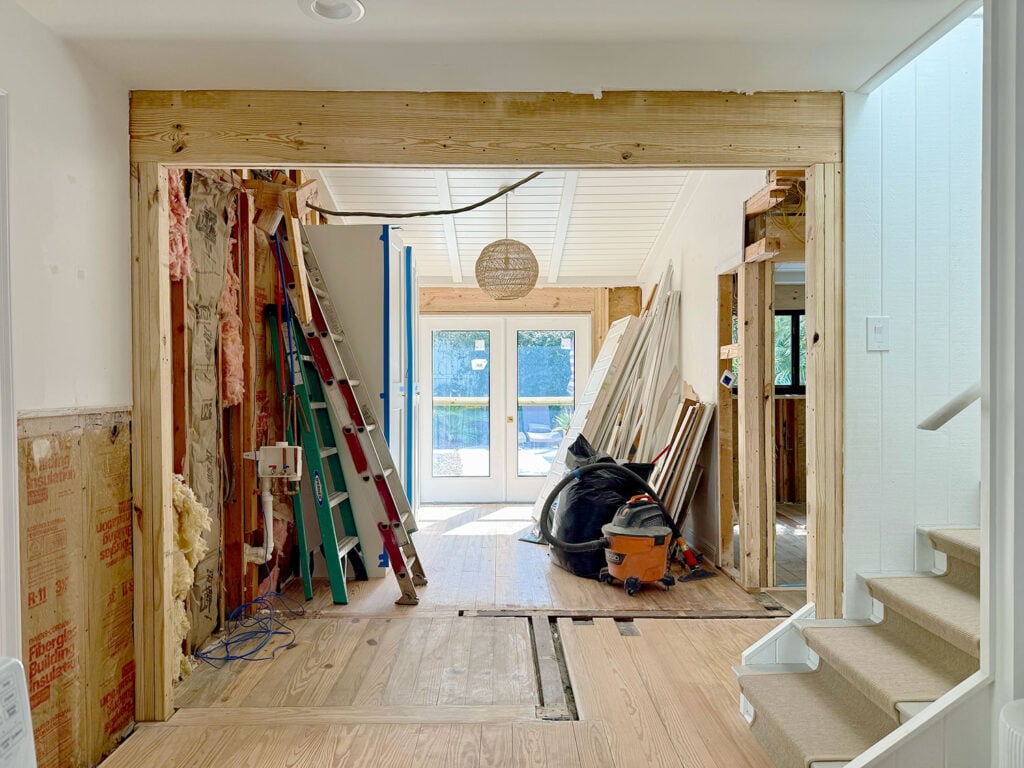
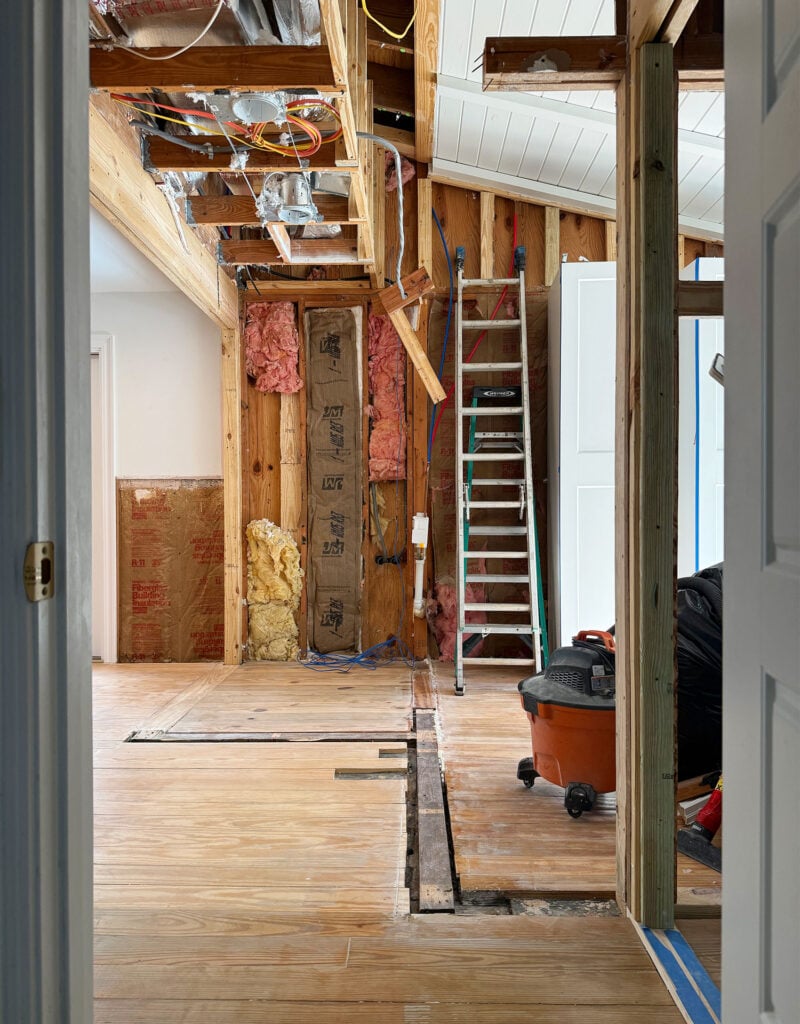
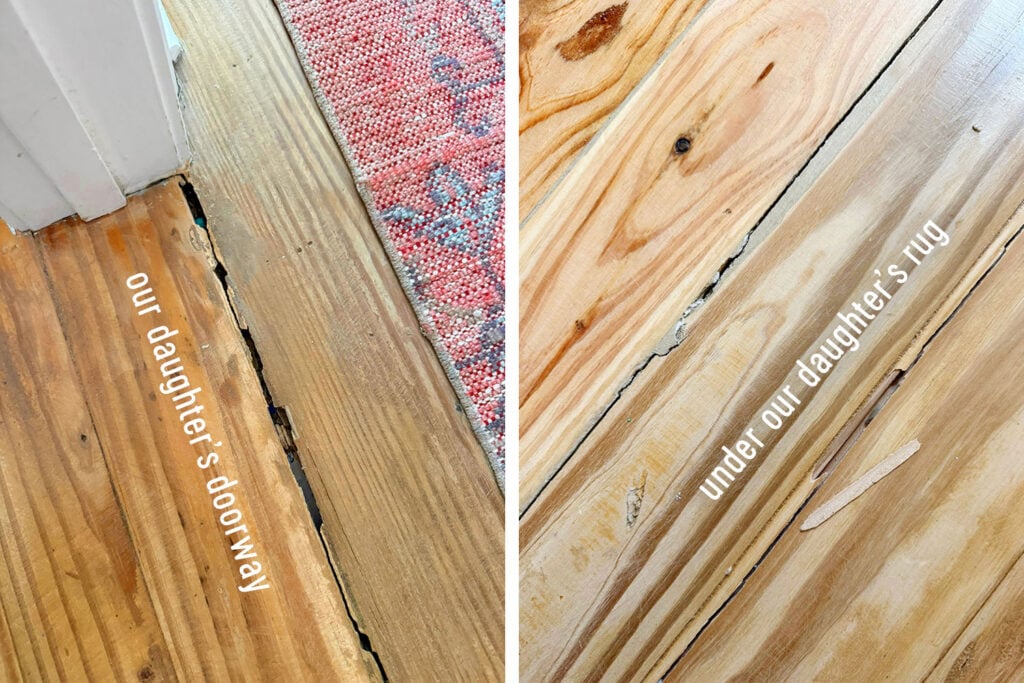
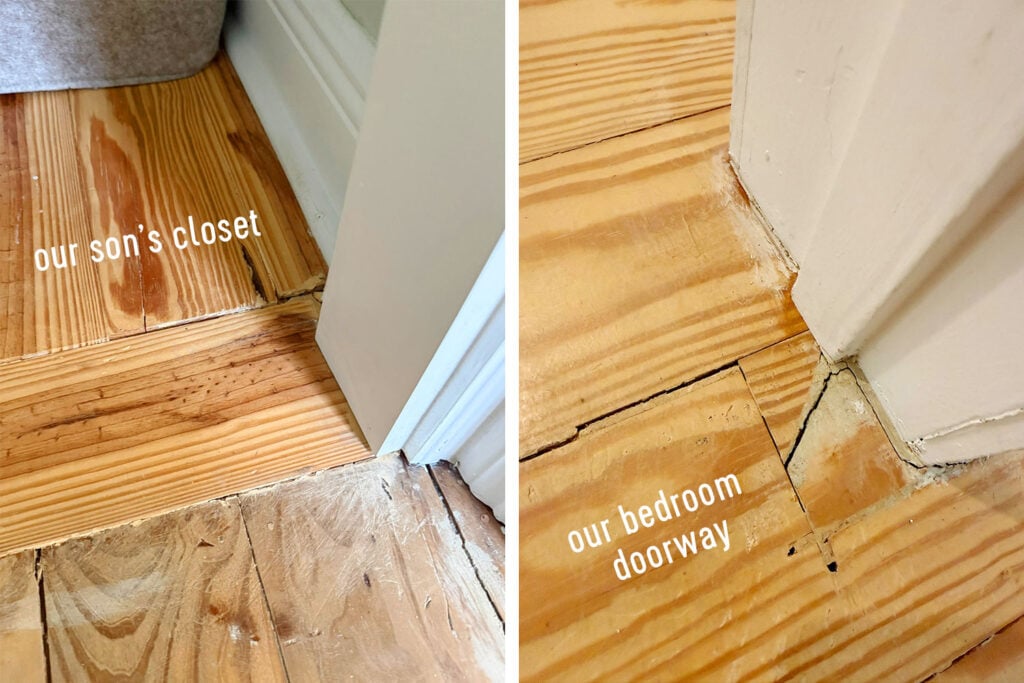
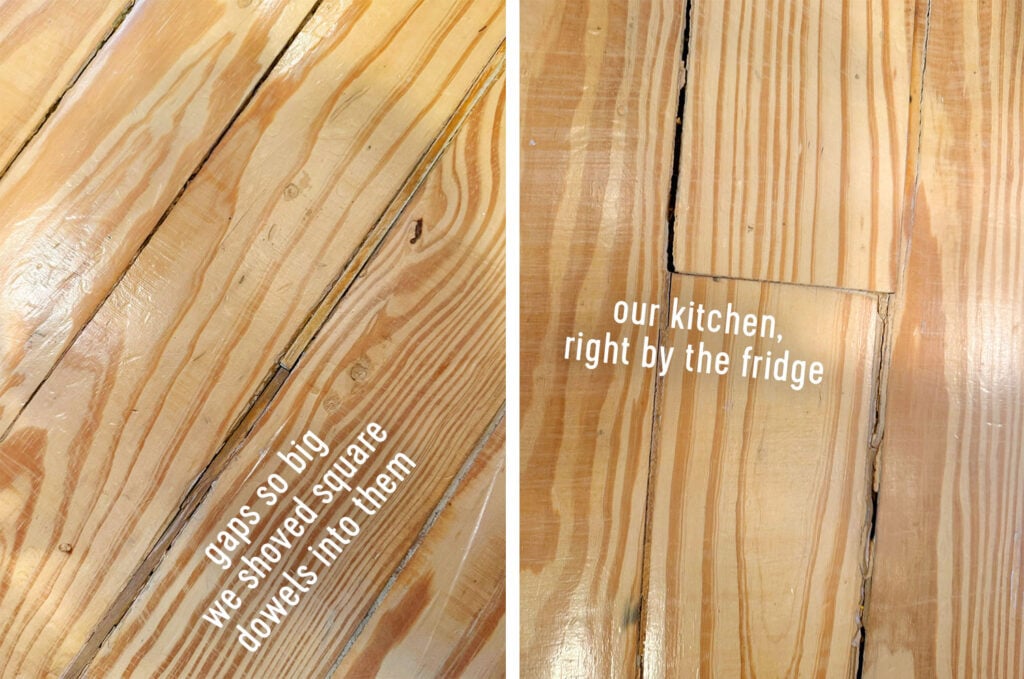
The second reason is that when you’re moving walls and building a new addition, the new layout can leave lots of gaps in an old floor, some of which you can see below. We also created a whole new room that had no flooring at all! So it would’ve been challenging to patch & match the existing floors for a seamless look.
But “challenging” doesn’t mean “impossible.” In fact, we’ve had hardwood floors patched in three of our previous homes with great results. So why not do that here?
Well, if we had loved how the old flooring had held up, it probably would have been worth the risk to us. We would have attempted to patch in new floors and hopefully could have gotten a reasonably close match. But in a nutshell, these floors were in rough shape. Like, embarrassingly bad in some spots – many of which you can see in the before & after video below.
Reason number three is the way they were poorly refinished, which became clearer over time. We actually considered replacing the floors even before we came up with our big idea for the renovation, but could never quite justify disrupting the house so much… which is why we waited until the house was already getting disrupted for our big “this is it” reno that accomplished all of our goals for the house at the same time (you can read more about those here).
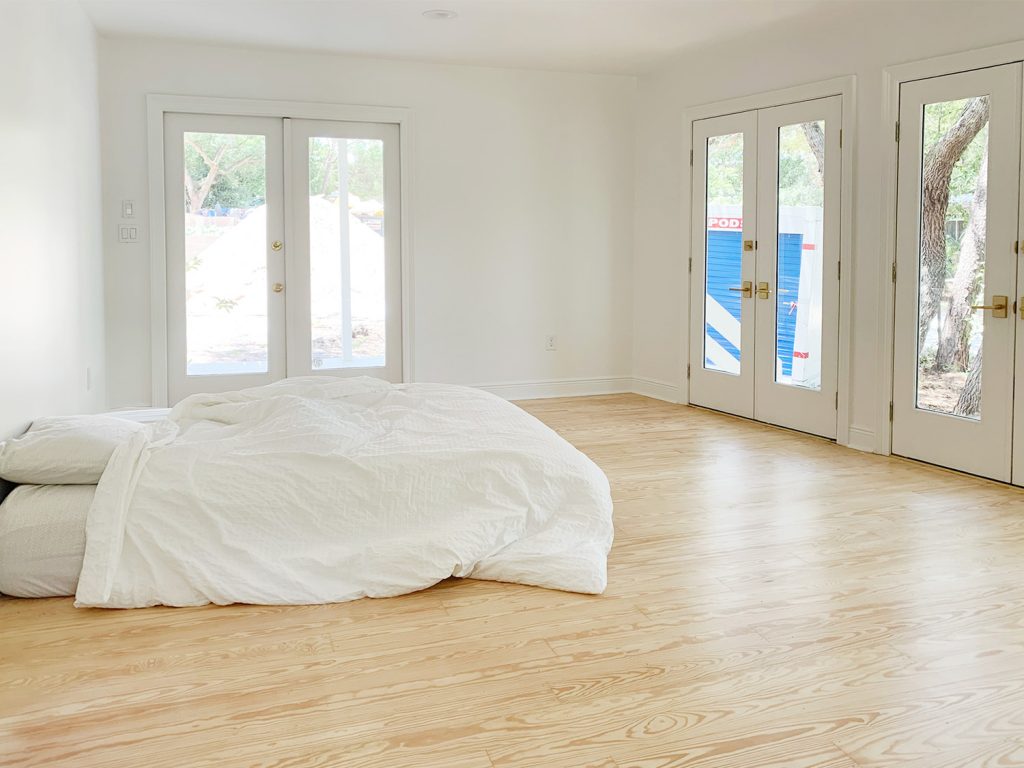
“But wait, weren’t you “thrilled” with these floors when you moved in?” We were! Initially we were in love with how the floors turned out! The color was EXACTLY what we had wanted, and we loved their laid-back, rustic charm. We were also generally giddy about our new home’s overall transformation. And in some rooms (like our bedroom), the floors were virtually perfect.
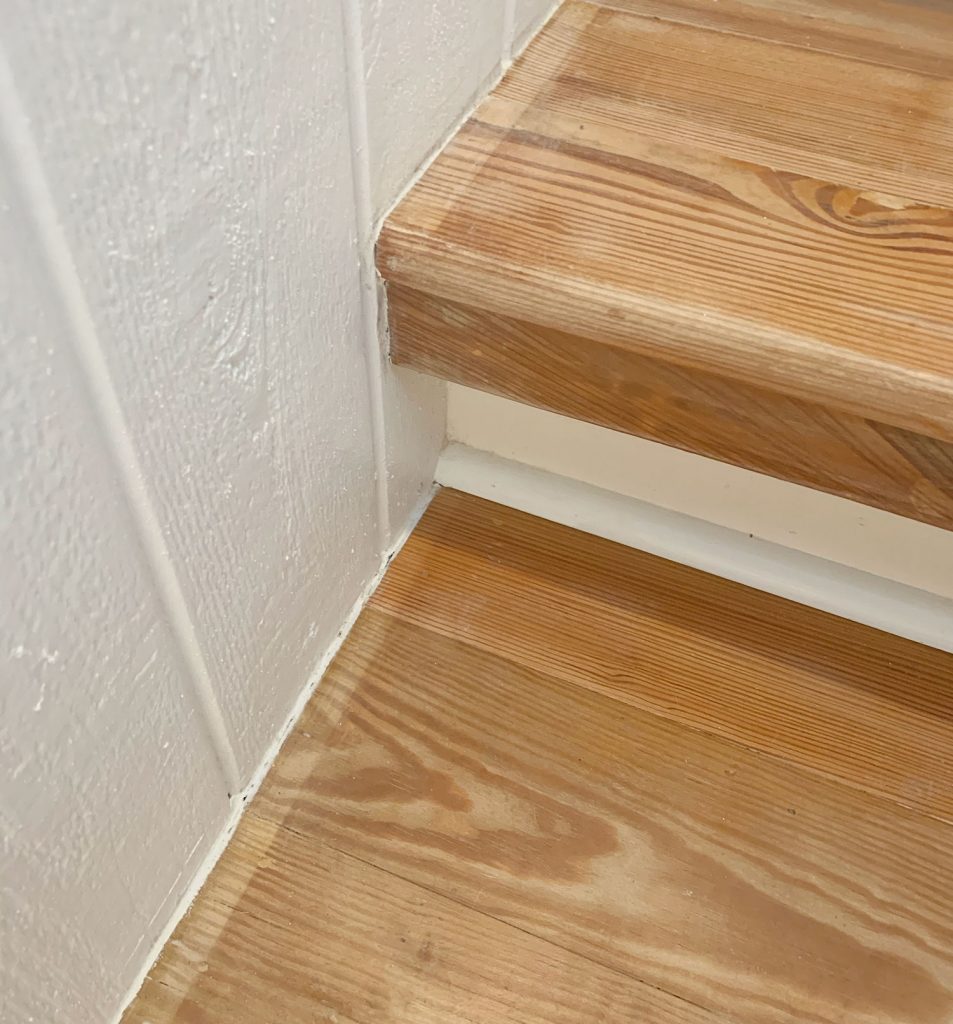
But the more time we spent living here, the more issues we noticed. We found areas that had been sanded, wood filled, and/or sealed poorly (like the edges of our stairs, which we ended up painting).
You may also remember from our home’s before photos that the previous owners had torn out a huge section of flooring due to a water leak. Many boards that the original contractor we used in 2020 had patched in began to separate and splinter over time. We believe they hadn’t been left to acclimate enough before installation, so as time went by, these separations and splinters occurred.
While the blame for this would fall at that contractor’s feet, we give him some grace because this was all happening during the height of the pandemic (Spring of 2020), which likely contributed to him rushing & not using skilled floor refinishers for the job. We (years later) learned that he used general handmen for our floor refinishing project instead of hardwood specialists, which is who we’ve always hired for every flooring reno we’ve done in previous houses.
COVID also prevented us from being on the ground in Florida to catch some of the initial issues sooner (we didn’t lay eyes on the refinished floors until the day we moved in!). And I’ll say it again: in some areas, like our bedroom, they looked absolutely beautiful at first! Look how beautiful and gap free they look in this photo:
If they had stayed that good-looking over time, we would have stuck with patching things in and trying to make them work. But instead, as the years rolled by, we spent hours wood-filling cracks, screwing down squeaky spots, and covering bad areas with rugs as they continued to separate and pop and splinter apart. And all the while, things like dropping an apple (yes, an apple) or someone stepping inside for a minute with heels on made actual visible dents and dings in the floor.
True story: we once had an insurance inspector come in and say “this house looks so new except for all the floor gaps.” Le sigh.
Ultimately, the floors were one big disappointment, between the not-as-durable material, the installation issues, and the patching challenges we knew we’d encounter in the upcoming renovation. But we’re not sorry we tried our best to save them back in 2020. It bought us 6 years to figure out our dream floor plan, which was the perfect moment to right this wrong at the same time.
So, long story long, the decision to fully replace this flooring was an easy (albeit sad) decision.
What Flooring Did You Use?
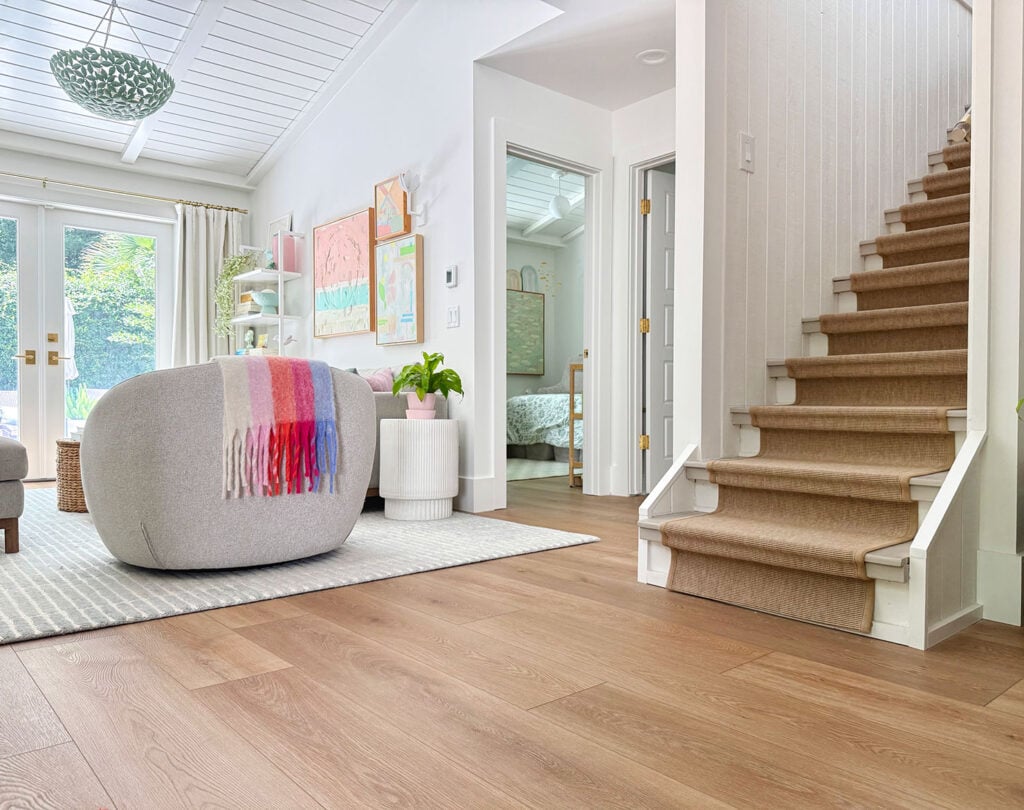
The new flooring is LVP, or luxury vinyl plank. Which I know will surprise some of you. In fact I think a ton of you might be hardwood purists like we were after decades of refinishing them and having great results. First let me say that LVP has come a long way. So if you saw it (or stood on it) 10 years ago, this is not anything like that stuff.
For this house and this climate/location our first instinct (of course) was to redo the whole downstairs with our favorite hardwood method (unfinished white oak, nailed down and then finished in place). But then we walked into a house that our new contractor was building during the planning process of this remodel (we didn’t use the same contractor we hired back in 2020, we found our new one through a local realtor & friend who personally had used him twice). Anyway, we walked into that house and we both said “we really like these hardwoods – lets just do this” and he’s said: “this is LVP.”
And then our heads exploded.
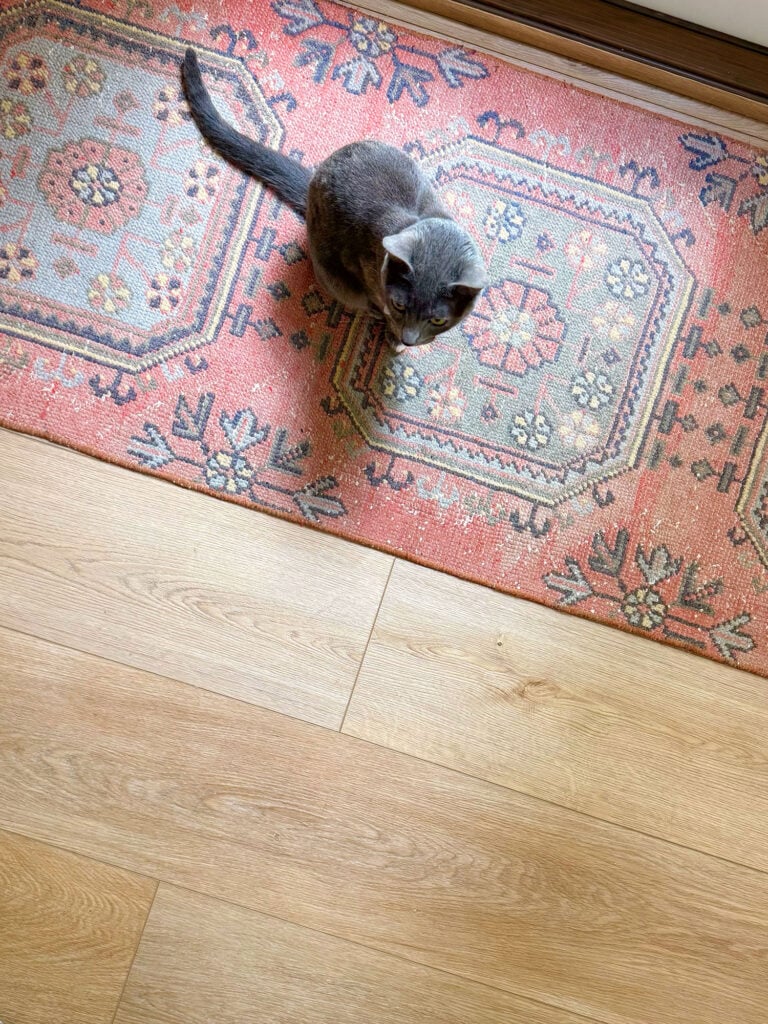
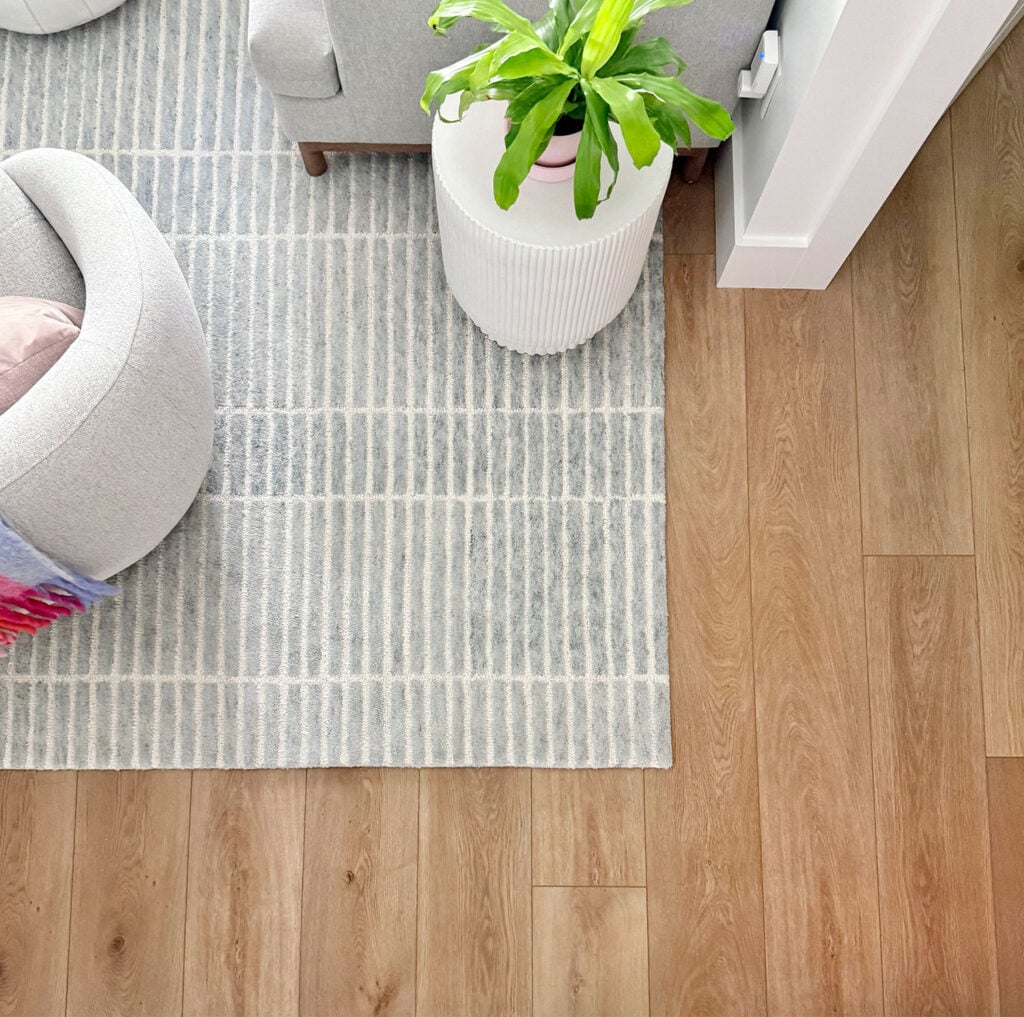
The specific name of it is V-Evo XL by Durato in the color “Biscotti.” We got it through our contractor, who got it through a local distributor – but I’ve found it listed in a couple of places online (here and here) with pretty terrible pictures, but you can order a sample and see it for yourself. If anyone spots it elsewhere, let me know, and I will update my links!
So yes, this is our first time using LVP, and we know some people have strong opinions about it, especially when compared real hardwood floors (which is typically our preference too – we totally get what you’re thinking). So let me walk you through how we came to this decision, and how we feel about our LVP floors now that they’re in and we’ve lived with them for around four months.
Why Did You Choose LVP?
In talking with our contractor at the big “these are LVP floors” reveal in that fancy new house he was building, we learned that LVP has two key advantages in a beach house like ours: ease of installation and long-term durability in our environment. LVP also tends to be cheaper than real hardwood (we spent A LOT LESS per square foot for this than we would on new hardwoods), which is not the only reason we’d ever pick something, but along with those two other perks it was compelling.
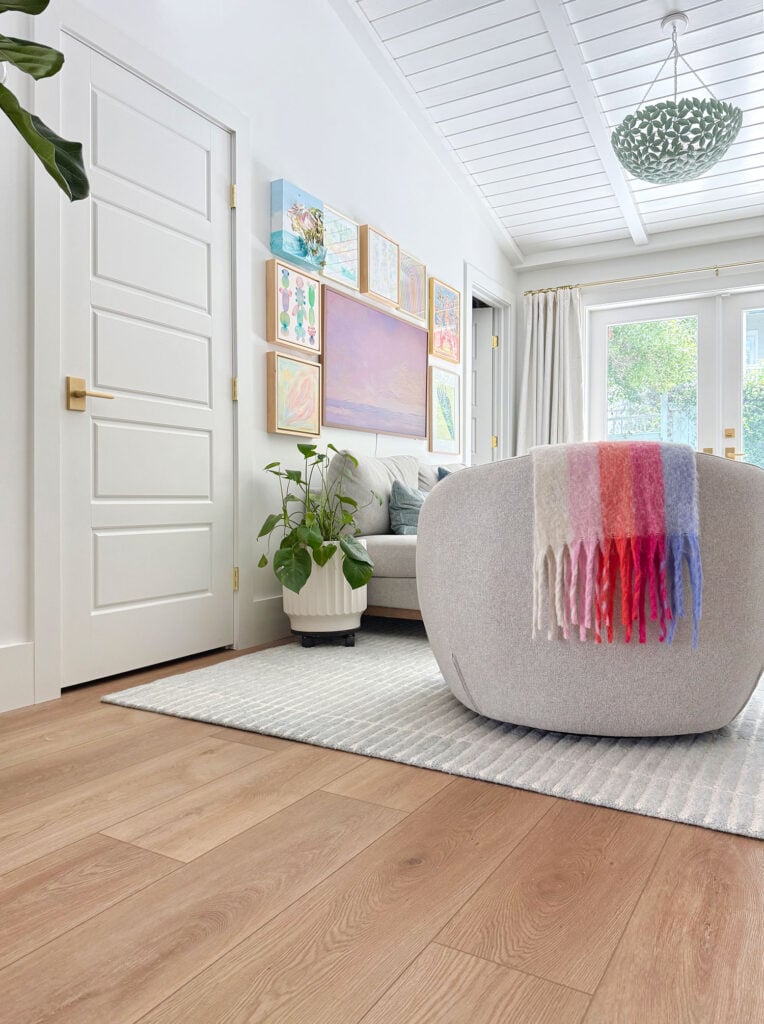
As for how it’s installed, LVP comes as pre-made planks that can be glued on or floated over a subfloor. Ours float, which makes it sound like they flex underfoot or sound hollow when you walk on them. Those were some of the misconceptions we had, but I’ve said it before and I’ll say it again: LVP has come a LOOOOOONG way. Our floors feel completely solid, there is no flex or bounce in them. Sherry was delighted to discover that when you walk on them in heels, they make that satisfying deep clacking sound like hardwood (not the lighter clicking sound that earlier floating laminate floors made).
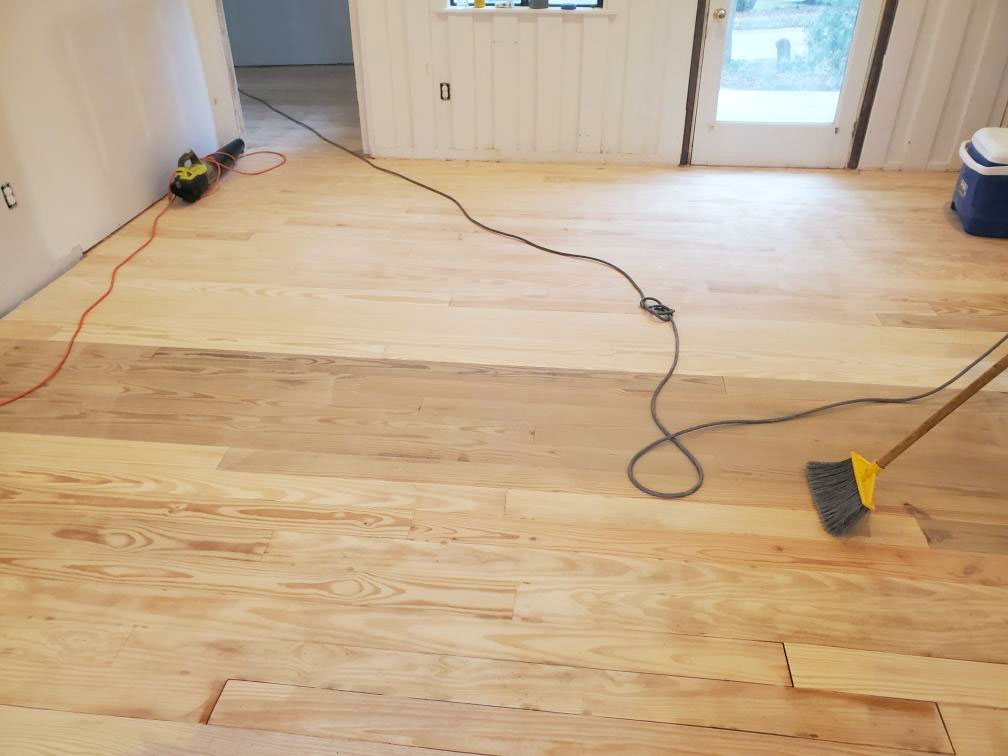
But back to the installation. Floating these pre-made planks makes for a much simpler and speedier installation than hardwoods, a contrast that we experienced firsthand when we did that in our last house. Those floors required 2+ weeks of laying, sanding, staining, sealing, and curing. It was long, messy, and smelly. By contrast, the LVP took one guy about 3 days – including demo of the old floor – and we could walk on it immediately. There was no smell, or extra waiting time to lay down rugs (I think they recommended 30 or even 45 full days of waiting to roll out rugs on our finished-in-place hardwoods in the last house).
Choosing LVP this time also meant the flooring contractor could work in sections. So rather than having to move EVERYTHING out of our entire house’s downstairs, we just shifted furniture around as he worked his way through the house, clearing one half of a room at a time.
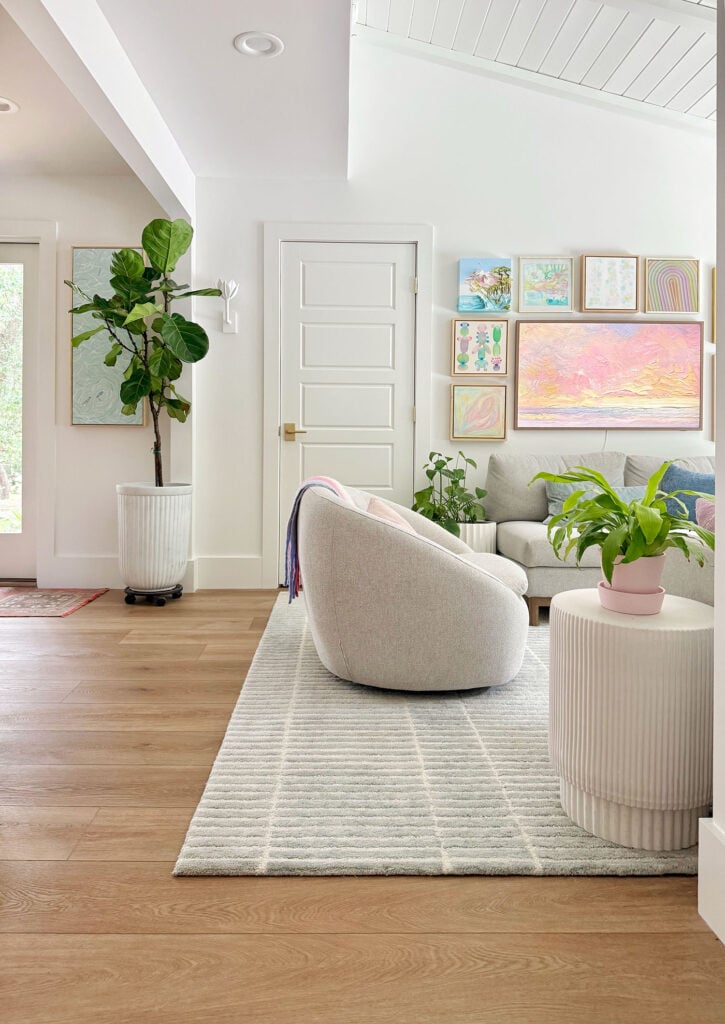
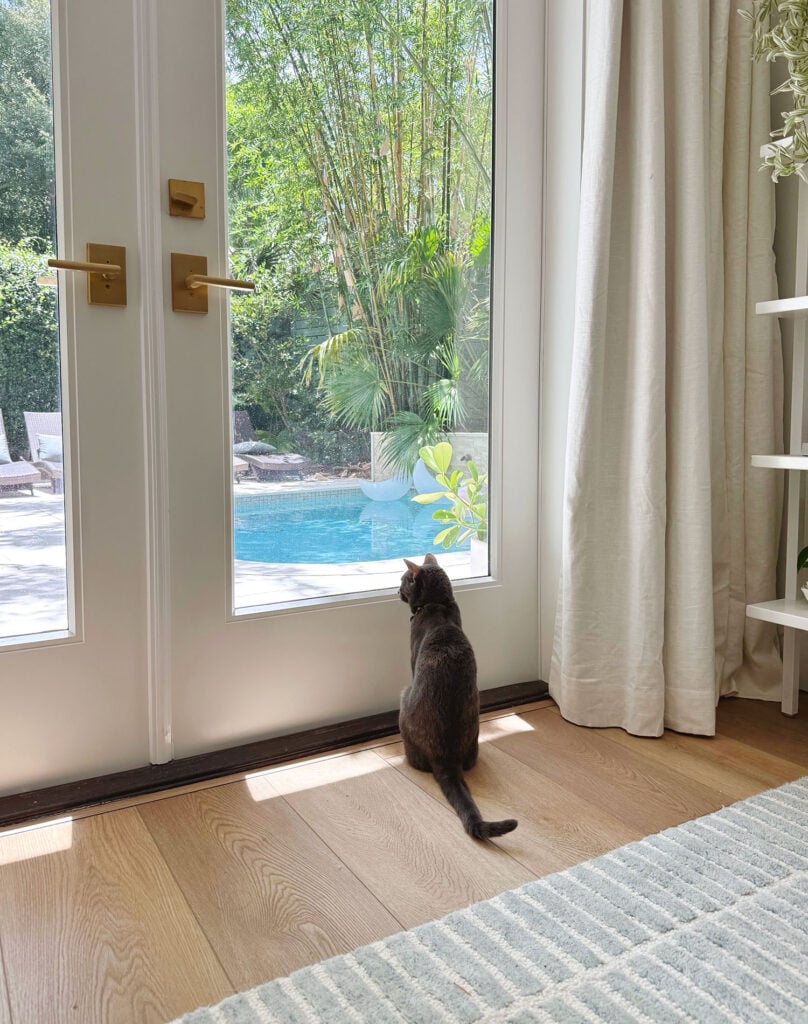
Beyond the easier install, LVP is also a popular choice because it’s waterproof and very durable. It’s a desirable choice in our area because you get the look of wood, but the performance of tile – so there’s less to worry about when people are coming in wet or sandy from the beach and pool. Another misconception we had is that the nice houses here don’t use LVP, they use hardwoods. Lo and behold, it’s so hard to tell that good-quality LVP isn’t hardwood, we learned that a ton of million-dollar beach homes are using LVP these days, because it looks like hardwood and it’s great for a beach environment.
So as much as we love real wood floors, all signs were pointing us towards LVP this time around, and we’re very very happy with our choice.
How’d You Pick This Specific Color and Size of LVP?
While standing in that home our contractor brought us to (wherein we basically screamed “we’ll have what they’re having!”) our contractor explained that we could choose narrower planks or other finishes. He even had a scrap piece of the Biscotti flooring from that new build and gave it to us while we were there. So we just that plank home and put it down in a few spots around the house and instantly knew it would be great.
We didn’t have any desire to change the thickness or the color at all, thanks to seeing it installed in the house he took us to. I’m sure we were also wowed by the general grandeur of this home (it was a fancy new build), but seeing it fully installed somewhere totally sold us on it. We decided not to overcomplicate this decision by comparing dozens of options when we had a perfectly great one laid out before us.
I can’t underline how much it helped to see it in person in another home first (and stand on it, and walk on it, and bend down and inspect it), thanks to our contractor bringing us to that house – so I’d highly recommend that if possible.
Do We Like Our LVP Floors?
Short answer: YES! Our old floors were long past the point of “rustic” and “charming” – so getting to walk on even, quiet, and won’t-give-you-a-splinter flooring feels downright luxurious. Longer answer: Yes, but there are certainly some differences from hardwood, if you’re a hardwood enthusiast like us. We’ll get into that more in a second.
First we just have to take a moment of appreciation. There’s no doubt that our new floors are the biggest unsung hero of this renovation. The new lounge area, extra bathroom, and open view to our pool are the more obvious improvements, but the new floors bring a sense of polish we could never achieve by patching in some yellow pine, just due to how it wears over time. No matter how well we worked to make them match and to get them glossy and crack-free at first, we knew that over time they wouldn’t hold up.
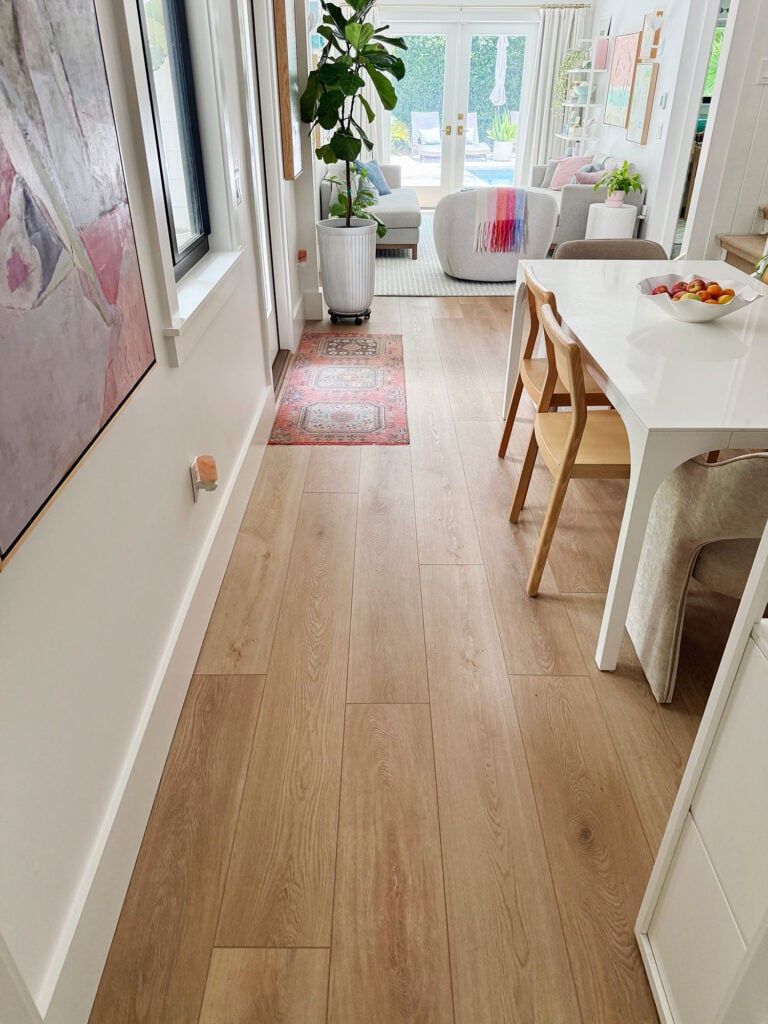
We’re really happy with the color, the wood grain, and the wide plank too. That last detail, in particular, helps our rooms feel larger than they actually are. They also make our home feel fresher and more updated. Our goal isn’t for a house to look brand new when renovating (we love an old house!) but having our floors look so bad a few years after refinishing was whispering “neglected” instead of “lovingly restored.” So going from a house that had annoying gaps and globs of wood putty to a fresh and smooth flooring result has been great.
And because this house was built in 1991 (it’s hardly historic), we love the wide planks, which are pretty popular in our area (this wasn’t an out-there choice). I will say, if you’ve got an older home or live in more historic area, I probably wouldn’t pick this wide-plank style. Maybe try something a bit darker and skinnier for less of a beach house vibe.
And now, here is what you’ve all been waiting for: the two things we had to adjust to with LVP after being such lifelong hardwood fans.
First, if you’re barefoot, the floors don’t feel like real hardwood on your feet. I can’t really describe how the feeling is different, just that it is. It’s not a bad thing, but you might be disappointed if you were hoping to pass them off as real hardwoods during a sockless party (you know, those are a thing, right?).
It’s like your feet can tell that the material is denser (it’s great for sound blocking) and not as slick. Our friends recently used LVP in their new home, and they observed the same thing about theirs. We both agreed that we love it overall, but it’s funny how your bare feet can tell the subtle difference in density and slickness. With socks and shoes on, you can’t tell though. At least we can’t.
The other adjustment was that it was sort of a rough feeling on our feet for the first week or so. It was as if the faux wood grain texture was just a little too “coarse” right out of the box. A few days after walking around on it, we’re not sure if our feet just adjusted or if we actually sanded it down a little with the foot traffic? Either way, then it wasn’t noticeable at all, and if you asked me now “does the floor feel rough?” I’d be like “…no. I’d describe it as smooth. Why would you say that?” It was just a funny and unexpected phenomenon at first, so heads up if you use the same or similar flooring!
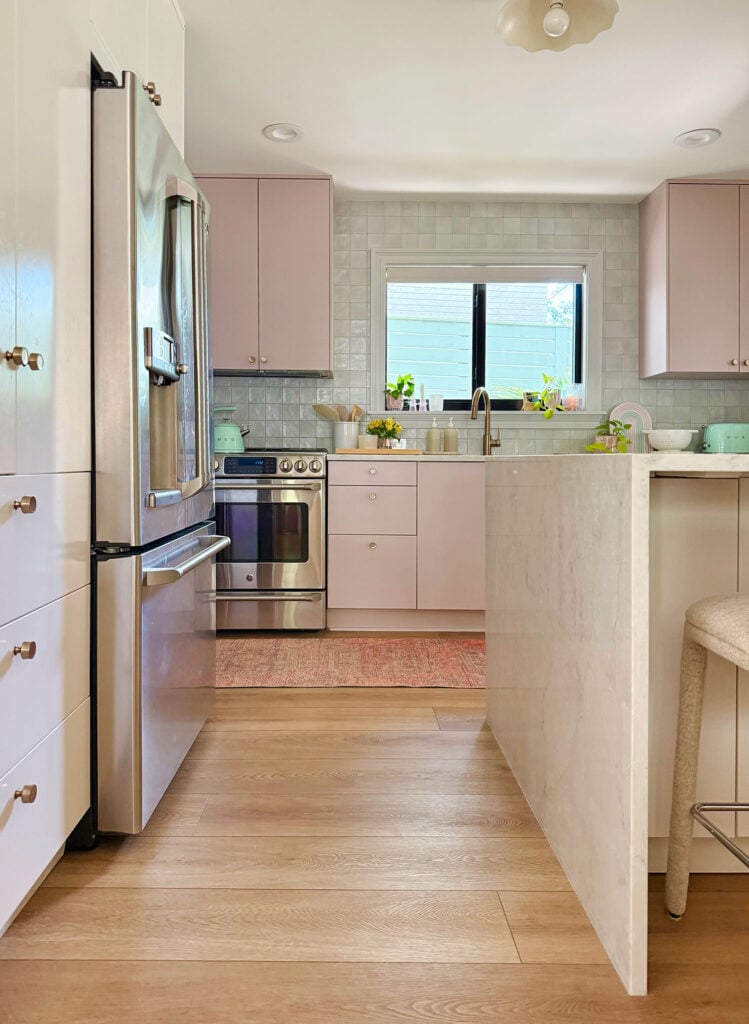
The last thing is that, while it is durable, LVP is not indestructable. We already put a small ding under our refrigerator because we forgot to raise the metal foot on the fridge before rolling it out. It’s not noticeable, but it was a reminder that (unlike hardwood) damage to LVP isn’t something you can sand or buff out. So that’s a mental adjustment for us, especially after so many years of trying to salvage our old floors with wood putty and wax. The good news is that we’ve dropped many things heavier than an apple without a dent, and Sherry has heel-tested them (no dings, wheras our previous floors looked hole-punched). So yes, overall they’re much more durable. We also have some extra boxes of this exact flooring (always get extra!) so we can replace any areas that might get dented somehow.
What About Your Upstairs Floors?
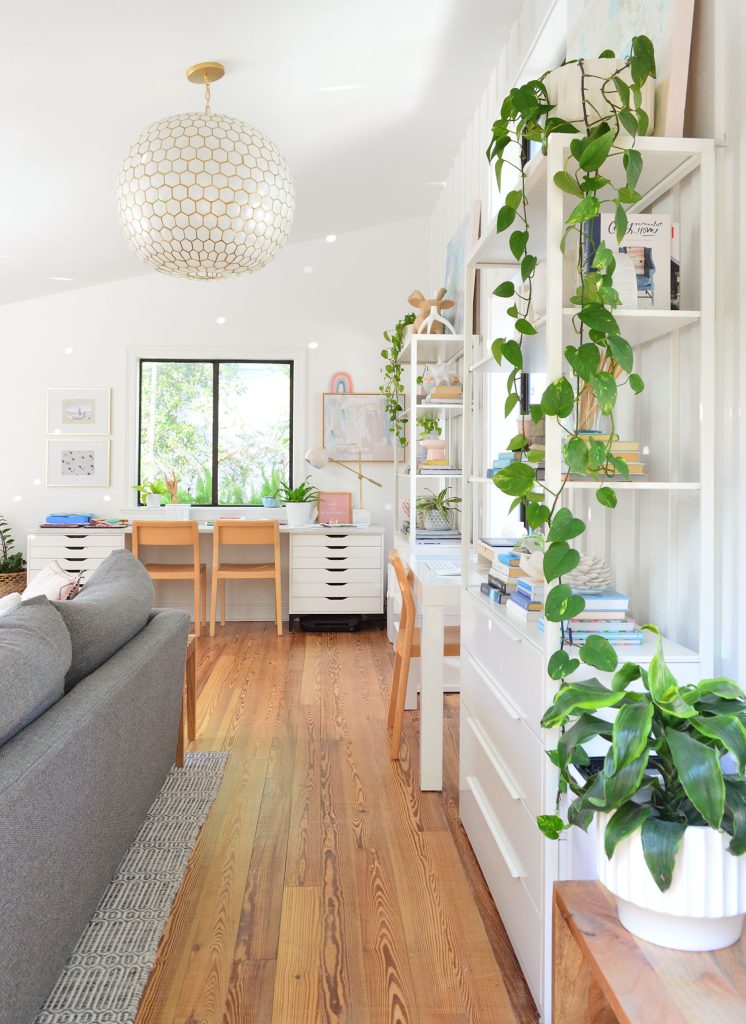
We didn’t do anything to our upstairs floors as part of this renovation. They’re still the original floors that we had refinished in 2020. Yes, that means our upstairs floors don’t match our downstairs floors. But… they never did! The upstairs has that much harder heart pine flooring that has held up a lot better than the regular pine downstairs.
Look ma, no cracks!
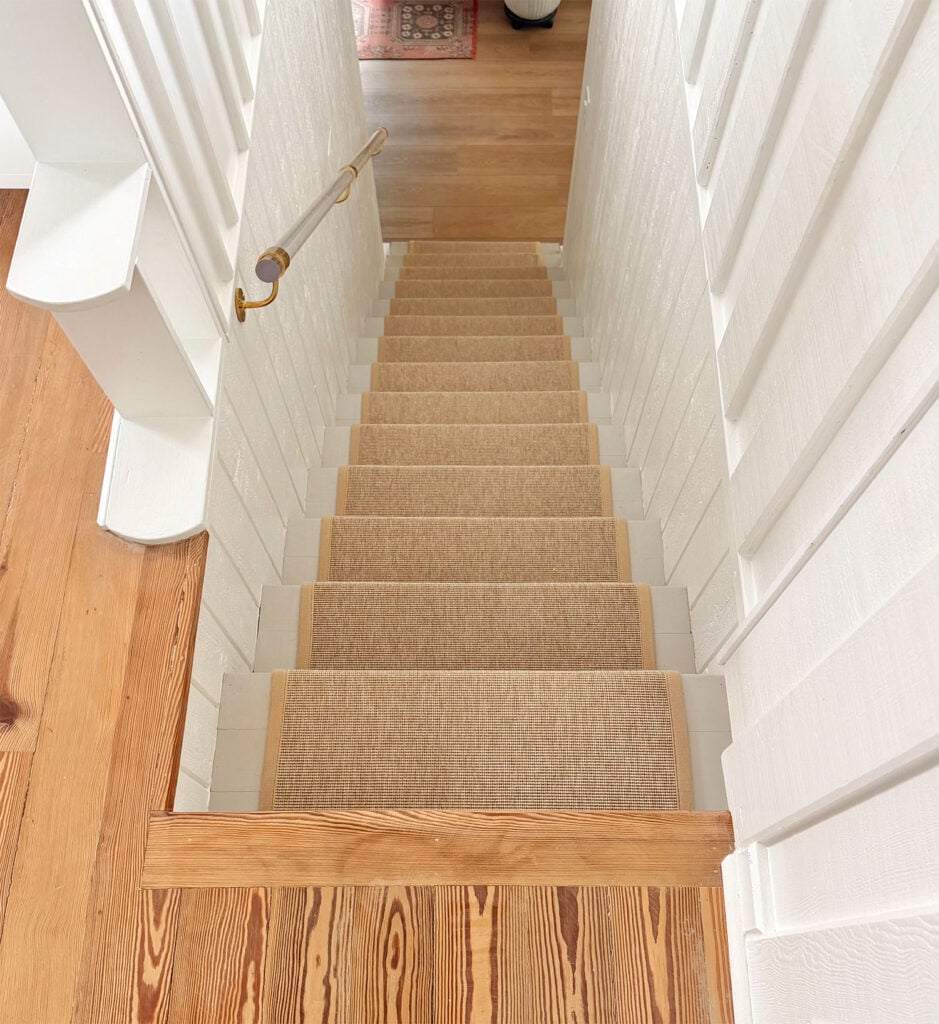
Maybe someday we’ll redo these to match the LVP downstairs if it bothers us over time, but the two materials never touch because we’ve got the painted stairs with the sisal runner separating them. Since the upstairs floors never pinch or splinter us, we don’t feel any urgency, and actually like that some of the orignal hardwoods get to live on up there.
So that’s the 411 on our new floors. We’ll get back to work on that larger post about the rest of our renovation, including our new bathroom. It’s pretty wild how much has changed thanks to this project, and we’re so glad we waited over 5 years to do it so we could be sure exactly what we wanted to get out of the update. It has exceeded our expectations, and we both think that’s from living here so long and truly figuring out what issues nagged at us (and what things we guessed would be issues down the line but never actually were). Your vision and how you live in a house just gets clearer over time.
More Flooring Posts
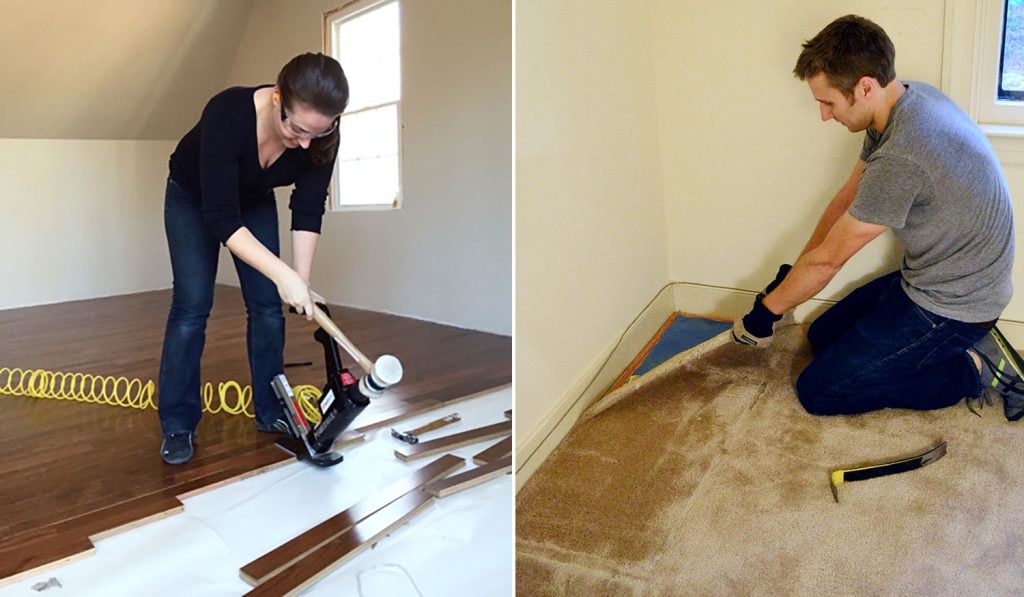
Here are more flooring posts you might enjoy, including some DIY tutorials for installing a click-and-lock floor like LVP.
A dining table is often one of the largest pieces of furniture in a room, so getting the size right can make a surprisingly big difference. Choose one that’s too large and you’ll find yourself squeezing past chairs and edging around corners. Go too small and the table can look rather lost, particularly in an open-plan kitchen-diner or a generous dining room.
The ideal dining table needs to do more than physically fit into the available space. There should be enough room to pull chairs out comfortably, walk behind seated diners and move between the table and surrounding furniture. It also needs to accommodate the number of people who normally eat there without taking over the room when it isn’t being used.
Fortunately, you don’t need an enormous dining room to create a comfortable eating area. By taking a few measurements and thinking about how you actually use the space, it’s much easier to work out which table dimensions, shape and style will suit your home.
Table of Contents
Quick Answer: What Size Dining Table Do I Need?
As a general guide, it’s recommended that you allow around 60cm of table width per person and aim to leave at least 90cm between the edge of the dining table and walls or other furniture wherever possible.
For comfortable everyday dining, typical table sizes are:
Number of people
Rectangular table
Round table
2–4 people
90–120cm long
80–100cm diameter
4 people
120–140cm long
100–110cm diameter
4–6 people
140–180cm long
110–130cm diameter
6 people
160–180cm long
120–140cm diameter
6–8 people
180–220cm long
140–160cm diameter
8 people
220–240cm long
160–180cm diameter
These measurements are a useful starting point rather than rigid rules. The best table size will depend on the shape of the room, the type of chairs you choose, the table-leg position and how much circulation space you need.
Start by Measuring the Room
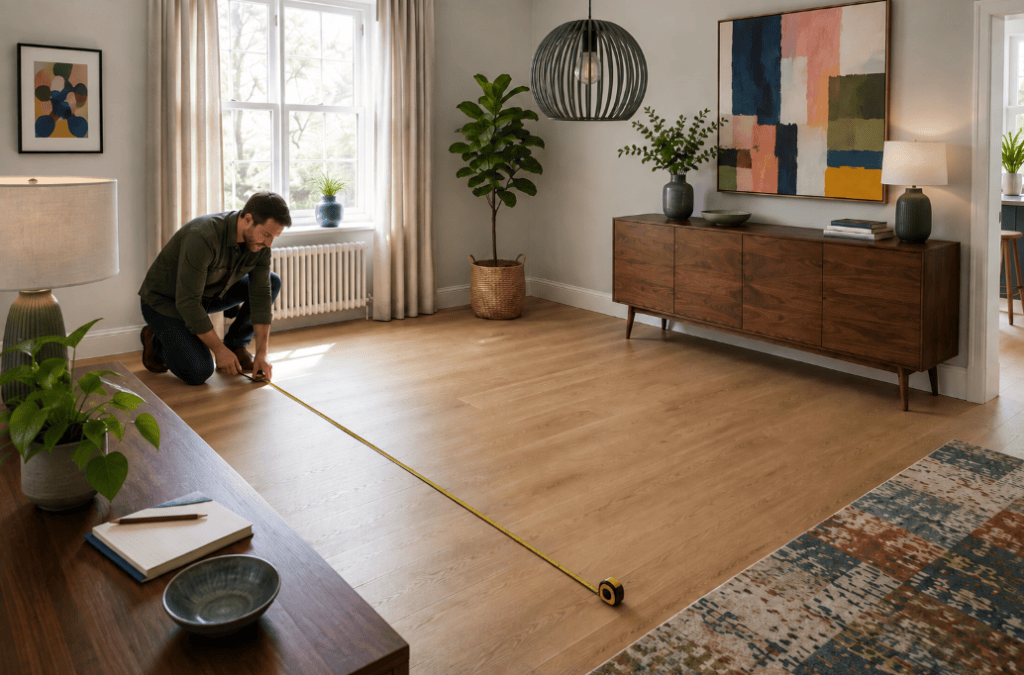
Before falling in love with a particular dining room table, measure the area where you intend to put it.
Measure the length and width of the usable floor space, rather than simply taking the dimensions of the entire room. In a kitchen-diner, for example, part of the room may already be needed for kitchen cabinets, an island or a walkway to the garden.
Make a note of anything that affects the usable space, including:
Doors and the direction in which they open
Radiators
Bay windows
Kitchen islands and peninsulas
Sideboards and display cabinets
Fireplaces
Routes between adjoining rooms
Patio or bifold doors
Built-in furniture
It’s particularly important to think about movement through the room. A table may technically fit into a space while making it irritatingly difficult to reach the kitchen or open the back door.
How Much Space Should You Leave Around a Dining Table?
This is one of the most important measurements to get right, especially in smaller spaces.
As a general rule, try to leave around 90cm between the edge of the table and the nearest wall or piece of furniture. This provides enough room for a dining chair to be pulled out and for someone to sit down reasonably comfortably.
If people regularly need to walk behind occupied chairs, 100–120cm is preferable.
You may be able to manage with around 75cm in a particularly compact dining area, but it will feel noticeably tighter. This is more suitable for an occasional dining space than somewhere used by a family several times a day.
Remember that these measurements should be taken from the table edge, not from the back of the chair when it’s tucked underneath.
A Simple Dining Table Space Calculation
There’s an easy way to estimate the largest comfortable table for your room.
Take the usable dimensions of the dining area and subtract approximately 180cm from both measurements. This allows for roughly 90cm of clearance on each side.
For example, if your dining area measures:
360cm x 300cm
subtract 180cm from each dimension:
180cm x 120cm
A table measuring around 180cm x 100cm could therefore work comfortably, leaving useful circulation space around it.
You don’t necessarily need to fill all the available space. In many rooms, choosing a slightly smaller table produces a more relaxed and balanced layout.
How Much Table Space Does Each Person Need?
For comfortable dining, allow approximately 60cm of table edge per person.
This gives most adults enough elbow room to eat without feeling crowded. If you have wide dining chairs or chairs with arms, allowing 65–70cm per person can be more comfortable.
Table depth matters too.
A rectangular dining table around 90cm wide works well for most homes because it gives diners sufficient space for plates and glasses while leaving room for serving dishes in the middle.
Tables around 75–80cm wide can work in smaller rooms, although the centre of the table will be more restricted. At the other end of the scale, very wide tables can make it surprisingly difficult to talk to or pass food to the person opposite.
Dining Table Sizes for 2, 4, 6 and 8 People
The number of people you want to seat will naturally influence your table size, but it’s worth distinguishing between everyday seating and occasional maximum capacity.
You don’t necessarily need an eight-seater permanently occupying the room just because you host eight people for family gatherings twice a year.
Dining Table for 2 People
For two people, a small table measuring around 70–80cm square can be perfectly adequate.
A round table of around 80–90cm diameter is another good choice, particularly in a small kitchen or dining corner.
If space permits, however, choosing something slightly larger gives you more flexibility for visitors, working from home or spreading out over breakfast at the weekend.
Dining Table for 4 People
For four diners, it’s helpful to look for approximately:
120–140cm x 75–90cm for a rectangular table
90–110cm for a square table
100–110cm diameter for a round table
A 120cm rectangular table can accommodate four people comfortably, although moving up towards 140cm gives everyone a little more breathing room.
Dining Table for 6 People
For six people, a rectangular table of approximately 160–180cm long and 80–100cm wide is a useful size.
For a round table, look at approximately 120–140cm diameter.
A six-seater is often a particularly practical choice for family homes because it provides enough everyday space without becoming excessively large.
Dining Table for 8 People
For eight people, a rectangular table will generally need to be approximately 200–240cm long.
A round eight-seater may need to be around 150–180cm in diameter, depending on the design.
At this size, remember to consider the room around the table as well as the table itself. Eight dining chairs require considerable space when they’re all occupied.
Rectangular, Round, Square or Oval: Which Table Shape Fits Best?
Table size isn’t the only consideration when looking for a new dining table. Choosing a shape that complements the proportions of your room can help you make much better use of the available floor space.
Rectangular Dining Tables
Rectangular tables are popular for good reason. They’re easy to position, widely available and work particularly well in long or rectangular dining rooms.
They can also accommodate larger groups efficiently because additional people can often be seated at either end.
A rectangular table is usually a natural choice for an open-plan kitchen-diner where the dining area follows the shape of a kitchen island or run of cabinets.
However, watch out for the corners in narrow spaces. If circulation routes pass close to the table, a rectangular design can sometimes feel more intrusive than a curved alternative.
Round Dining Tables
A round dining table can be an excellent space-saving solution for a small or roughly square dining area.
Without corners projecting into the room, it’s easier to move around and can make a compact space feel less crowded. Round tables are also very sociable, as everyone can see and talk to one another easily.
They’re particularly useful in breakfast areas, bay windows and smaller kitchen-diners.
There’s a limit to how effectively they scale up, though. Once a round table becomes very large, the distance across the centre can make passing dishes and holding conversations less convenient.
Square Dining Tables
Square tables work particularly well in square rooms and compact dining areas.
A table measuring around 90–110cm square can comfortably accommodate four people and creates an intimate arrangement.
Larger square tables are less common because they take up a considerable amount of floor space. A 150cm square table, for example, requires a much larger room than you might initially expect once you’ve allowed for chairs and circulation.
Oval Dining Tables
An oval dining table offers an appealing compromise between rectangular and round designs.
You get much of the seating capacity of a rectangular table but without hard corners projecting into circulation areas. This can make an oval table particularly useful in narrow dining rooms or busy open-plan spaces.
The curved shape can also visually soften a room dominated by straight kitchen cabinetry, shelving and architectural lines.
Don’t Forget to Measure Your Dining Chairs
One of the easiest mistakes to make when buying a dining table is measuring the table carefully but barely considering the chairs.
Dining chairs vary enormously in size.
A slim armless chair may be only around 45cm wide, while a generous upholstered dining chair with arms could be 60cm wide or more. Six bulky chairs therefore require significantly more room than six slim designs.
Measure the:
Overall chair width
Chair depth
Chair height
Seat height
Arm height, if applicable
Check that the chairs can slide underneath the tabletop without the arms hitting the table apron.
Also look at the position of the table legs. A 180cm table doesn’t automatically provide 180cm of usable seating space if chunky legs are positioned well inside each end.
This is particularly important if you’re planning to use mismatched dining chairs, as different chair widths and shapes can affect how many fit comfortably around the table.
Table Legs and Pedestal Bases Can Change How Many People Fit
Two tables with identical dimensions can offer very different amounts of usable seating.
Traditional four-legged tables may restrict where chairs can be positioned, especially when someone needs to sit close to a corner.
Trestle tables can have a similar problem if the supports are positioned close to the ends.
A pedestal table often provides more flexibility because there are no corner legs competing for space with diners’ knees and chair legs. This is one reason pedestal bases work particularly well for round tables.
Before buying, look underneath the table rather than focusing solely on its external measurements.
Should You Choose an Extending Dining Table?
For many modern homes, extendable dining tables offer the best balance between everyday comfort and occasional entertaining.
Rather than dedicating a large proportion of the room to a table for eight when only two or four people normally use it for everyday meals, you can keep the table relatively compact most of the time and extend it when guests arrive.
There are several types of extension tables available, including:
Butterfly extensions stored within the table
Removable extension leaves
Draw-leaf tables
Drop-leaf tables
Console tables that convert into dining tables
When measuring for an extending table, always check its fully extended dimensions.
It’s no use having a clever table that seats eight if extending it blocks the kitchen doorway or leaves guests trapped against the wall.
Also check where the extension leaves are stored. Some fit neatly inside the table, while others need to be kept elsewhere, so ensure you have somewhere suitable and easily accessible to store the extendable sections.
Choosing a Dining Table for a Small Space
A small dining area doesn’t necessarily mean sacrificing comfortable dining.
The key is to avoid choosing furniture that’s unnecessarily bulky.
Consider tables with slender legs, pedestal bases or visually lightweight materials. Being able to see more floor underneath and around the furniture can help a compact room feel more spacious.
Round and oval tables are particularly useful where circulation is tight because there are no sharp corners to negotiate.
An extending table is another practical option. Alternatively, a drop-leaf design can sit against a wall when not in use.
You can also combine conventional chairs with a dining bench. A bench can often be pushed completely underneath the table, freeing up valuable floor space between meals.
Don’t automatically choose the smallest table you can find, though. A tiny table surrounded by undersized furniture can actually emphasise the limited dimensions of the room. One appropriately scaled standard height table often looks more confident and considered.
Dining Tables for Open-Plan Kitchen-Diners
Open-plan spaces present a slightly different challenge because there may be plenty of overall floor area but several competing functions.
Your dining table needs to work alongside kitchen cabinetry, islands, sofas, doors and major circulation routes.
Start by identifying the boundaries of the dining zone rather than treating the whole open-plan room as one large rectangle.
Pay particular attention to the distance between the table and a kitchen island. This is often a busy walkway, particularly when people are cooking, loading the dishwasher or opening drawers.
If stools are positioned at the island as well, allow for people sitting on both sides of the gap.
The shape of your table can also help define the dining zone. A rectangular table positioned parallel to an island creates a neat sense of order, while a round or oval design introduces softer lines and can distinguish the dining area from the kitchen.
A rug underneath the table can provide further visual definition, provided it’s large enough for the dining chairs to remain on the rug when they’re pulled out.
What About Dining Tables in Multi-Purpose Rooms?
Many dining tables have a second life as desks, homework stations, craft tables and places to sort out paperwork.
If that’s true in your home, factor it into your dining table size decision.
A table that’s just large enough for four dinner plates may feel frustratingly cramped when you’re using a laptop, notebooks and paperwork.
You may benefit from a slightly deeper or longer table, particularly if several people regularly use it simultaneously.
Consider storage too. A nearby sideboard or cupboard can prevent everyday work equipment from permanently colonising the dining table.
Try the Table Size on the Floor Before Buying
One of the simplest ways to avoid buying the wrong table is to recreate its footprint before ordering it.
Use masking tape or painter’s tape to mark the proposed table dimensions on the floor.
Then place your existing chairs around the outline, if you have them, and pull them out as though someone were sitting down.
Walk around and assess the room layout.
Can you comfortably get to the kitchen? Can the doors open? Can someone walk behind a chair? Can you easily walk around the side of the table? Does the table look appropriately proportioned?
You can go a step further and place flattened cardboard boxes or sheets of newspaper within the taped outline. Seeing a solid area on the floor often gives a much stronger impression of scale than tape alone.
Live with the outline for a day or two if possible. You’ll quickly discover whether it’s positioned in the path you naturally take through the room and whether or not it’s the right table size for your home.
Common Dining Table Sizing Mistakes
Even when the table technically fits, a few common mistakes can make the finished dining area less comfortable.
Choosing for occasional guests rather than everyday life. If four people live in the house, you probably don’t need a permanent ten-seater simply because the whole family visits at Christmas. An extending table is usually more practical.
Forgetting chair clearance. The table footprint is only part of the equation. Chairs need room to move backwards.
Ignoring circulation routes. Think about how people actually move between the kitchen, dining area, sitting room and garden.
Measuring the room but not the furniture. Sideboards, radiators and kitchen islands all reduce the usable floor area.
Ignoring table-leg positions. Legs can turn what appears to be a six-seater into a frustrating four-seater.
Choosing oversized dining chairs. Large upholstered chairs can be beautiful, but make sure there’s enough room for them around your chosen table.
Buying purely by seating capacity. A retailer’s “six-seater” isn’t a universal measurement. Always check the actual dimensions.
Dining Table Size Checklist
Before ordering your table, check:
I’ve measured the usable dining area, not just the entire room.
I’ve allowed approximately 90cm around the table where possible.
I’ve allowed extra space where people regularly walk behind chairs.
I’ve measured the dining chairs as well as the table.
I’ve checked the position of the table legs or pedestal.
I’ve considered doors, radiators and surrounding furniture.
I’ve checked important circulation routes.
I’ve considered how many people use the table every day.
I’ve considered an extending table if I only occasionally need extra seats.
I’ve checked the table’s fully extended dimensions.
I’ve marked the proposed dimensions on the floor before buying.
Finding the Right Balance
Choosing the right dining table size for a modern dining space is ultimately about balancing seating capacity with breathing space.
It’s tempting to buy the largest table that will physically fit into a room, but bigger isn’t necessarily better. A slightly smaller table surrounded by comfortable circulation space will usually make a dining area feel more inviting and easier to use.
Start with the people who eat at the table every day, allow roughly 60cm of table space per diner, and aim for around 90cm of clearance around the table wherever your room allows.
Then think beyond the measurements. Consider the shape of the room, the width of your chairs, the position of the table legs and the way people move through the space.
Get those details right and your dining table won’t simply fit your room — it will feel as though it was chosen specifically for it.
Molly Mae has become synonymous with cosy minimalism, and her recent bedroom transformation is no exception. She turned a cold and icy space into warm, old-money elegance.
If you’re in need of new bedroom ideas, influencer and businesswoman Molly Mae Hague has shown that you don’t need a full-blown renovation; a fresh lick of paint and a few design tricks can completely transform your sleep space.
The Ideal Home team raved about Molly’s last neutral bedroom, and this most recent transformation shows she’s not lost her gift. If you want warm, cosy bedroom inspiration, here’s why Molly Mae’s is where you should look.
Latest Videos FromIdeal Home
Posting the before-and-after photos on her home Instagram @mollymaison, Molly explained that while there was absolutely nothing wrong with the space before, she was planning to stay in her home for a long time, so she wanted something ‘that feels completely like us’.
There’s an undeniable difference between the two rooms. While the layout hasn’t changed, Molly Mae’s switch to warmer-toned colours and natural finishes gives the room a far cosier, yet luxurious look.
(Image credit: Future PLC / Maxwell Attenborough)
‘The original bedroom’s cool greys, reflective surfaces and sharper contrasts gave it a sleek, contemporary hotel feel, but it could also appear slightly icy and impersonal. The finished bedroom feels softer, warmer and much more established. The natural timber, creamy neutrals, layered textiles and traditional furniture shapes give it the character associated with the ‘old-money’ aesthetic,’ says Melanie Whetstone, in-house interior design expert at British Bedmakers Get Laid Beds. Melanie also designed the house prior to Molly Mae moving in.
‘The warmer scheme also feels better suited to the proportions of the room. The bed provides a strong visual anchor, while the deeper wood tones prevent such a large space from feeling empty or overly polished. It now feels like a private retreat rather than simply an impressive room.
Sign up to our newsletter for style inspiration, real homes, project and garden advice and shopping know-how
‘It is also a more tactile space. Timber grain, soft bedding, upholstery and layered fabrics bring sensory warmth, which is particularly important in a bedroom. The styling feels luxurious without being showy, and the combination of traditional forms with a restrained modern palette gives the room a timeless quality. Ultimately, it feels designed around rest rather than display.’
Is Molly Mae a good example to follow?
If you plan on decorating with neutrals, Molly Mae is always a good example to follow. She transformed her bedroom into a space that is both welcoming and screams old money sophistication.
And it’s for this reason that Marianne Shillingford, Creative Director and Colour Expert at Dulux, prefers the renovated bedroom, too.
(Image credit: Future PLC/James French)
‘They’re both beautifully considered, but for a bedroom I’d lean towards the new design. There’s something very comforting about those warm cream tones, particularly when they’re paired with natural materials and softer lighting. A bedroom is ultimately somewhere we want to unwind at the end of the day, and this palette creates that sense of calm without the room feeling bland or lacking in character,’ she says.
‘What works so well in the finished room is the layering. Rather than relying on one colour or one statement feature, you’ve got warm neutral tones sitting alongside wood, linen, soft upholstery and pools of lamplight, which gives the room depth without making it feel busy
‘It’s also a really timeless approach to decorating. When you build a decorating scheme around a considered palette and beautiful natural textures, rather than lots of competing trends, you create something that feels stylish now but will still feel lovely to live with for years to come.’
<aside data-article-category="all-rooms" data-block-layout="hero" data-block-type="featured-product" data-editorial-currency="GBP" data-editorial-merchant-name="From £25 at Next" data-editorial-price="25" data-hawk-json="{"product":{"variants":{"Default":{"image":{"copyright":"","height":2400,"id":"KGvMUPDGy2vecWY6RcsmKA","mimeType":"image\/jpeg","mos":"https:\/\/cdn.mos.cms.futurecdn.net\/v2\/t:600,l:0,cw:1800,ch:1800,q:80\/KGvMUPDGy2vecWY6RcsmKA.jpg","role":"","width":1800,"credit":"Next","alt":"Ivory Supersoft Brushed Cotton Plain Bed Set – Size Single","caption":"","crop":{"label":"1:1","left":0,"top":600,"cropWidth":1800,"cropHeight":1800,"quality":80}},"strapline":"
Treat yourself to some brushed cotton bedding to make your bed even more cosy and comfy.","brand":"","name":"Ivory Supersoft Brushed Cotton Plain Bed Set ","urlStyle":"","layout":"hero","noFollow":true,"noAffiliateTracking":false,"promoLabel":"","price":25,"salePrice":null,"currency":"GBP","linkLayout":"text","sponsored":false,"hawkProductNameMatchedCode":"","review":{"cons":[],"id":"","name":"","pros":[],"rating":0,"strapline":"","url":""},"id":"","externalId":"cf940a019838b601f62e1bbb8a77677601a76b20","lastCheckedPriceDate":"","link":{"url":"https:\/\/click.linksynergy.com\/deeplink?id=kXQk6%2AivFEQ&mid=53096&u1=hawk-custom-tracking&murl=https%3A%2F%2Fwww.next.co.uk%2Fstyle%2Fst555187%2Ff76274%3F","linkText":"From \u00a325 at Next","editorialMerchantName":"From \u00a325 at Next","merchantName":"Next UK","merchantId":491232,"merchantNetwork":"LSfutureusLlc","merchantUrl":"next.co.uk"}}}}}” data-link=”https://click.linksynergy.com/deeplink?id=kXQk6%2AivFEQ&mid=53096&u1=hawk-custom-tracking&murl=https%3A%2F%2Fwww.next.co.uk%2Fstyle%2Fst555187%2Ff76274%3F” data-link-merchant=”Next UK” data-link-text=”From £25 at Next” data-merchant-id=”491232″ data-merchant-name=”Next UK” data-merchant-network=”LSfutureusLlc” data-merchant-url=”next.co.uk” data-model-name=”Ivory Supersoft Brushed Cotton Plain Bed Set” data-name=”Product Block merchantlink widget” data-render-type=”fte” data-show-fallback=”button” data-widget-type=”merchantlink” class=”ecom-root”>
Treat yourself to some brushed cotton bedding to make your bed even more cosy and comfy.
While I normally opt for a splash of colour, I have to say Molly Mae has nailed the cosy neutral look. I’ll definitely be using her for inspiration for my own bedroom this autumn.
They may be slightly unexpected style icons, but Martin and Shirlie Kemp have been offering fans plenty of design inspiration this summer. The celeb couple’s fans have spent the summer swooning over the Kemps’ picturesque garden, admiring both their statement DIY water feature and, more recently, their ingenious pumpkin archway.
However, the design inspo doesn’t stop at their outside space. The Ideal Home team has already been impressed by the Kemps’ classic Shaker kitchen, and now it’s their restful bedroom that’s caught our eye. The vintage-inspired boudoir is a masterclass in creating a relaxing sleeping space, and it’s all down to Shirlie’s use of one of Farrow & Ball’s most popular colours.
In a social media post shared to her @maisonnumber9 Instagram account, Shirlie tells her followers about her bedroom redecoration project, and the star of the room is a decorative wooden headboard painted in a soft green shade.
Latest Videos FromIdeal Home
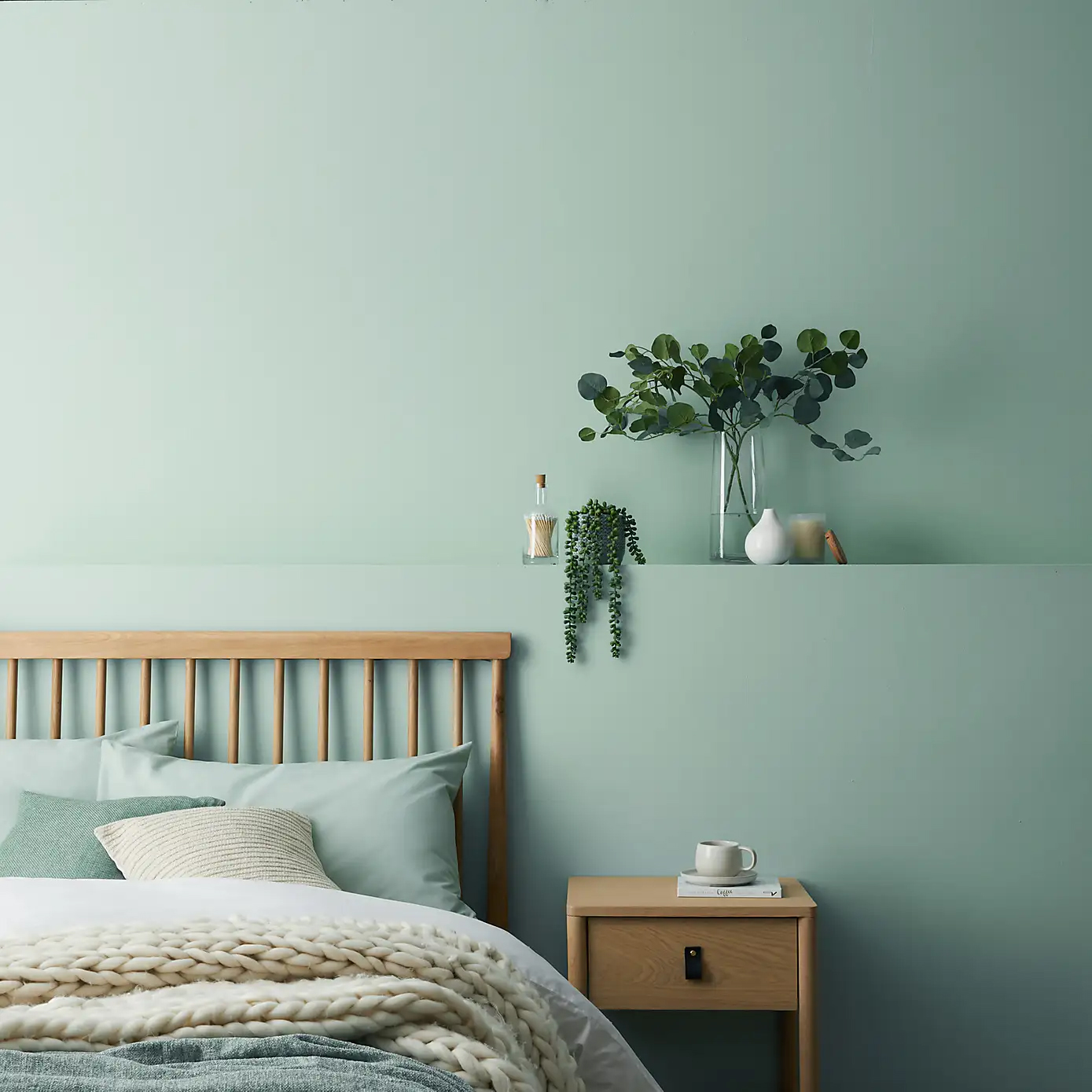
Her followers can’t get enough of the colourway, which Shirlie soon reveals is Farrow & Ball’s Green Blue No. 84. ‘The headboard needed a paint, so I used @farrowandball blue and green which matched the wallpaper beautifully!’, shares Shirlie.
Yes, the paint’s official title is ‘Green Blue’, not blue green, but it’s an easy mistake to make, and it’s clear which Farrow & Ball shade Shirlie plumped for. A delicate and slightly ‘dirty’ duck egg blue, Green Blue is pretty without being *too* pretty, and her followers are quick to praise its relaxing qualities.
‘That’s very pretty…a lovely restful colour!,’ says one follower. ‘Beautiful ✨want this same colour for my bedroom one day,’ shares another admirer.
Decorating Centre Online
Farrow & Ball ‘Green Blue No.84’ 2.5L
<aside data-article-category="all-rooms" data-block-layout="hero" data-block-type="featured-product" data-editorial-currency="GBP" data-editorial-price="79" data-hawk-json="{"product":{"variants":{"Default":{"image":{"copyright":"","height":713,"id":"uFJkGw96cHe3xcwr6tcuwK","mimeType":"image\/jpeg","mos":"https:\/\/cdn.mos.cms.futurecdn.net\/uFJkGw96cHe3xcwr6tcuwK.jpg","role":"","width":713,"credit":"Decorating Centre Online","alt":"Decorating Centre Online, Farrow & Ball 'Green Blue No.84' 2.5L","caption":""},"strapline":"
According to the brand, Farrow & Ball's 'Green Blue' can appear 'sometimes blue and sometimes green depending on the changing light throughout the day.'","brand":"Decorating Centre Online","name":"Farrow & Ball ‘Green Blue No.84’ 2.5L","urlStyle":"","retailer":"","layout":"hero","linkText":"","noFollow":true,"noAffiliateTracking":false,"promoLabel":"","price":79,"salePrice":null,"currency":"GBP","linkLayout":"text","sponsored":false,"hawkProductNameMatchedCode":"","review":{"cons":[],"id":"","name":"","pros":[],"rating":0,"strapline":"","url":""},"id":"","externalId":"f82d4c909575d85a9dbf1cc87ce50472363f03ea","lastCheckedPriceDate":"","link":{"url":"https:\/\/go.redirectingat.com?id=92X1623319&xcust=hawk-custom-tracking&xs=1&url=https%3A%2F%2Fwww.decoratingcentreonline.co.uk%2Fproducts%2Ffarrow-ball-green-blue-no-84&sref=https%3A%2F%2Fwww.idealhome.co.uk%2Fall-rooms%2Fbedroom%2Fmartin-and-shirlie-kemp-bedroom","merchantName":"decoratingcentreonline.co.uk"}}}}}” data-link=”https://go.redirectingat.com?id=92X1623319&xcust=hawk-custom-tracking&xs=1&url=https%3A%2F%2Fwww.decoratingcentreonline.co.uk%2Fproducts%2Ffarrow-ball-green-blue-no-84&sref=https%3A%2F%2Fwww.idealhome.co.uk%2Fall-rooms%2Fbedroom%2Fmartin-and-shirlie-kemp-bedroom” data-link-merchant=”decoratingcentreonline.co.uk” data-merchant-name=”decoratingcentreonline.co.uk” data-model-brand=”Decorating Centre Online” data-model-name=”Decorating Centre Online Farrow & Ball ‘Green Blue No.84’ 2.5L” data-name=”Product Block merchantlink widget” data-render-type=”fte” data-show-fallback=”button” data-widget-type=”merchantlink” class=”ecom-root”>
According to the brand, Farrow & Ball’s ‘Green Blue’ can appear ‘sometimes blue and sometimes green depending on the changing light throughout the day.’
Love the colour but not the price? Dunelm has a similar (and much more affordable) option in its 'Seafoam' matt emulsion paint.","brand":"Dunelm","name":"’Seafoam’ Matt Emulsion Paint 2.5L","urlStyle":"","retailer":"","layout":"hero","linkText":"","noFollow":true,"noAffiliateTracking":false,"promoLabel":"","price":17.6,"salePrice":null,"currency":"GBP","linkLayout":"text","sponsored":false,"hawkProductNameMatchedCode":"","review":{"cons":[],"id":"","name":"","pros":[],"rating":0,"strapline":"","url":""},"id":"","externalId":"a160555efe3a8230f58431014cf3f072f7f2f2d6","lastCheckedPriceDate":"","link":{"url":"https:\/\/www.prf.hn\/click\/camref:1011l5dAX6\/pubref:hawk-custom-tracking\/destination:https%3A%2F%2Fwww.dunelm.com%2Fproduct%2Fdunelm-matt-emulsion-paint-1000185240%3FdefaultSkuId%3D30732768%26colour%3DSeafoam%26option%3D2.5%2BLitre%2BPot","merchantName":"Dunelm","merchantId":579677,"merchantNetwork":"PHG","merchantUrl":"dunelm.com"}}}}}” data-link=”https://www.prf.hn/click/camref:1011l5dAX6/pubref:hawk-custom-tracking/destination:https%3A%2F%2Fwww.dunelm.com%2Fproduct%2Fdunelm-matt-emulsion-paint-1000185240%3FdefaultSkuId%3D30732768%26colour%3DSeafoam%26option%3D2.5%2BLitre%2BPot” data-link-merchant=”Dunelm” data-merchant-id=”579677″ data-merchant-name=”Dunelm” data-merchant-network=”PHG” data-merchant-url=”dunelm.com” data-model-brand=”Dunelm” data-model-name=”Dunelm ‘Seafoam’ Matt Emulsion Paint 2.5L” data-name=”Product Block merchantlink widget” data-render-type=”fte” data-show-fallback=”button” data-widget-type=”merchantlink” class=”ecom-root”>
Love the colour but not the price? Dunelm has a similar (and much more affordable) option in its ‘Seafoam’ matt emulsion paint.
Decorating Centre Online
Laura Ashley Paint – ‘Duck Egg’ Matt Emulsion 2.5L
<aside data-article-category="all-rooms" data-block-layout="hero" data-block-type="featured-product" data-editorial-currency="GBP" data-editorial-price="44" data-hawk-json="{"product":{"variants":{"Default":{"image":{"copyright":"","height":713,"id":"QUtYomn2eYyUGjfdd6Z6Sh","mimeType":"image\/jpeg","mos":"https:\/\/cdn.mos.cms.futurecdn.net\/QUtYomn2eYyUGjfdd6Z6Sh.jpg","role":"","width":713,"credit":"Decorating Centre Online","alt":"Decorating Centre Online, Laura Ashley Paint – 'Duck Egg' Matt Emulsion 2.5L","caption":""},"strapline":"
Laura Ashley's 'Duck Egg' is another pretty blue-green colour choice that creates a relaxing bedroom.","brand":"Decorating Centre Online","name":"Laura Ashley Paint – ‘Duck Egg’ Matt Emulsion 2.5L","urlStyle":"","retailer":"","layout":"hero","linkText":"","noFollow":true,"noAffiliateTracking":false,"promoLabel":"","price":44,"salePrice":null,"currency":"GBP","linkLayout":"text","sponsored":false,"hawkProductNameMatchedCode":"","review":{"cons":[],"id":"","name":"","pros":[],"rating":0,"strapline":"","url":""},"id":"","externalId":"e4fa950f01b9837a3bc6f9f844a88c88b1380755","lastCheckedPriceDate":"","link":{"url":"https:\/\/go.redirectingat.com?id=92X1623319&xcust=hawk-custom-tracking&xs=1&url=https%3A%2F%2Fwww.decoratingcentreonline.co.uk%2Fproducts%2Flaura-ashley-paint-duck-egg&sref=https%3A%2F%2Fwww.idealhome.co.uk%2Fall-rooms%2Fbedroom%2Fmartin-and-shirlie-kemp-bedroom","merchantName":"decoratingcentreonline.co.uk"}}}}}” data-link=”https://go.redirectingat.com?id=92X1623319&xcust=hawk-custom-tracking&xs=1&url=https%3A%2F%2Fwww.decoratingcentreonline.co.uk%2Fproducts%2Flaura-ashley-paint-duck-egg&sref=https%3A%2F%2Fwww.idealhome.co.uk%2Fall-rooms%2Fbedroom%2Fmartin-and-shirlie-kemp-bedroom” data-link-merchant=”decoratingcentreonline.co.uk” data-merchant-name=”decoratingcentreonline.co.uk” data-model-brand=”Decorating Centre Online” data-model-name=”Decorating Centre Online Laura Ashley Paint – ‘Duck Egg’ Matt Emulsion 2.5L” data-name=”Product Block merchantlink widget” data-render-type=”fte” data-show-fallback=”button” data-widget-type=”merchantlink” class=”ecom-root”>
Laura Ashley’s ‘Duck Egg’ is another pretty blue-green colour choice that creates a relaxing bedroom.
And her paint choice isn’t the only thing her keen-eyed followers are quick to appreciate about Shirley’s restful bedroom idea. The delicately patterned wallpaper is another hit.
Sign up to our newsletter for style inspiration, real homes, project and garden advice and shopping know-how
‘The wallpaper is beautiful,’ says one commenter, after Shirlie shares that it’s from one of her favourite brands.
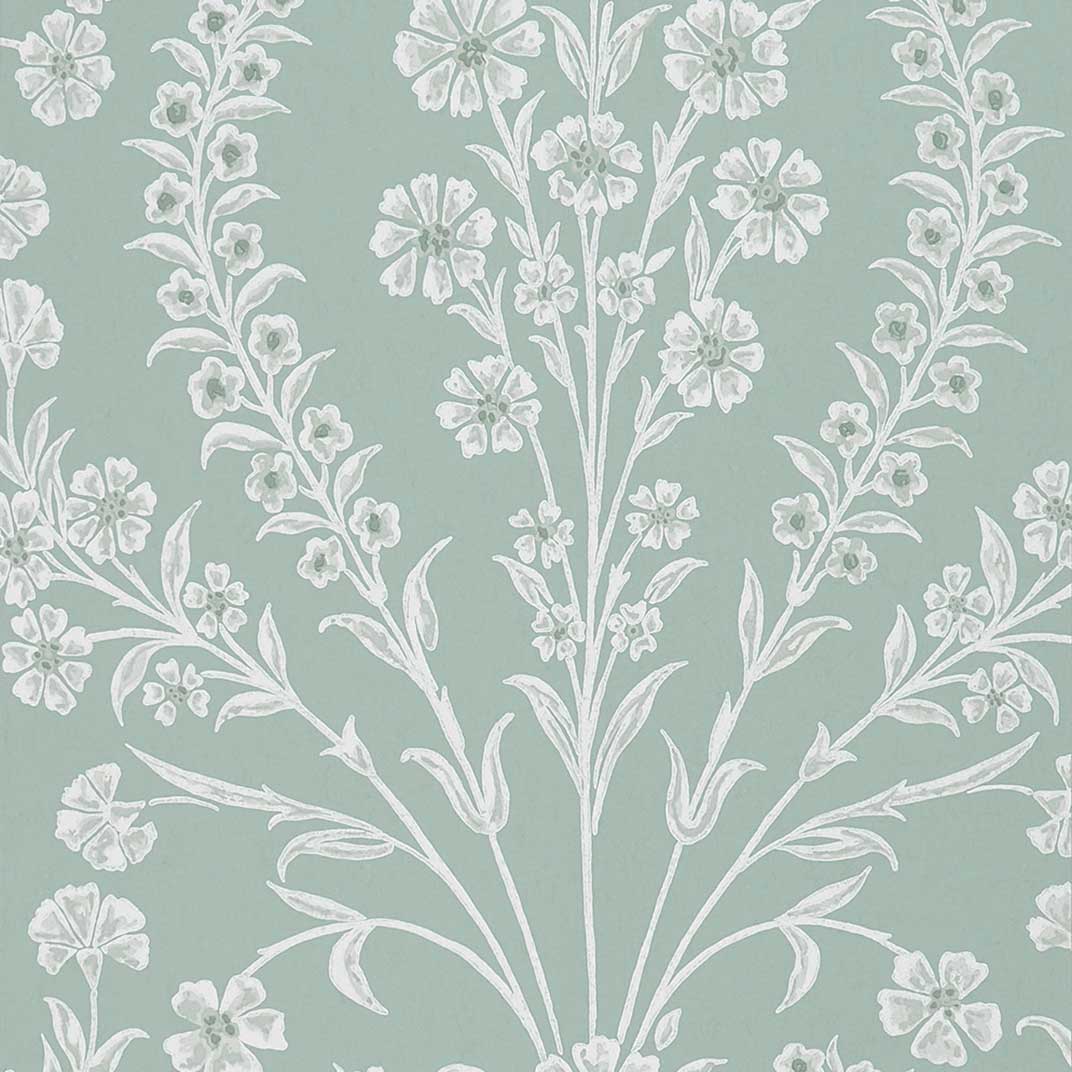
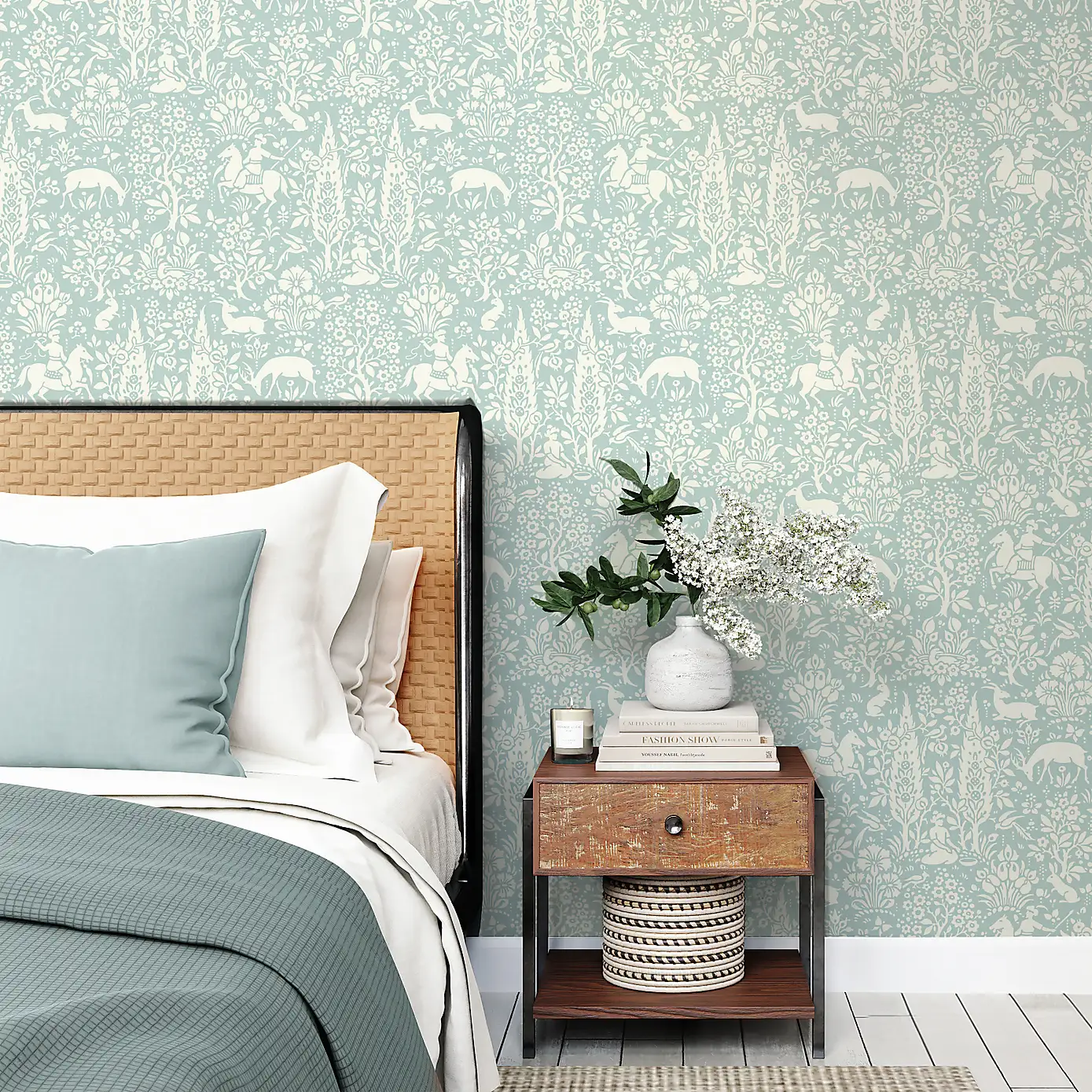
‘I’m a huge Nina Campbell fan, so I chose one of her wallpapers to decorate this bedroom, and I’m so pleased with it,’ says Shirlie in the Instagram post, ‘it has turned out prettier than I thought!’.
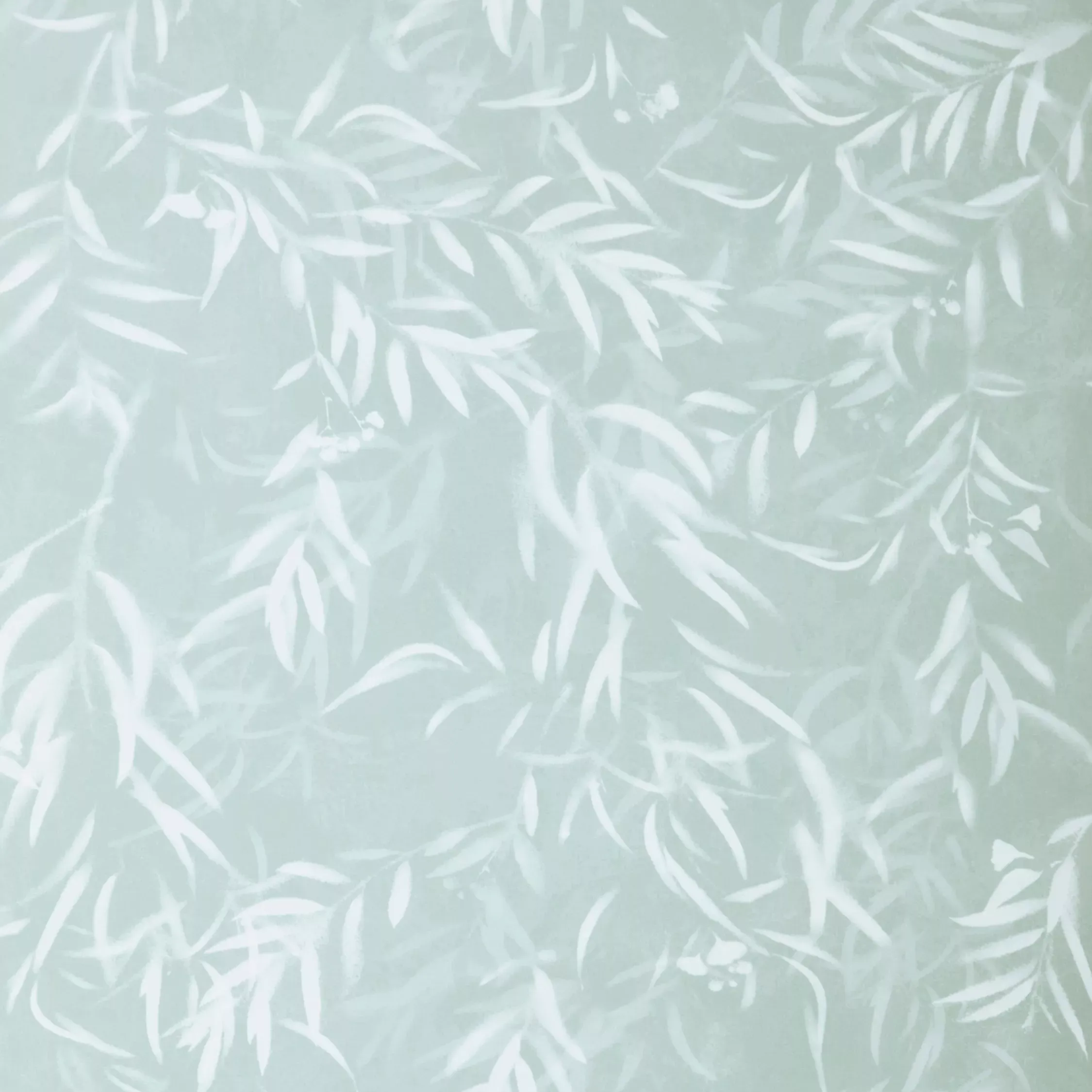
John Lewis' Kari Wallpaper in dusty green is also a pretty alternative that features restful foliage.","brand":"John Lewis","name":"Karri Wallpaper","urlStyle":"","retailer":"","layout":"hero","linkText":"","noFollow":true,"noAffiliateTracking":false,"promoLabel":"","price":10.8,"salePrice":null,"currency":"GBP","linkLayout":"text","sponsored":false,"hawkProductNameMatchedCode":"","review":{"cons":[],"id":"","name":"","pros":[],"rating":0,"strapline":"","url":""},"id":"","externalId":"5f3e22890bc0fbedecc08fe37fb0380ee930d4fb","lastCheckedPriceDate":"","link":{"url":"https:\/\/john-lewis-and-partners.pxf.io\/c\/221109\/871855\/12148?subId1=hawk-custom-tracking&sharedId=hawk-prefix&u=https%3A%2F%2Fwww.johnlewis.com%2Fjohn-lewis-karri-wallpaper-dusty-green%2Fp5130210","merchantName":"John Lewis","merchantId":179552,"merchantNetwork":"ImpactRad","merchantUrl":"johnlewis.com"}}}}}” data-link=”https://john-lewis-and-partners.pxf.io/c/221109/871855/12148?subId1=hawk-custom-tracking&sharedId=hawk-prefix&u=https%3A%2F%2Fwww.johnlewis.com%2Fjohn-lewis-karri-wallpaper-dusty-green%2Fp5130210″ data-link-merchant=”John Lewis” data-merchant-id=”179552″ data-merchant-name=”John Lewis” data-merchant-network=”ImpactRad” data-merchant-url=”johnlewis.com” data-model-brand=”John Lewis” data-model-name=”John Lewis Karri Wallpaper” data-name=”Product Block merchantlink widget” data-render-type=”fte” data-show-fallback=”button” data-widget-type=”merchantlink” class=”ecom-root”>
John Lewis’ Kari Wallpaper in dusty green is also a pretty alternative that features restful foliage.
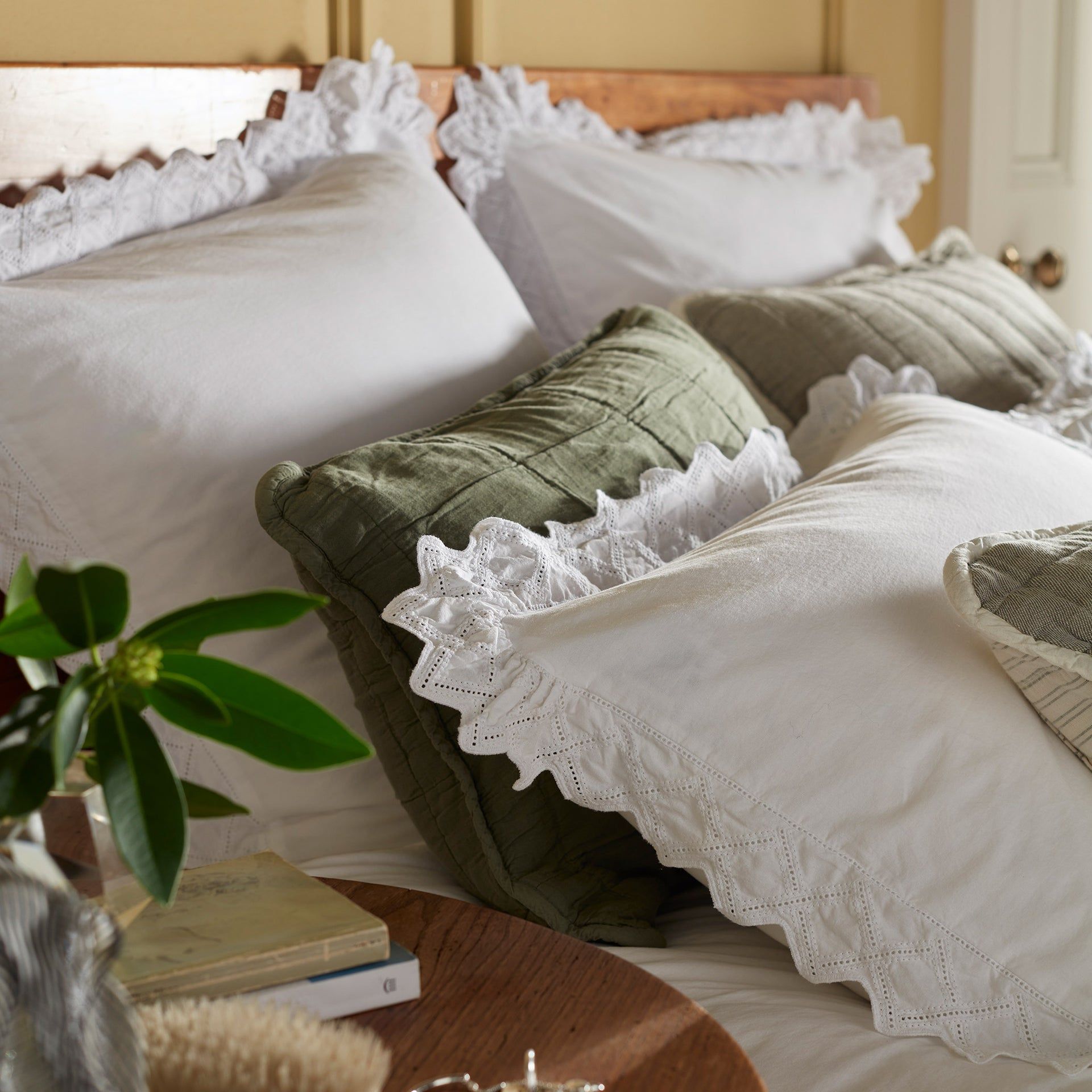
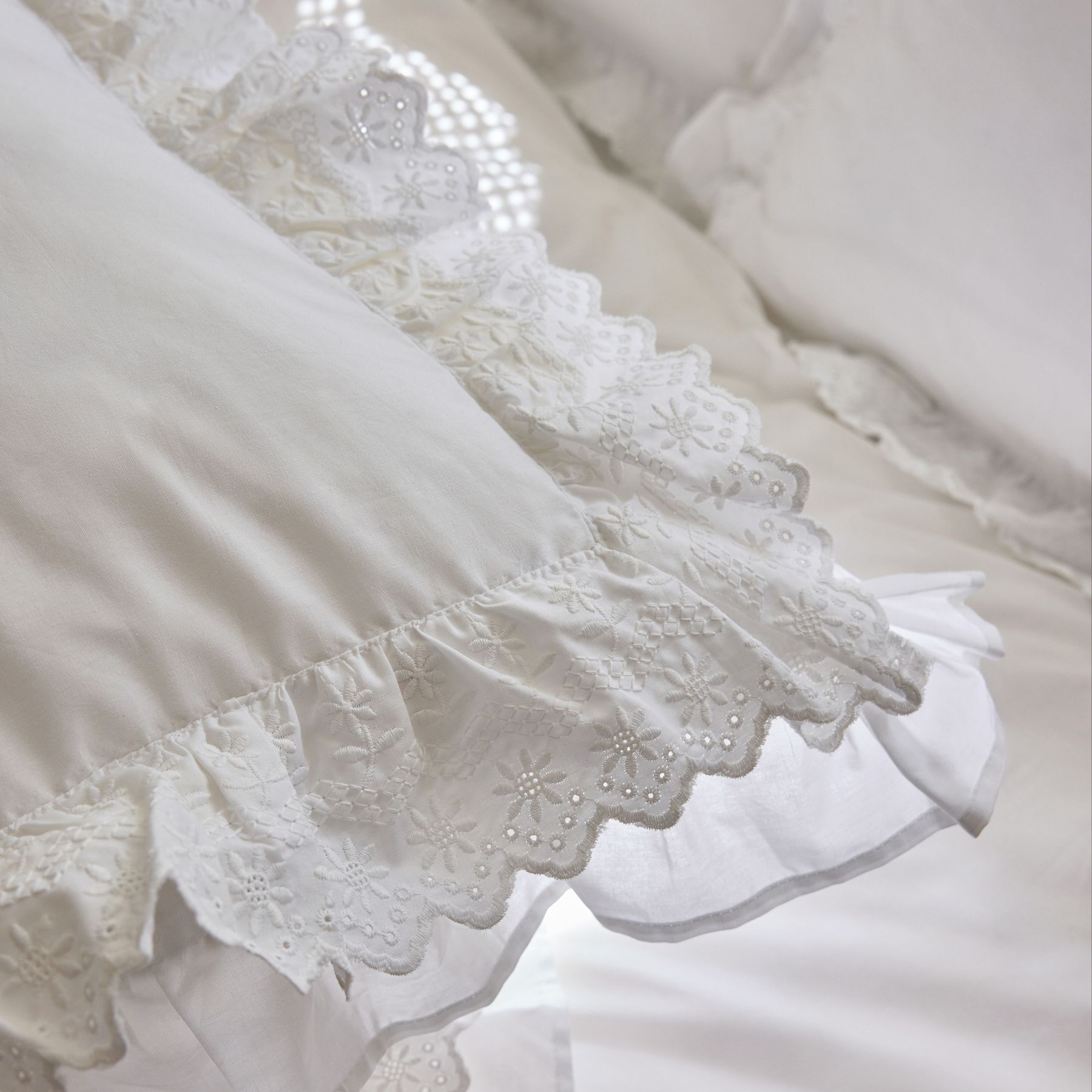
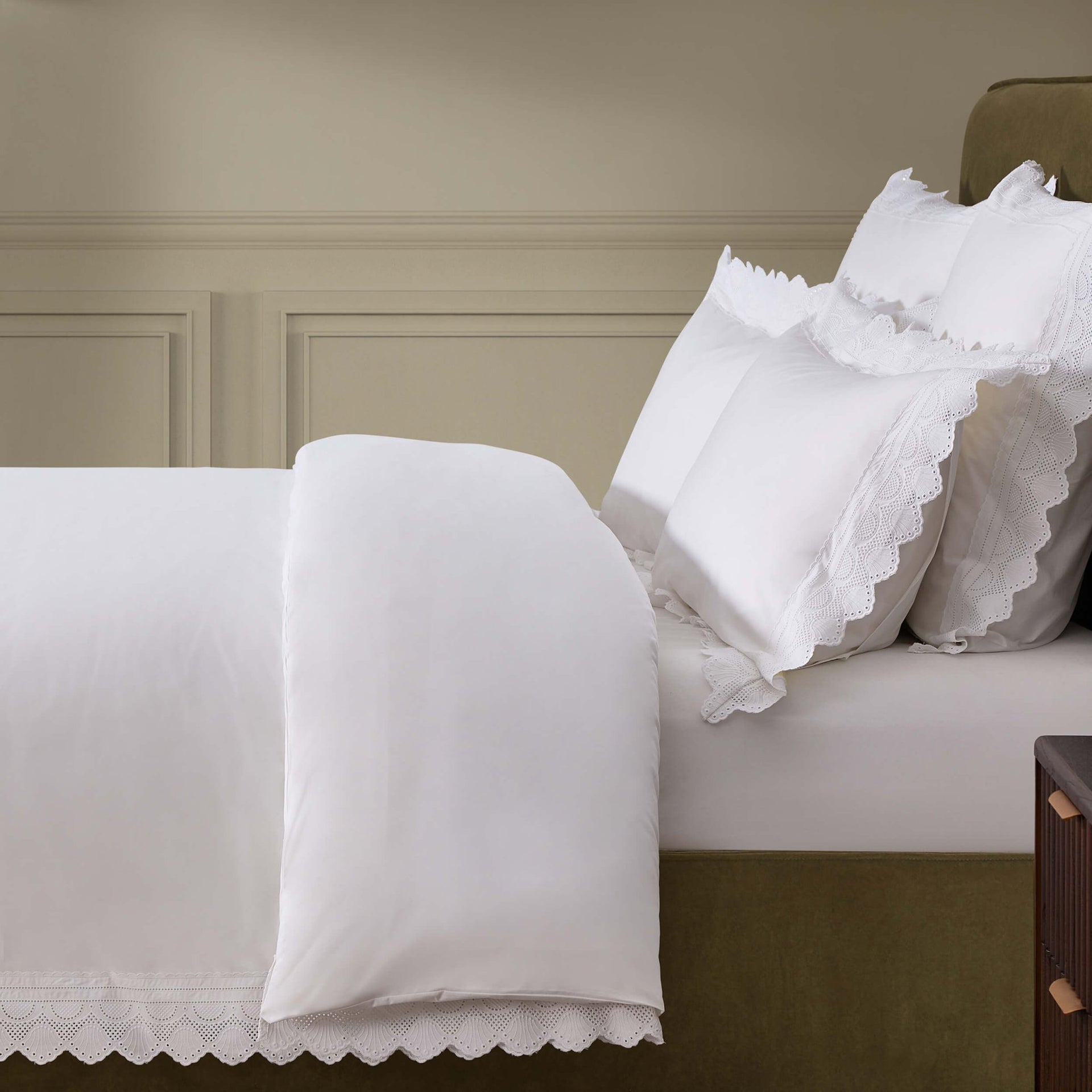
Personally, I’m also impressed by Shirlie’s choice of bed linen. She’s chosen to finish off her romantic Parisian-chic bedroom look with lace-edged pillowcases.
Pinterest named ‘laced up’ as one of the biggest trends of 2026, saying ‘lace sets the pace in 2026, bringing unexpected elegance to absolutely everything. This trend is a gentle reminder that more is more: especially when it’s this gorgeous.’
And I certainly think that lace-edged bed linen is the finishing touch to this pretty bedroom idea.
These vintage-inspired embroidered border pillowcases from Secret Linen Store recreate the romantic feel of Shirlie's bed.","brand":"Secret Linen Store","name":"White Valerie 100% Cotton Pillowcase","urlStyle":"","retailer":"","layout":"hero","linkText":"","noFollow":true,"noAffiliateTracking":false,"promoLabel":"","price":30.4,"salePrice":null,"currency":"GBP","linkLayout":"text","sponsored":false,"hawkProductNameMatchedCode":"","review":{"cons":[],"id":"","name":"","pros":[],"rating":0,"strapline":"","url":""},"id":"","externalId":"2763b3f6f7d1cdbb636b69bc78de45a12929c812","lastCheckedPriceDate":"","link":{"url":"https:\/\/go.redirectingat.com?id=92X1623319&xcust=hawk-custom-tracking&xs=1&url=https%3A%2F%2Fwww.secretlinenstore.com%2Fproducts%2Fwhite-valerie-100-cotton-pillowcase&sref=https%3A%2F%2Fwww.idealhome.co.uk%2Fall-rooms%2Fbedroom%2Fmartin-and-shirlie-kemp-bedroom","merchantName":"secretlinenstore.com"}}}}}” data-link=”https://go.redirectingat.com?id=92X1623319&xcust=hawk-custom-tracking&xs=1&url=https%3A%2F%2Fwww.secretlinenstore.com%2Fproducts%2Fwhite-valerie-100-cotton-pillowcase&sref=https%3A%2F%2Fwww.idealhome.co.uk%2Fall-rooms%2Fbedroom%2Fmartin-and-shirlie-kemp-bedroom” data-link-merchant=”secretlinenstore.com” data-merchant-name=”secretlinenstore.com” data-model-brand=”Secret Linen Store” data-model-name=”Secret Linen Store White Valerie 100% Cotton Pillowcase” data-name=”Product Block merchantlink widget” data-render-type=”fte” data-show-fallback=”button” data-widget-type=”merchantlink” class=”ecom-root”>
These vintage-inspired embroidered border pillowcases from Secret Linen Store recreate the romantic feel of Shirlie’s bed.
Next
Shabby Chic by Rachel Ashwell® Set of 2 White Broderie Anglaise Ruffle Pillowcases
<aside data-article-category="all-rooms" data-block-layout="hero" data-block-type="featured-product" data-editorial-currency="GBP" data-editorial-price="35" data-hawk-json="{"product":{"variants":{"Default":{"image":{"copyright":"","height":2400,"id":"iiaWnZRGPq6pw9iFhw4QxF","mimeType":"image\/jpeg","mos":"https:\/\/cdn.mos.cms.futurecdn.net\/v2\/t:160,l:0,cw:1800,ch:1800,q:80\/iiaWnZRGPq6pw9iFhw4QxF.jpg","role":"","width":1800,"credit":"Shabby Chic by Rachel Ashwell\u00ae","alt":"Shabby Chic by Rachel Ashwell\u00ae Set of 2 White Broderie Anglaise Ruffle Pillowcases – Size Oxford Pair","caption":"","crop":{"label":"1:1","left":0,"top":160,"cropWidth":1800,"cropHeight":1800,"quality":80}},"strapline":"
Next also has a similar look in this classic white ruffled Broderie Anglaise pillowcase set.","brand":"Next","name":"Shabby Chic by Rachel Ashwell\u00ae Set of 2 White Broderie Anglaise Ruffle Pillowcases","urlStyle":"","retailer":"","layout":"hero","linkText":"","noFollow":true,"noAffiliateTracking":false,"promoLabel":"","price":35,"salePrice":null,"currency":"GBP","linkLayout":"text","sponsored":false,"hawkProductNameMatchedCode":"","review":{"cons":[],"id":"","name":"","pros":[],"rating":0,"strapline":"","url":""},"id":"","externalId":"06785e28b8b52b5873c24e670db32bf0e4f2b54a","lastCheckedPriceDate":"","link":{"url":"https:\/\/click.linksynergy.com\/deeplink?id=kXQk6%2AivFEQ&mid=53096&u1=hawk-custom-tracking&murl=https%3A%2F%2Fwww.next.co.uk%2Fstyle%2Fsu486299%2Fad0026","merchantName":"Next UK","merchantId":491232,"merchantNetwork":"LSfutureusLlc","merchantUrl":"next.co.uk"}}}}}” data-link=”https://click.linksynergy.com/deeplink?id=kXQk6%2AivFEQ&mid=53096&u1=hawk-custom-tracking&murl=https%3A%2F%2Fwww.next.co.uk%2Fstyle%2Fsu486299%2Fad0026″ data-link-merchant=”Next UK” data-merchant-id=”491232″ data-merchant-name=”Next UK” data-merchant-network=”LSfutureusLlc” data-merchant-url=”next.co.uk” data-model-brand=”Next” data-model-name=”Next Shabby Chic by Rachel Ashwell® Set of 2 White Broderie Anglaise Ruffle Pillowcases” data-name=”Product Block merchantlink widget” data-render-type=”fte” data-show-fallback=”button” data-widget-type=”merchantlink” class=”ecom-root”>
Next also has a similar look in this classic white ruffled Broderie Anglaise pillowcase set.
DUSK
Alice 200 Thread Count Duvet Cover
<aside data-article-category="all-rooms" data-block-layout="hero" data-block-type="featured-product" data-editorial-currency="GBP" data-editorial-price="41" data-hawk-json="{"product":{"variants":{"Default":{"image":{"copyright":"","height":1920,"id":"peW4ttkutrftxMPte2Cp3S","mimeType":"image\/jpeg","mos":"https:\/\/cdn.mos.cms.futurecdn.net\/peW4ttkutrftxMPte2Cp3S.jpg","role":"","width":1920,"credit":"DUSK","alt":"Pair of Alice Oxford Pillowcases – 200 Thread Count – White","caption":""},"strapline":"
DUSK's Alice duvet cover continues the lace detail onto the duvet cover, and has matching pillowcases available.","brand":"DUSK","name":"Alice 200 Thread Count Duvet Cover","urlStyle":"","retailer":"","layout":"hero","linkText":"","noFollow":true,"noAffiliateTracking":false,"promoLabel":"","price":41,"salePrice":null,"currency":"GBP","linkLayout":"text","sponsored":false,"hawkProductNameMatchedCode":"","review":{"cons":[],"id":"","name":"","pros":[],"rating":0,"strapline":"","url":""},"id":"","externalId":"504f09ba948032a03ea365e6b438ceee855930c5","lastCheckedPriceDate":"","link":{"url":"https:\/\/www.awin1.com\/awclick.php?awinmid=20873&awinaffid=103504&clickref=hawk-custom-tracking&p=https%3A%2F%2Fdusk.com%2Fproducts%2Falice-200-thread-count-duvet-cover-white","merchantName":"Dusk.com","merchantId":188597,"merchantNetwork":"AW","merchantUrl":"dusk.com"}}}}}” data-link=”https://www.awin1.com/awclick.php?awinmid=20873&awinaffid=103504&clickref=hawk-custom-tracking&p=https%3A%2F%2Fdusk.com%2Fproducts%2Falice-200-thread-count-duvet-cover-white” data-link-merchant=”Dusk.com” data-merchant-id=”188597″ data-merchant-name=”Dusk.com” data-merchant-network=”AW” data-merchant-url=”dusk.com” data-model-brand=”DUSK” data-model-name=”DUSK Alice 200 Thread Count Duvet Cover” data-name=”Product Block merchantlink widget” data-render-type=”fte” data-show-fallback=”button” data-widget-type=”merchantlink” class=”ecom-root”>
DUSK’s Alice duvet cover continues the lace detail onto the duvet cover, and has matching pillowcases available.
Martin and Shirlie Kemp may not have been on our radar as bedroom style aficionados before, but following this room reveal, they are now!
In fact, as one follower comments on Shirlie’s bedroom post: ‘Love it! If you’ve not done already, you should publish an interiors book.’
We’ll definitely be watching this space to see if that request becomes reality!
I don’t know about you, but I’m a little over summer now, and all I can think about is putting my autumn decorating ideas into practice. And if you’re also seeking that cosy, autumnal feeling, George Home’s autumn/ winter range is the place to find it.
This month, plenty of autumn ranges such as Primark’s Heritage Collection and Matalan’s pumpkin decor have caught my eye, but I’m not convinced that any brand has nailed the cosy brief as well as George Home.
If you’re looking for affordable, stylish homeware that makes you excited for the upcoming season, you’ve landed in the right place. Here are my top picks from George Home’s AW26 collection.
Latest Videos FromIdeal Home
(Image credit: George Home)
Regarding home decor trends, George Home is always a viable option for picking up stylish home accessories, from bedding to lighting, on a budget. And this year, cosy is certainly the buzzword on everyone’s lips.
We’re all sick of the recurrent heatwaves and are looking forward to snuggling up under a blanket this autumn. In particular, the Green Argyle Brushed Throw (£15), whose mossy green and beige colourway looks very autumnal, while its timeless argyle design means it won’t go out of fashion either. It’s perfect for giving your living room a country makeover.
Then, if you want to create a Piglet In Bed vibe in your bedroom, George Home is offering a seriously discounted alternative. Their Gingham Piped Edge Duvet Set in ochre starts at just £14 for a set, and its warm colourway makes it perfect for the cosy season.
And if you are in need of more cosy picks, here are the rest of my top picks.
Sign up to our newsletter for style inspiration, real homes, project and garden advice and shopping know-how
George Home
Green Argyle Brushed Throw – 120 x 150cm
<aside data-article-category="all-rooms" data-block-layout="hero" data-block-type="featured-product" data-editorial-currency="GBP" data-editorial-merchant-name="£15 at George Home" data-hawk-json="{"product":{"variants":{"Default":{"image":{"copyright":"","height":1026,"id":"WXusU5SEwxdeqTm3x8UZ5V","mimeType":"image\/webp","mos":"https:\/\/cdn.mos.cms.futurecdn.net\/WXusU5SEwxdeqTm3x8UZ5V.webp","role":"","width":762,"credit":"George Home","alt":"George Home, Green Argyle Brushed Throw – 120 x 150cm","caption":""},"strapline":"
I think this throw is perfect for cuddling up on the sofa with a book. Imagine how cosy you'd feel on dark, rainy evenings.","brand":"George Home","name":"Green Argyle Brushed Throw – 120 x 150cm","urlStyle":"","layout":"hero","noFollow":true,"noAffiliateTracking":false,"promoLabel":"","price":null,"salePrice":null,"currency":"GBP","linkLayout":"text","sponsored":false,"hawkProductNameMatchedCode":"","review":{"cons":[],"id":"","name":"","pros":[],"rating":0,"strapline":"","url":""},"id":"","lastCheckedPriceDate":"","link":{"url":"https:\/\/www.anrdoezrs.net\/click-100624752-15729988?sid=hawk-custom-tracking&url=https:\/\/direct.asda.com\/george\/home\/throws-blankets\/green-argyle-brushed-throw-120-x-150cm\/GEM1462540-24896,default,pd.html?","linkText":"\u00a315 at George Home","editorialMerchantName":"\u00a315 at George Home","merchantName":"George at Asda","merchantId":446839,"merchantNetwork":"CJ","merchantUrl":"direct.asda.com"}}}}}” data-link=”https://www.anrdoezrs.net/click-100624752-15729988?sid=hawk-custom-tracking&url=https://direct.asda.com/george/home/throws-blankets/green-argyle-brushed-throw-120-x-150cm/GEM1462540-24896,default,pd.html?” data-link-merchant=”George at Asda” data-link-text=”£15 at George Home” data-merchant-id=”446839″ data-merchant-name=”George at Asda” data-merchant-network=”CJ” data-merchant-url=”direct.asda.com” data-model-brand=”George Home” data-model-name=”George Home Green Argyle Brushed Throw – 120 x 150cm” data-name=”Product Block merchantlink widget” data-render-type=”fte” data-show-fallback=”button” data-widget-type=”merchantlink” class=”ecom-root”>
I think this throw is perfect for cuddling up on the sofa with a book. Imagine how cosy you’d feel on dark, rainy evenings.
George Home
Gingham Piped Edge Duvet Set
<aside data-article-category="all-rooms" data-block-layout="hero" data-block-type="featured-product" data-editorial-currency="GBP" data-editorial-merchant-name="From £14 at George Home" data-hawk-json="{"product":{"variants":{"Default":{"image":{"copyright":"","height":1026,"id":"BYS7Ns2e7ioLSbWTSHDfsd","mimeType":"image\/webp","mos":"https:\/\/cdn.mos.cms.futurecdn.net\/BYS7Ns2e7ioLSbWTSHDfsd.webp","role":"","width":762,"credit":"George Home","alt":"George Home, Gingham Piped Edge Duvet Set","caption":""},"strapline":"
This stunning duvet set is serving serious Piglet In Bed looks at a fraction of the price. While personally, gingham feels quite autumnal, this set can be used all year round unlike typical autumn sets.","brand":"George Home","name":"Gingham Piped Edge Duvet Set","urlStyle":"","layout":"hero","noFollow":true,"noAffiliateTracking":false,"promoLabel":"","price":null,"salePrice":null,"currency":"GBP","linkLayout":"text","sponsored":false,"hawkProductNameMatchedCode":"","review":{"cons":[],"id":"","name":"","pros":[],"rating":0,"strapline":"","url":""},"id":"","lastCheckedPriceDate":"","link":{"url":"https:\/\/www.anrdoezrs.net\/click-100624752-15729988?sid=hawk-custom-tracking&url=https:\/\/direct.asda.com\/george\/home\/bedding\/duvet-covers\/gingham-piped-edge-duvet-set\/GEM1439454,default,pd.html?","linkText":"From \u00a314 at George Home","editorialMerchantName":"From \u00a314 at George Home","merchantName":"George at Asda","merchantId":446839,"merchantNetwork":"CJ","merchantUrl":"direct.asda.com"}}}}}” data-link=”https://www.anrdoezrs.net/click-100624752-15729988?sid=hawk-custom-tracking&url=https://direct.asda.com/george/home/bedding/duvet-covers/gingham-piped-edge-duvet-set/GEM1439454,default,pd.html?” data-link-merchant=”George at Asda” data-link-text=”From £14 at George Home” data-merchant-id=”446839″ data-merchant-name=”George at Asda” data-merchant-network=”CJ” data-merchant-url=”direct.asda.com” data-model-brand=”George Home” data-model-name=”George Home Gingham Piped Edge Duvet Set” data-name=”Product Block merchantlink widget” data-render-type=”fte” data-show-fallback=”button” data-widget-type=”merchantlink” class=”ecom-root”>
This stunning duvet set is serving serious Piglet In Bed looks at a fraction of the price. While personally, gingham feels quite autumnal, this set can be used all year round unlike typical autumn sets.
George Home
Burgundy Brushed Buffalo Check Textured Cushion
<aside data-article-category="all-rooms" data-block-layout="hero" data-block-type="featured-product" data-editorial-currency="GBP" data-editorial-merchant-name="£10 at George Home" data-hawk-json="{"product":{"variants":{"Default":{"image":{"copyright":"","height":1026,"id":"mhzm82FMS8858xZWAsD3uB","mimeType":"image\/webp","mos":"https:\/\/cdn.mos.cms.futurecdn.net\/mhzm82FMS8858xZWAsD3uB.webp","role":"","width":762,"credit":"George Home","alt":"George Home, Burgundy Brushed Buffalo Check Textured Cushion","caption":""},"strapline":"
Displaying the stunning colours of falling leaves, this cushion also has a brushed textured for added cosiness.","brand":"George Home","name":"Burgundy Brushed Buffalo Check Textured Cushion","urlStyle":"","layout":"hero","noFollow":true,"noAffiliateTracking":false,"promoLabel":"","price":null,"salePrice":null,"currency":"GBP","linkLayout":"text","sponsored":false,"hawkProductNameMatchedCode":"","review":{"cons":[],"id":"","name":"","pros":[],"rating":0,"strapline":"","url":""},"id":"","lastCheckedPriceDate":"","link":{"url":"https:\/\/www.anrdoezrs.net\/click-100624752-15729988?sid=hawk-custom-tracking&url=https:\/\/direct.asda.com\/george\/home\/cushions\/burgundy-brushed-buffalo-check-textured-cushion\/060180251,default,pd.html?","linkText":"\u00a310 at George Home","editorialMerchantName":"\u00a310 at George Home","merchantName":"George at Asda","merchantId":446839,"merchantNetwork":"CJ","merchantUrl":"direct.asda.com"}}}}}” data-link=”https://www.anrdoezrs.net/click-100624752-15729988?sid=hawk-custom-tracking&url=https://direct.asda.com/george/home/cushions/burgundy-brushed-buffalo-check-textured-cushion/060180251,default,pd.html?” data-link-merchant=”George at Asda” data-link-text=”£10 at George Home” data-merchant-id=”446839″ data-merchant-name=”George at Asda” data-merchant-network=”CJ” data-merchant-url=”direct.asda.com” data-model-brand=”George Home” data-model-name=”George Home Burgundy Brushed Buffalo Check Textured Cushion” data-name=”Product Block merchantlink widget” data-render-type=”fte” data-show-fallback=”button” data-widget-type=”merchantlink” class=”ecom-root”>
Displaying the stunning colours of falling leaves, this cushion also has a brushed textured for added cosiness.
George Home
Green Round Ribbed Storage Stoo
<aside data-article-category="all-rooms" data-block-layout="hero" data-block-type="featured-product" data-editorial-currency="GBP" data-editorial-merchant-name="£35 at George Home" data-hawk-json="{"product":{"variants":{"Default":{"image":{"copyright":"","height":1026,"id":"ve2L4zfsXNnhhZDe6Apt4N","mimeType":"image\/webp","mos":"https:\/\/cdn.mos.cms.futurecdn.net\/ve2L4zfsXNnhhZDe6Apt4N.webp","role":"","width":762,"credit":"George Home","alt":"George Home, Green Round Ribbed Storage Stoo","caption":""},"strapline":"
Every living room needs a storage stool to tuck away blankets and remotes when not in use. The forest green boucle number has a lovely autumnal look, perfect for making your living room that little bit more cosy.","brand":"George Home","name":"Green Round Ribbed Storage Stoo","urlStyle":"","layout":"hero","noFollow":true,"noAffiliateTracking":false,"promoLabel":"","price":null,"salePrice":null,"currency":"GBP","linkLayout":"text","sponsored":false,"hawkProductNameMatchedCode":"","review":{"cons":[],"id":"","name":"","pros":[],"rating":0,"strapline":"","url":""},"id":"","lastCheckedPriceDate":"","link":{"url":"https:\/\/www.anrdoezrs.net\/click-100624752-15729988?sid=hawk-custom-tracking&url=https:\/\/direct.asda.com\/george\/home\/living-room-furniture\/green-round-ribbed-storage-stool\/060154407,default,pd.html?","linkText":"\u00a335 at George Home","editorialMerchantName":"\u00a335 at George Home","merchantName":"George at Asda","merchantId":446839,"merchantNetwork":"CJ","merchantUrl":"direct.asda.com"}}}}}” data-link=”https://www.anrdoezrs.net/click-100624752-15729988?sid=hawk-custom-tracking&url=https://direct.asda.com/george/home/living-room-furniture/green-round-ribbed-storage-stool/060154407,default,pd.html?” data-link-merchant=”George at Asda” data-link-text=”£35 at George Home” data-merchant-id=”446839″ data-merchant-name=”George at Asda” data-merchant-network=”CJ” data-merchant-url=”direct.asda.com” data-model-brand=”George Home” data-model-name=”George Home Green Round Ribbed Storage Stoo” data-name=”Product Block merchantlink widget” data-render-type=”fte” data-show-fallback=”button” data-widget-type=”merchantlink” class=”ecom-root”>
Every living room needs a storage stool to tuck away blankets and remotes when not in use. The forest green boucle number has a lovely autumnal look, perfect for making your living room that little bit more cosy.
George Home
Red & White Toadstool Canister – 600ml
<aside data-article-category="all-rooms" data-block-layout="hero" data-block-type="featured-product" data-editorial-currency="GBP" data-editorial-merchant-name="£6 at George Home" data-hawk-json="{"product":{"variants":{"Default":{"image":{"copyright":"","height":1026,"id":"nSXAeSVAG63EcaQL8DRf3","mimeType":"image\/webp","mos":"https:\/\/cdn.mos.cms.futurecdn.net\/nSXAeSVAG63EcaQL8DRf3.webp","role":"","width":762,"credit":"George Home","alt":"George Home, Red & White Toadstool Canister – 600ml","caption":""},"strapline":"
George Home has loads of adorable toadstool designs, but this jar is my favourite. I'd use to store sugar or teabags in my kitchen, adding an autumnal pop to my otherwise bare kitchen.","brand":"George Home","name":"Red & White Toadstool Canister – 600ml","urlStyle":"","layout":"hero","noFollow":true,"noAffiliateTracking":false,"promoLabel":"","price":null,"salePrice":null,"currency":"GBP","linkLayout":"text","sponsored":false,"hawkProductNameMatchedCode":"","review":{"cons":[],"id":"","name":"","pros":[],"rating":0,"strapline":"","url":""},"id":"","lastCheckedPriceDate":"","link":{"url":"https:\/\/www.anrdoezrs.net\/click-100624752-15729988?sid=hawk-custom-tracking&url=https:\/\/direct.asda.com\/george\/home\/kitchen-storage\/red-white-toadstool-canister-600ml\/060171619,default,pd.html?","linkText":"\u00a36 at George Home","editorialMerchantName":"\u00a36 at George Home","merchantName":"George at Asda","merchantId":446839,"merchantNetwork":"CJ","merchantUrl":"direct.asda.com"}}}}}” data-link=”https://www.anrdoezrs.net/click-100624752-15729988?sid=hawk-custom-tracking&url=https://direct.asda.com/george/home/kitchen-storage/red-white-toadstool-canister-600ml/060171619,default,pd.html?” data-link-merchant=”George at Asda” data-link-text=”£6 at George Home” data-merchant-id=”446839″ data-merchant-name=”George at Asda” data-merchant-network=”CJ” data-merchant-url=”direct.asda.com” data-model-brand=”George Home” data-model-name=”George Home Red & White Toadstool Canister – 600ml” data-name=”Product Block merchantlink widget” data-render-type=”fte” data-show-fallback=”button” data-widget-type=”merchantlink” class=”ecom-root”>
George Home has loads of adorable toadstool designs, but this jar is my favourite. I’d use to store sugar or teabags in my kitchen, adding an autumnal pop to my otherwise bare kitchen.
George Home
Brown Felt Mushroom LED String Lights
<aside data-article-category="all-rooms" data-block-layout="hero" data-block-type="featured-product" data-editorial-currency="GBP" data-editorial-merchant-name="£10 at George Home" data-hawk-json="{"product":{"variants":{"Default":{"image":{"copyright":"","height":1026,"id":"xMdNeLy77MUFH27gsqff3U","mimeType":"image\/webp","mos":"https:\/\/cdn.mos.cms.futurecdn.net\/xMdNeLy77MUFH27gsqff3U.webp","role":"","width":762,"credit":"George Home","alt":"George Home, Brown Felt Mushroom LED String Lights","caption":""},"strapline":"
The key to a cosy home is great lighting. These string lights have to be one of the cutest I've seen this year. Perfect for hanging on your mantlepiece, bookshelf or even TV stand.","brand":"George Home","name":"Brown Felt Mushroom LED String Lights","urlStyle":"","layout":"hero","noFollow":true,"noAffiliateTracking":false,"promoLabel":"","price":null,"salePrice":null,"currency":"GBP","linkLayout":"text","sponsored":false,"hawkProductNameMatchedCode":"","review":{"cons":[],"id":"","name":"","pros":[],"rating":0,"strapline":"","url":""},"id":"","lastCheckedPriceDate":"","link":{"url":"https:\/\/www.anrdoezrs.net\/click-100624752-15729988?sid=hawk-custom-tracking&url=https:\/\/direct.asda.com\/george\/home\/lighting\/decorative-lighting\/brown-felt-mushroom-led-string-lights\/060180588,default,pd.html?","linkText":"\u00a310 at George Home","editorialMerchantName":"\u00a310 at George Home","merchantName":"George at Asda","merchantId":446839,"merchantNetwork":"CJ","merchantUrl":"direct.asda.com"}}}}}” data-link=”https://www.anrdoezrs.net/click-100624752-15729988?sid=hawk-custom-tracking&url=https://direct.asda.com/george/home/lighting/decorative-lighting/brown-felt-mushroom-led-string-lights/060180588,default,pd.html?” data-link-merchant=”George at Asda” data-link-text=”£10 at George Home” data-merchant-id=”446839″ data-merchant-name=”George at Asda” data-merchant-network=”CJ” data-merchant-url=”direct.asda.com” data-model-brand=”George Home” data-model-name=”George Home Brown Felt Mushroom LED String Lights” data-name=”Product Block merchantlink widget” data-render-type=”fte” data-show-fallback=”button” data-widget-type=”merchantlink” class=”ecom-root”>
The key to a cosy home is great lighting. These string lights have to be one of the cutest I’ve seen this year. Perfect for hanging on your mantlepiece, bookshelf or even TV stand.
George Home has so many stylish seasonal looks this year. If you’re looking for autumn decor on a budget, this is one of the best places to look.
If you’re considering adding a pergola to your garden, you might want to double-check the planning permission rules in your local area. Even if you know the rules, it can be easy to be caught out, as a content creator in Nottingham found out when the council ordered her to take down her pergola.
Belle Rogers from Nottingham, known as @bydesignermum on TikTok and Instagram, has gone viral after revealing that the council has ordered her to take down the wooden pergola in the garden at the back of her house, where she’s lived for 11 years, following an anonymous complaint.
The content creator originally built the pergola in 2021 during COVID as the finishing touch to her patio ideas. This little sanctuary included a stylish dip tank and seating area filled with plants and festoon lights. Typically, pergolas fall under permitted development, meaning you don’t need to apply for planning permission if your structure meets certain criteria. In the case of a pergola, it must cover less than 50% of the garden, and it is below 2.5 metres high (if it’s within 2 metres of a neighbour’s fence). However, the rules differ if you’re dealing with a listed building or live in a conservation area, where restrictions are tighter.
Latest Videos FromIdeal Home
The original pergola built during Covid
(Image credit: Annabelle Rogers)
Belle’s beautiful home is a Grade II listed home in a conservation area. When speaking to Ideal Home, Belle admits that despite being pros at renovating older properties, it didn’t occur to either her or her partner to apply for planning permission for the pergola because it wasn’t a permanent enclosed structure.
‘This is our 14th renovation in 10 years, we’ve always renovated older things – an old chapel, old Georgian houses, an old bank – so we’re pretty much always applying for planning. Everything in this house we’ve applied for planning for: the barn conversion, the conservatory round the back. So we do follow the guidance, but I didn’t think that a wooden pergola outside that wasn’t permanent would need planning permission.’
(Image credit: Annabelle Rogers)
The pergola was first reported in 2022 for being a permanent structure that was attached to the property. To comply with the council guidelines, Belle took the pergola down.
‘I think they were concerned about the attachment to the actual building, which I do actually understand,’ says Belle. ‘I asked what if we put it on wheels, what if it was movable? And they said, well, if it’s movable, then that’s fine.’
Sign up to our newsletter for style inspiration, real homes, project and garden advice and shopping know-how
‘I have to admit, at first, I was absolutely gutted when the first, you know, when I had to take down the first one; I left it for a year,’ she explains.
In 2025 she decided to take on the challenge of building a moveable pergola and created a new freestanding wooden covering on wheels that was detached from the house.
The pergola built in 2025 on wheels
(Image credit: Annabelle Rogers)
However, the pergola was reported again. This time the council said that the pergola would need to be taken down by the end of August (2026). In emails seen by Ideal Home, the main reason given for the decision was the similarity between the original pergola and the new one built on wheels, along with maintained objections from the council’s conservation officers that it introduced an ‘intrusive feature’.
When approached for a comment on the ruling, Councillor Andy Freeman, Chair of Planning Committee at Newark and Sherwood District Council, said: ‘as with any listed building, homeowners must follow specific rules and regulations, and planning permission is often required for structures of this kind.
‘This is a protected Grade II listed building, and planning permission was not obtained for the work undertaken. Although the structure has now been placed on wheels, this has not removed the harmful impact identified by the Council’s Conservation professionals. The owner has therefore been asked to remove the structure.’
(Image credit: Annabelle Rogers)
It’s not the outcome Belle hoped for. She told Ideal Home that she’s confused about why the pergola has been targeted, explaining that it’s hidden around the back of the house and is one of several other garden structures, including a greenhouse and a shepherd’s hut built under permitted development. However, these other structures have drawn no complaints or action from the council.
But despite her disappointment, she has maintained a sunny outlook. She plans to find a way to reuse the pergola (watch this space!) She is also already thinking of ways to replace the structure with parasol trees or something similar to create a natural covering over the patio that the council will approve. ‘I emailed the council, and in terms of planting, there are no planning restrictions on what you plant, where it goes, or the height it eventually grows to,’ she explains of her new idea.
Following the experience, Belle’s advice for other homeowners living in a listed building or a conservation area is to always check regulations if they’re hoping to build a pergola. ‘The first thing you need to do is look at what’s allowed. Contact the local council because they are pretty good at responding, and find out what the rules are around non-permanent and permanent structures in your garden.’
There’s a new interiors microtrend doing the rounds this summer, having influenced many of our favourite high street stores. While one could argue that it is a retro trend making a comeback, this trend has its origins in ancient Greece.
I’m talking about Greek chic as the surprising home decor trend taking interior design by storm this year. If you’re a fan of crisp, white hues, marble and sun-washed natural materials, this Mediterranean-inspired trend is one you should get on board with.
I spoke to interior design experts about how to modernise this ancient trend and make our homes look more stylish this season. Here’s what they said.
Latest Videos FromIdeal Home
Why is Greek chic trending?
Perhaps it’s not that surprising. Last year, Greek gardens dominated garden trends, and this year Christopher Nolan’s Odyssey has led to a sudden interest in ancient Greek aesthetics.
Up until now, Mediterranean decor (which has been immensely popular over the past few years) has focused on ‘la dolce vita’, citrus motifs and an overwhelming amount of sardines. Greek chic is stripping this back to its roots.
(Image credit: Future PLC/ Dominic Blackmore)
‘After a summer of bright colour and playful interiors, we’re beginning to crave spaces that feel calmer, cooler and more grounded. There’s almost a sense that we’re in denial that winter is coming, holding onto that Mediterranean feeling for a little longer,’ comments Natalie Evans, founder and CEO of home styling and staging company Little Barn Door.
‘Greek chic taps into that beautifully. It gives us sun-baked colours, tactile surfaces and relaxed, lived-in spaces that feel warm and comforting without being heavy. It’s less about recreating a holiday villa and more about capturing that wonderfully effortless Grecian way of living.
Sign up to our newsletter for style inspiration, real homes, project and garden advice and shopping know-how
‘Popular culture is also helping to reignite our fascination with the ancient world. With the Odyssey bringing Greek mythology, landscapes and architecture back into workplace conversations. But I think its appeal goes deeper than a single cultural moment. We’re increasingly looking for homes that feel restful rather than overly designed. The earthy colours, raw materials and simplicity of Grecian architecture offer exactly that.’
How to style the Greek chic trend in modern homes
Don’t worry, you don’t have to fully embrace the ancient Greek lifestyle to embrace the trend. So that’s a no to dealing with the Gods and monsters Greek heroes were expected to put up with them thousands of years ago.
‘The good news is you don’t need a villa in Santorini to embrace the look. In a modern home, I’d focus on natural textures like linen, stone and ceramics, alongside a palette of warm whites and sandy neutrals. Even a few sculptural accessories or oversized pottery pieces can capture that Greek-inspired feel without making the space look themed,’ says Victoria Robinson, style and trend expert at Hillarys.
(Image credit: Future PLC/ Paul Raeside)
With the Greek Chic aesthetic, the key is to keep your decor as stripped back as possible. You need to let your materials do the talking. Because of this, it’s worth investing in quality materials such as marble vases (£80, Next) or textured ceramics.
‘Paint brands are already leaning heavily into these natural plaster-inspired shades, which makes this one of the easier trends to introduce without completely redecorating. Coat Paints have even introduced a Natural Plaster collection to bring this look into our homes with ease,’ adds Natalie.
‘The secret to getting Greek chic right is influence rather than imitation. You want the warmth, texture and architectural simplicity of a Greek home without making your living room feel like a Mediterranean-themed restaurant.’
Shop the Greek chic trend
nkuku
Affiti Clay Tapered Pot – Small – Small / Antique Grey
M&S
Marble Effect Ceramic Vase
Next
White Ceramic Pleat Pillar Candlestick – Size Small
Ready to embrace the Greek way of life? I hope I’ve provided you with the best ways to get started.
Prue Leith’s stunning sunflower and ammi visnaga (khella) display is serving as inspiration for anyone who wants a flower display that looks equally striking in a vase as in the garden.
Anyone who has grown sunflowers this summer will know how beautiful they look both in your kitchen and in your garden. But what has impressed us about Prue’s display is that she has paired them with a second bloom that helps emphasise the sunflower’s beauty even more.
If you’re looking for a flower bed idea that is as simple as it is stunning, this is why you may want to consider planting khella and sunflowers together for next year’s summer display.
Latest Videos FromIdeal Home
Prue Leith’s sunflower and khella display
In an Instagram post, Prue shared a video of her blooming flowers, thanking her gardener, Philippa Lillywhite, for her hard work over the past eight years as she was moving away to live by the sea. Phillipa then commented, informing followers that the flowers on display were ammi visnaga (khella) and sunflowers. And we’re keen to agree that this makes for a great flower pairing.
‘Sunflowers are bold and graphic, while khella have these light, domed heads made up of tiny flowers. The khella almost acts like a cloud around the sunflower heads. It stops the yellow feeling too heavy and gives the whole display movement,’ says Dr Russell Sharp, founder of Eutrema.
‘It feels quite loose and garden-picked. Sunflowers can easily dominate a display because they’re so recognisable, but the khella breaks up those big yellow circles and gives your eye somewhere to rest. It’s also a combination that makes sense both in the border and in a vase, which I always love. You can grow the two together, then cut a few stems and get the same relationship indoors. Prue Leith is known for using strong colour throughout her garden, so the sunflowers feel in keeping with that, while the white khella gives the colour some breathing room.’
(Image credit: Getty Images)
Dr Russel also goes on to explain that this isn’t the only khella pairing that works beautifully in a garden. And it’s great news for anyone who loves to grow dahlias.
Sign up to our newsletter for style inspiration, real homes, project and garden advice and shopping know-how
‘Dahlias give you that dense, sculptural flower head, while ammi adds air and softness around them. I particularly like deep burgundy or plum dahlias with white ammi because the contrast feels rich outdoors but still looks elegant when you cut it for the house,’ he says.
‘Plant the ammi through and around the dahlias rather than in a separate block, so it weaves between them naturally. Then when you cut the flowers, don’t make the arrangement too perfect. A few dahlia stems with airy ammi around them will usually look much better than trying to cram twenty different flowers into one vase.’
Where to buy sunflowers and khella
When choosing flower combinations, you want a pair that complement each other. Sunflowers and khella make a dreamy display that is perfect for summer.