
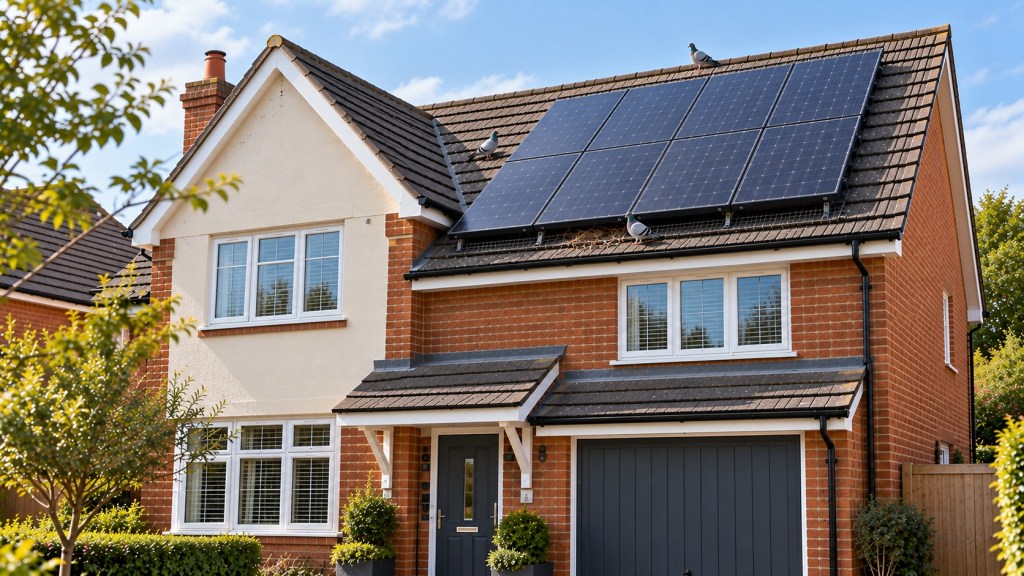
Most homeowners only notice a pigeon problem once it’s already expensive. A gutter stops draining properly, a roof tile turns out to be cracked from years of nest debris, or a solar installer mentions, almost in passing, that output has dropped more than it should have. Pigeons are so familiar a sight in British towns that it’s easy to underestimate what they’re actually doing to a building while nobody’s looking.
The UK is home to an estimated 18 million pigeons, and feral pigeons in particular have adapted to nest on exactly the ledges, eaves, and flat surfaces that modern roofs and solar arrays provide. Anyone researching pest control Bromley households actually book tends to find pigeons, not wasps or rodents, are the most common reason for a first call about birds specifically. This piece looks at what the damage really involves, what’s legally allowed when dealing with it, and how proofing should be done properly rather than as an afterthought.
A Problem Most Homeowners Only Notice After It’s Expensive

Pigeons favour flat or gently sloped surfaces with a bit of shelter nearby, which describes most British roofs, porches, and increasingly, the underside of solar panels. A single pair can produce several broods a year, and once a ledge or gap proves usable, successive generations tend to return to the same spot.
The issue rarely announces itself immediately. Droppings accumulate quietly, nesting material builds up in gutters and valleys, and by the time a blockage or a leak shows up, the underlying cause has usually been active for a season or more. Nottingham City Council received more than 300 complaints in 2022 about blocked gutters, damaged tiles, and leaking roofs, almost entirely linked to homes that had fitted solar panels without any pigeon proofing beforehand.
What Pigeons Actually Do to a Roof and Gutters
The mechanics of the damage are fairly straightforward once you know what to look for. Nesting material, twigs, feathers, and debris collects in gutters and downpipes, which blocks proper drainage and can eventually cause water to back up under roof tiles. Pigeons also dislodge loose tiles while building nests, and will sometimes peck at already-damaged tiles to widen a gap into a loft space.
Droppings cause a separate kind of problem. They’re corrosive enough over time to degrade roofing materials, render, and paintwork, and a heavy accumulation left unaddressed becomes genuinely difficult and unpleasant to clear safely without the right equipment.
The Solar Panel Problem Nobody Mentions at Installation

This is where the numbers get more striking than most people expect. The gap between a solar panel and the roof, typically around 10 to 15 centimetres, is close to an ideal nesting cavity: sheltered, slightly warm, and largely undisturbed.
Research from the Vellore Institute of Technology found that just 10 grams of bird droppings on a panel reduced its efficiency by 31.25 percent, and 50 grams cut output by 86.53 percent. Separately, the effect has been estimated to reduce panel efficiency by up to 30 percent over a system’s lifetime if left unmanaged. There’s a fire risk element too: droppings and debris under a panel can raise electrical resistance and create hotspots capable of damaging electrical components, while pigeons occasionally peck at wiring directly.
The cost comparison makes the timing argument fairly clearly. Proofing at installation typically costs around £25 per panel, so a modest 5-panel system runs to roughly £125. Adding protection later usually means paying for scaffolding again, which can add hundreds or even thousands of pounds to what would otherwise have been a minor addition to the original job.
Are Pigeons Protected, and What Can Homeowners Actually Do
This is one of the more commonly misunderstood parts of the problem. Feral pigeons are not legally classed as vermin, and under the Wildlife and Countryside Act 1981, all wild birds in the UK, pigeons included, are protected. It’s an offence to kill, injure, or take a wild bird, or to damage or destroy a nest that’s in use or being built, without a licence covering that specific action.
Where control is genuinely necessary for public health or safety reasons, it’s permitted under a general licence issued by Natural England. The current framework is set out in GL41, the general licence covering certain wild bird species for public health and safety, which sets out the conditions under which lethal control can legally take place. In practice, almost no residential situation needs to go anywhere near that point. Proofing, spikes, netting, and mesh barriers that simply prevent birds from landing or nesting in the first place, is the standard, humane, and legally straightforward route, and it’s the method the Animal Welfare Act 2006 effectively steers homeowners toward by making any less careful approach considerably riskier to get wrong.
Getting Proofing Right the First Time

Not all proofing methods suit every part of a building, and choosing the wrong one for the location is a common reason problems come back within a year or two.
- Bird spikes work well on narrow ledges, gutters, and roof edges, discouraging landing without harming the bird.
- Netting suits larger open areas such as courtyards, roof voids, and gable ends where multiple birds are roosting.
- Solar panel mesh is purpose-built to seal the gap beneath panels while still allowing airflow, which matters for panel cooling and performance.
- Professional installation tends to outlast DIY attempts considerably, since gaps left around the edge of a poorly fitted mesh are exactly what a determined pigeon will exploit first.
Firms such as Clearzone Pest Control, which handle bird management solutions including spikes, netting, and solar panel proofing, generally assess the specific site before recommending a method rather than applying the same fix everywhere. That site-specific approach is worth asking about directly when getting quotes, since a one-size answer over the phone is a reasonable sign to look elsewhere.
Frequently Asked Questions
Is it illegal to remove an active pigeon nest myself? Yes, generally. Nests that are in use or being built are protected under the Wildlife and Countryside Act 1981, and removing one without a licence covering that action can be an offence. Proofing to prevent nesting in the first place avoids this issue entirely.
Do bird spikes actually harm pigeons? No, properly installed spikes are designed to make a surface uncomfortable to land on, not to injure birds. They’re widely considered one of the more humane and low-maintenance proofing methods available.
Can solar panel bird proofing be added after panels are already installed? Yes, though it typically costs more than fitting it at installation, mainly because scaffolding or roof access needs arranging again. It’s still worth doing if droppings or nesting are already causing efficiency loss or drainage problems.
How quickly does pigeon nesting usually cause a noticeable problem? It varies, but gutter blockages and early solar efficiency loss can show up within a single breeding season, often before any visible roof damage becomes obvious from ground level.
Pigeons aren’t going anywhere, and given how adaptable they are to modern roof lines and solar installations, the realistic goal isn’t eliminating them from the area but making a particular roof considerably less appealing to nest on. Getting proofing right once, ideally at the same time as any roofing or solar work, tends to be far cheaper and far less disruptive than dealing with the consequences a year or two down the line.
Related
<!–
–>