
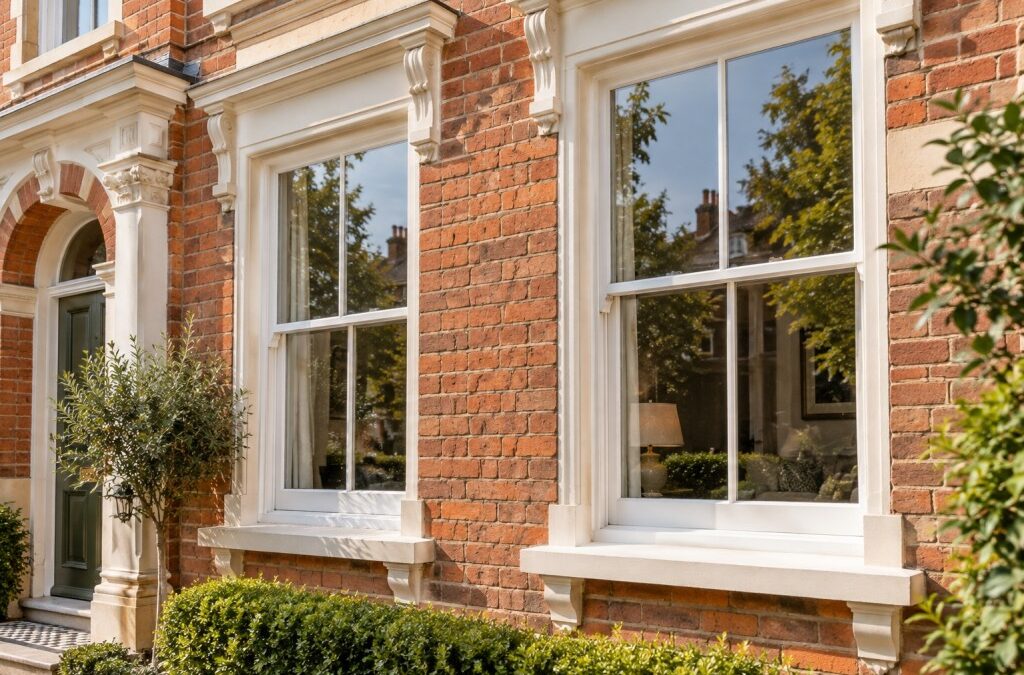
Few features define a period home quite like its original sash windows. The slim glazing bars, the tall proportions, the faint ripple in old glass that catches the light differently from anything made today: these are the details that give a Georgian, Victorian or Edwardian facade its character. They are also, more often than not, the first thing a renovation puts at risk.
It is an easy trap to fall into. Decades of paint have clogged the mechanism, the sashes rattle in a winter draught, a cord has snapped, or there is a soft patch of timber near the bottom rail. The temptation is to strip everything out and start again with something sealed and modern. But in doing so you lose the very character you bought the house for, and often you are discarding windows built to be mended.
This guide covers what sash window restoration involves, how to judge whether yours can be saved, roughly what it costs, the rules in conservation areas and listed buildings, and the point at which replacement becomes the better answer.
What Makes a Sash Window Worth Saving

A traditional sash window is really an assembly of separate parts: two glazed panels that slide past one another in a hollow timber frame, counterbalanced by concealed weights on cords so each one glides and stays where you leave it.
That design is the first reason originals are worth keeping. Because the window is built from separate, replaceable parts, any one of them can be renewed without discarding the rest: a frayed cord, a cracked pane, a worn bead or a patch of soft timber can each be dealt with individually. Modern sealed units, by contrast, tend to fail as a whole once the seal goes. The timber helps too: most period sashes are dense, slow-grown softwood that is hard to source today, which is why so many Victorian windows are still serviceable over a century on.

It also helps to know what you are looking at. Georgian sashes tend to have six panes over six; Victorian glassmaking allowed much larger panes, often two over two or one over one; Edwardian windows often pair a plain lower sash with a decorative upper one. Matching that pattern matters, because the rhythm of the glazing bars is what reads as “right” on a period facade.
Finally, there is the character case. Original crown or cylinder glass scatters light in a way float glass cannot imitate, and genuine slim glazing bars sit far more delicately than the chunky profiles of most replacements. These are things a careful eye notices, and they are very hard to fake convincingly.
Assessing the Condition: Can Your Sashes Be Restored?

Timber sash window restoration means stripping off old paint, overhauling the sliding mechanism, renewing cords and sometimes weights, replacing worn beads, splicing fresh timber into decayed sections, draught-proofing, then re-puttying, re-glazing and repainting. The aim throughout is to keep as much of the original window as possible and renew only what has actually failed.
Before any of that, it is worth a quick survey of your own, window by window. Do the sashes rattle or stick? Has one dropped so it no longer sits square? Can you feel a draught around the edges? Press gently on the lower rails and cill: is the timber firm, or soft underfoot? Look too for flaking putty, blistered paint and condensation on the inside.
The reassuring news is that most of what you will find is routine. Sticking sashes, draughts, snapped cords, decades of paint build-up and small, localised patches of rot are all everyday repairs for a joiner who works on period windows. What changes the picture is widespread decay, particularly rot that has spread through the box frame or along the cill, where water collects. A soft patch the size of a coin is one thing; a frame that crumbles when you press it is another.
Because that distinction is not always obvious from the inside, it is worth having a specialist survey the windows before you commit to a plan. An experienced sash joiner can tell quickly whether the problems are superficial or structural, and can often save windows that look past help.
What Restoration Actually Involves

The process follows a consistent sequence, and knowing it helps you judge whether a quote is thorough. The sashes are removed from the frame by taking out the beads and releasing the cords. Old paint is stripped back, often the step that reveals the true condition of the timber and frees up a mechanism that has not moved in years. The pulley-and-weight system is then overhauled: cords, the usual point of failure, are renewed, pulleys cleaned or replaced, and the weights rebalanced so each sash glides and stays put.
Where there is localised decay, the craft lies in keeping the original fabric. Rather than scrapping a whole sash for one soft corner, a skilled joiner cuts back to sound timber and splices in a matching new piece, shaped so the repair all but disappears once painted. That is exactly the detail that separates genuine restoration from a quick refit. Beads are renewed where worn, the glass is re-puttied and re-glazed, and the whole window is primed and repainted to protect it.
Restoration is also the natural moment to deal with the two things people complain about most: draughts and heat loss. Discreet brush or compression seals can be routed into the frame so the sashes still slide freely but close against the weather, and it is possible to re-glaze with slim-profile or vacuum glazing that fits within a traditional sash without spoiling its proportions. Done well, these measures can significantly reduce draughts and heat loss, though it is more honest to talk about meaningful improvement than a fixed saving, since results depend on the house.
Costs and What Drives Them

As a guide, sash window restoration typically costs a few hundred pounds for a straightforward overhaul of a single window, rising considerably where there is substantial decay to repair or double glazing to add. These are indicative figures only: the real price varies with the condition of the windows, your region, and the specification you choose, so the only reliable number is a surveyed quote.
Several things push the figure up or down. The extent of decay is the biggest variable, because splicing in new timber takes time. The number of windows matters, as does whether you add draught-proofing and double glazing or simply overhaul what is there. Access plays a part too: upper-floor windows may need scaffolding. And in a listed building or conservation area, sympathetic materials and approved methods add to both the work and the cost.
Listed Buildings and Conservation Areas

Period windows often come with an extra layer of rules. In conservation areas, and particularly on listed buildings, altering or replacing windows is frequently controlled, and like-for-like restoration is usually the preferred and most straightforward route precisely because it changes nothing about the building’s appearance.
This is guidance, not a ruling, and the detail varies from one authority and property to the next. Before you start work, check with your local planning authority, which handles conservation-area and listed-building consent, and look at the general guidance on the Planning Portal and from Historic England. What is permitted on one house is not automatically permitted on the next, so confirming your own position early saves a great deal of trouble later.
When Restoration Isn’t the Right Answer

Honesty matters here, because not every window can be saved. Some sashes really are too far gone: rot that has spread through the box frame and cills, previous “repairs” botched with filler that has trapped moisture, or frames so decayed that the cost of saving them climbs past the cost of starting afresh. A good specialist will tell you when you have reached that point rather than quietly repairing something that will fail again in a year.
When that happens, the sympathetic answer is not to reach for uPVC, which rarely sits well on a period facade and cannot be repaired the way timber can. The better route is like-for-like replacement: new sashes made to the original profile, in durable timber, matching the glazing-bar pattern and proportions of the house. For this, it is worth seeking out a joiner who makes bespoke timber sash windows to the original design, so the new windows read as part of the building rather than an intrusion on it. Done properly, replacement preserves the period look while giving you a window that will last for decades.
One honest caveat applies to both restored and replacement timber windows: real wood needs looking after. It is not maintenance-free, and it should not be sold as such. In practice, that means a fresh coat of paint every several years and an eye on the putty and seals, modest upkeep for a window that, cared for, can outlast anything sealed and synthetic.
For most period homes, the original sashes can be brought back to life, protecting both the character and the value of the house. Where they genuinely cannot, a faithful timber replacement keeps the look intact. Either way, the goal is the same: a window that stays true to the home it belongs to.
Related
<!–
–>