
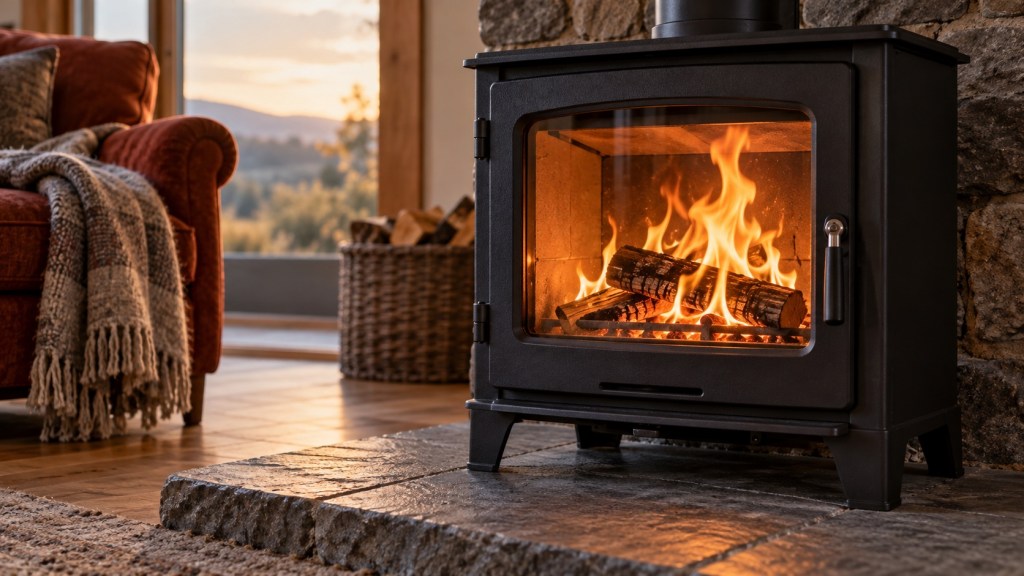
There’s a moment every autumn when the evenings draw in, the radiators can’t quite take the edge off, and a real fire stops feeling like an indulgence and starts feeling essential. It’s also the time of year when plenty of us finally decide to do something about the empty chimney breast, the tired gas fire or the open grate that has never really been used.
Choosing a stove or fireplace is part interiors decision and part practical one. Get both halves right and it becomes the piece the whole room is arranged around. Get one wrong and you can end up with something beautiful that you can’t legally use, or something efficient that never quite suits the space. Here’s how to approach it, starting with the question most people forget to ask.
Start with where you live, not what you like

Before you fall for a particular stove, it’s worth finding out whether your home sits inside a Smoke Control Area. These are areas, set by local councils, where you can’t let smoke escape from a chimney unless you’re burning an authorised fuel or using an appliance that’s been approved for that area. Much of London and a great many other towns and cities are covered, and the boundaries don’t always follow the lines you’d expect. Two streets a short walk apart can fall under different rules.
If you are inside one, you can still have a real fire. It simply narrows your choices. A wood burning stove would need to be a DEFRA exempt model, meaning it has been tested and approved to burn wood cleanly enough for a Smoke Control Area. An open fire would generally be limited to authorised smokeless fuels. Ignore the rules and the council can issue a fixed penalty, starting at £300 in England.
The easiest way to find out where you stand is to use Chesneys’ free Smoke Control Area Checker. You type in your postcode and it tells you whether the address falls within a Smoke Control Area, along with what that means for the stoves and fuels you can use. It’s intended as a quick first check rather than a legal ruling, so if your result is borderline, a call to your local council will confirm it. Scotland and Wales have their own legislation, so it’s worth checking locally there too.
Doing this first saves a surprising amount of wasted browsing, because it tells you whether you’re shopping from the full range or a shorter list.
Decide what you want the fire to do

Next, be honest about how you’ll use it. A fire that’s mostly about atmosphere on a Friday night is a different proposition from one you’re relying on to take the chill off a draughty period house every evening from October to March.
For warmth you’ll lean on regularly, a closed wood burning or multi fuel stove is hard to beat. It burns far more efficiently than an open fire, with more of the heat coming into the room rather than disappearing up the chimney. Every new stove sold in the UK since January 2022 has to meet Ecodesign emission limits, so a modern model is considerably cleaner than one bought even a decade ago.
For a focal point first, a traditional fireplace with a surround in stone, marble or cast iron gives a room an architectural anchor that a freestanding stove doesn’t. You can pair a surround with a stove fitted into the opening, which gives you the look of a classic fireplace with the efficiency of a closed appliance.
For homes without a chimney, gas, electric and bioethanol options have come a long way and avoid the need for a flue, although they’re a different experience from a log fire.
Size it to the room

One of the most common mistakes is buying a stove that’s too powerful. An oversized stove either cooks you out of the room or gets run slowly with the air turned down, which is exactly how you end up with sooty glass and a dirty flue.
As a rough guide, measure your room’s length, width and height in metres, multiply them together, and divide by 14. The result is an approximate heat output in kilowatts. A living room of five metres by four with a 2.5 metre ceiling comes out at around 3.5kW. Older, draughtier houses may need a little more, and a well insulated new build less. A good installer will survey the room properly, but the sum gives you a sensible starting point.
Let the style follow the house

Here’s where the interiors side comes in. In a Georgian or Victorian home, a surround that reflects the period, whether a simple reeded design or something more ornate, tends to look as though it has always been there. In a contemporary space, a clean lined stove or a minimal stone surround keeps things calm. And in a mixed or eclectic home, a classical fireplace can be a lovely counterpoint to modern furniture.
Think about the hearth and the surrounding wall too. The fire becomes the natural place for the eye to settle, so the mantel, any alcove shelving and even the log store are part of the overall look.
The practical bits before installation
A few things to plan for:
• Installation and paperwork. A solid fuel stove needs to meet building regulations, including the right flue and a suitable hearth. A HETAS registered installer can certify the work for you. Otherwise it needs to go through building control.
• A carbon monoxide alarm. In England this is a legal requirement in the room where a new solid fuel appliance is installed, and it’s sensible everywhere.
• The chimney. Have it swept before first use, and at least once a year after that.
• The fuel. Burn wood with a moisture content of 20% or below. Look for the Ready to Burn logo on smaller bags of logs, which certifies that they’re dry enough. Wet wood gives off more smoke, less heat and more soot.
The first fire of the season

Once it’s in, the first proper fire of autumn is worth the planning. Start small and hot rather than packing the firebox, give it enough air to burn cleanly, and enjoy the way the whole room settles around it.
Do the groundwork in the right order (where you live, how you’ll use it, the size, then the style) and you’ll end up with a fire that looks right, heats well and keeps you on the right side of the rules for years to come.
Related
<!–
–>