
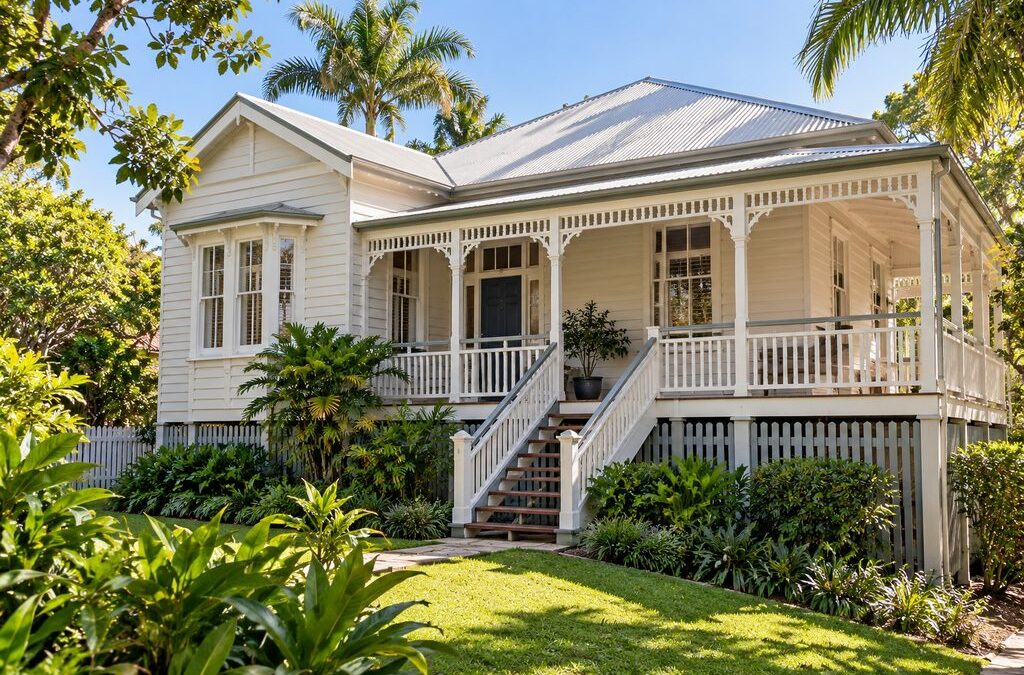
Planning a kitchen renovation in Brisbane? Whether you live in a timber Queenslander in Paddington or a 1980s brick lowset in Carindale, the house you’ve got decides a lot about the kitchen you can build. The climate matters too. Cabinets that would last for decades in a drier city can swell at the edges after a few Brisbane summers if the board and finish are wrong.
So where do you start? Before you look at door colours, look at the floor and walls you’re building against.
1. Brisbane house types bring different problems

Queenslanders and workers’ cottages built before the 1940s are timber framed and usually sit on stumps. Many have VJ board walls. After a century of settling, floors often slope and walls are rarely square. The original kitchen was often at the back of the house or in an enclosed verandah, so the room tends to be long and narrow.
Post-war homes in suburbs like Holland Park and Stafford are smaller timber or fibro houses on low stumps. Brick lowsets from the 1970s and 80s, common around Mansfield and Capalaba, are squarer but often have closed galley kitchens with bulkheads over the cabinets.
Before you design anything, check these:
- Is the floor level along the full run of cabinets? A Queenslander floor can fall noticeably from one end of the room to the other.
- Do the stumps or bearers under the kitchen need work before a heavy stone benchtop goes in?
- Does the house have fibro sheeting or other materials from before 1990 that might contain asbestos? In Queensland, removing more than 10 square metres of non-friable asbestos needs a licensed removalist, so get samples tested before demolition.
- Is the property in a Brisbane City Council character overlay? Work inside the kitchen usually isn’t affected, but moving an external window or extending the room can be.
Before settling on a layout, it’s worth exploring different kitchen design ideas to see how storage, preparation areas and appliances can work within the available space.
2. Cabinet materials for humid conditions

Brisbane summers are hot and humid, and many older homes have timber floors and open eaves that let damp air in. The kitchen adds steam from the cooktop and dishwasher. Most cabinet failures start at an exposed edge, where moisture gets into the particleboard and it swells.
Ask for moisture-resistant board for the carcasses. It’s often sold as HMR and has a green-tinted core. At minimum it should go under the sink and beside the dishwasher, where leaks happen. Every edge should be sealed with edge banding, including the backs and undersides no one sees.
Each door finish has a trade-off:
- Polyurethane (2-pac) doors are sealed on every face and handle humidity well, but they cost more and can chip if knocked.
- Laminate is hard-wearing and tolerates moisture at a lower price, with a smaller range of profiles.
- Vinyl wrap is cheap and looks good new, but it can lift near ovens and in a hot west-facing kitchen.
- Solid timber and timber veneer suit a Queenslander. Timber moves with the seasons, so it needs a full seal and a maker who allows for that movement.
Fit a ducted rangehood vented outside rather than a recirculating unit. It takes steam out of the house instead of pushing it into the overhead cupboards. Stainless or coated hinges and drawer runners are worth the small extra cost in a humid kitchen.
3. Why made-to-measure suits older homes

Flat-pack cabinets come in fixed widths and assume a level floor and square walls. In a Queenslander neither is likely, so the installer closes gaps with filler panels and packs the legs to level the run. The result can be uneven gaps at the wall or a benchtop that sits away from the splashback.
Custom cabinets are built to the room you have. A maker can scribe an end panel to follow a wavy VJ wall and set the kickboard height to take up a fall in the floor. Cabinet widths are set to the space, so a narrow galley doesn’t lose storage to fillers at each end.
Flat-pack isn’t always the wrong choice. In a square, newer brick lowset on a tight budget it can work well, especially if you upgrade to moisture-resistant carcasses. Some owners pair flat-pack carcasses with custom doors and a stone benchtop to keep costs down.
4. Choosing a Brisbane kitchen renovator

Ask any renovator whether the people who measure and design your kitchen are the same people who build and install it. When one team carries the job through, measurements taken on site go straight to the workshop, and out-of-square walls or uneven floors in an older Brisbane home get dealt with in the cabinet design rather than on installation day.
On the southside, Capalaba-based Action Kitchens has been handling kitchen renovations in Brisbane since 1985. One carpentry-led team takes each job from the first sketch to the final fit. The company builds every cabinet to measure rather than using flat-pack, and it can work with appliances and sinks the homeowner supplies. Whoever you choose, check their QBCC licence and ask who will coordinate the plumber and electrician before you sign.
In Queensland, a contractor needs a QBCC licence for building work worth more than $3,300, and you can search a licence on the QBCC website in a minute. Work over that amount also needs a written contract, and residential work is covered by the QBCC Home Warranty Scheme. Match the licence number to the name on the quote.
Ask when the final measure happens. Walls and floors in an older home can change once the old kitchen comes out, so a careful renovator does a check measure after demolition, before cabinets go into production. It adds time, but it’s cheaper than cabinets that don’t fit.
A kitchen needs a licensed plumber and a licensed electrician. Many jobs also need a tiler or plasterer. Ask who books these trades and what happens to the schedule if one runs late. If the answer is that you book them yourself, factor that into your time and the price comparison.
5. Before you sign: a checklist

- Search the renovator’s QBCC licence and confirm the name matches the quote.
- Get a written contract that names the cabinet board and door finish.
- Confirm a check measure after demolition, before production starts.
- Ask whether the quote includes plumbing and electrical work.
- Arrange asbestos testing if the house was built before 1990.
- Settle who supplies the appliances and sink, and have the cabinets built around the exact models.
This article is general information for Queensland homeowners. Check current licensing and warranty rules with the QBCC before work starts.
Related
<!–
–>