
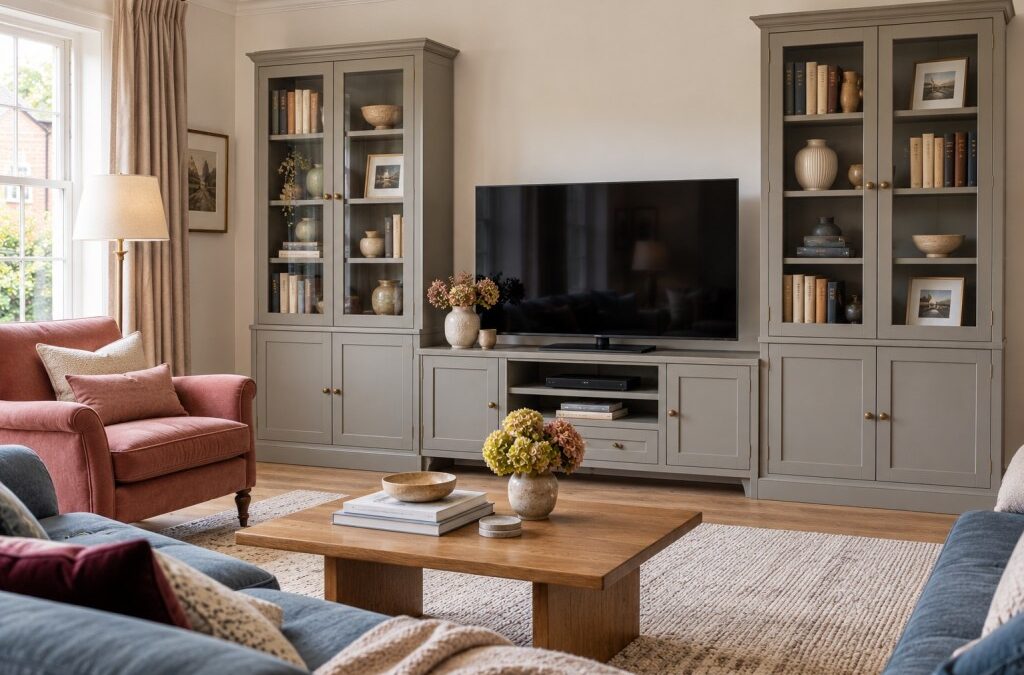
A living room built around a television can gradually start to feel like a dedicated media room. When every cabinet, shelf, and piece of furniture serves the screen, the space can lose the warmth and balance that make it comfortable for everyday living.
The solution is not necessarily to make the television disappear. Instead, give technology an appropriate place while letting books, decorative objects, and other living room essentials remain part of the design.
Five practical considerations help achieve that balance: choosing suitable storage for electronics, selecting furniture that complements the room, managing cords, planning for changing needs, and avoiding unnecessary finishing projects. These principles apply regardless of the furniture system or layout.
1. Decide Which Devices Actually Need to Disappear

Not every electronic device needs to be hidden, and heat generation matters more than appearance when deciding where equipment belongs. Lower-heat accessories are generally better suited for enclosed storage, while equipment that heats up during operation needs adequate ventilation.
Devices that run cool, a streaming stick, a cable box, a router, a soundbar remote, sit fine behind closed cabinet doors. Game consoles under load and AV receivers generate real heat and need either a vented cabinet or an added fan; BDI’s Corridor line and AC Infinity’s cabinet fans are built for that case.
Visual organisation is a separate consideration. Opaque cabinet doors remove their contents from view, while glass-fronted cabinets keep items enclosed but visible. Open shelving offers space for objects intended to remain on display, including books, photographs, and decorative accessories.
Before arranging equipment, homeowners can separate items according to their storage requirements. Remote controls and small accessories can occupy drawers or suitable enclosed compartments, while electronics that generate substantial heat need appropriately ventilated locations.
This approach also leaves more visible space for decorative elements. Books, artwork, and personal objects can share the room with technology without turning every shelf into equipment storage.
2. Choose Furniture That Still Looks Like Furniture
Storage arranged around a television should read as considered living room furniture rather than a rack designed primarily to hold electronic equipment. Matching finishes, balanced proportions, and a combination of storage and display areas help maintain that distinction. A coordinated wall system is one way to create that balance without making every piece look dedicated to the television.
The Martha Stewart Living Room Collection is a modular storage system from Flash Furniture, available in the Bedford and Lily Pond lines, that combines cabinets, hutches, and TV stands into a custom built-in look with solid wood frames, soft-close doors, and adjustable shelving.
The Bedford Set of 2 Modular Cabinets and Hutches in Bedford Gray stands 79.25 inches (about 201 cm) high, with tempered-glass Shaker doors and soft-close hinges that give the storage a more furniture-led appearance. The glass-fronted sections organise and display their contents rather than concealing them.
Its coordinated finish allows books, decorative objects, and everyday belongings to share the wall with the television without making the arrangement look entirely devoted to technology.
For households prioritising specialised equipment storage, the Salamander Synergy 603 offers a furniture-grade modular AV cabinet with dedicated AV engineering. That is a distinct consideration from choosing cabinetry primarily for its appearance within a living room.
A balanced arrangement also benefits from leaving some surfaces relatively clear. Not every shelf needs an object, and decorative pieces generally look more intentional when grouped rather than distributed evenly across every available space.
3. Give Cords a Route That Stays Out of Sight

Visible cord clutter often comes from cables that have no planned route between devices, furniture, and power connections. Even a carefully arranged TV wall can look disorganised when loose cords cross open surfaces or hang beneath the screen.
The Bedford Set of 2 Modular Cabinets and Hutches supports a coordinated storage arrangement with matching cabinetry and hutches, allowing decorative objects and everyday accessories to occupy designated sections of the TV wall. Its hutches include rear cord management openings, giving cables a defined route behind the display area rather than leaving them to cross visible surfaces.
A practical arrangement starts by identifying where devices will sit and how their cables will reach the necessary connections. Excess cable length can be gathered using suitable organisers, while cable sleeves or channels help keep visible runs together.
Cords should not be pulled tightly across furniture edges or placed where they interfere with doors and drawers. Power cables also need to remain accessible and positioned according to the equipment manufacturer’s instructions.
Where possible, furniture can be positioned so that cable runs follow existing edges or remain behind the TV unit. Keeping nearby decorative surfaces clear of loose adapters and accessories helps the arrangement feel less dominated by technology.
4. Choose Storage That Can Grow With the Room
A living room arrangement changes over time, so furniture that accommodates additional storage can reduce the need to replace an entire setup. New books, decorative pieces, and household accessories often require more space than the original arrangement provided.
The Bedford Set of 2 Modular Cabinets and Hutches, manufactured by Flash Furniture, a Ubique Group company, belongs to a coordinated modular system, with matching cabinet and hutch designs that support a consistent appearance as storage requirements change. The wider collection includes 2-piece through 6-piece configurations, allowing homeowners to plan around different wall sizes and furniture arrangements.
A 2-piece setup can expand to a 6-piece media wall without replacing the original pieces. Before expanding, homeowners should check the dimensions, finish, and compatibility of the intended additions to maintain consistent proportions across the wall.
Modular storage also offers flexibility in how different sections are used. One area might initially hold books and decorative objects, while another provides space for household accessories. Adjustable shelving can accommodate objects of different heights as those needs change.
Matching finishes and hardware help the expanded arrangement remain visually connected. The broader Bedford and Lily Pond lines offer six curated finishes for different interior colour schemes, which can help additions feel like part of the same arrangement. This is particularly useful when furniture is added gradually rather than purchased as a complete wall arrangement.
5. Avoid Furniture That Needs Extra Work to Look Finished

A finished furniture arrangement should not depend on extensive additional work simply to achieve a coordinated appearance. The amount of configuration, assembly, and modification required deserves attention alongside the design itself.
The IKEA BESTÅ 118-inch (about 300 cm) Media Storage Combination requires configuration and assembly, with the final arrangement depending on the components selected. The Martha Stewart Bedford pieces use structural solid wood rather than the particleboard and honeycomb-paper construction used in flat-pack systems.
Contempo Space semi-custom wall units follow a different process, requiring buyers to specify and configure the intended arrangement rather than selecting a single finished configuration. This approach provides another level of design involvement before the furniture reaches the room.
Ready-made modular cabinetry offers an alternative for homeowners seeking a coordinated appearance with no construction, cutting, trim, or painting. The furniture can arrive with matching finishes and proportions already established, avoiding the need for additional decorative modifications.
That does not mean the furniture arrives fully assembled. Some coordinated systems require adult assembly and ship in multiple boxes, so checking the instructions and dimensions beforehand remains important.
A Living Room That Feels Like a Living Room
A comfortable TV-focused living room depends on more than where the screen sits. Suitable electronic storage, furniture-led design, organised cords, adaptable cabinetry, and manageable assembly requirements all contribute to a balanced space.
The goal is to let technology serve everyday living rather than determine the room’s entire appearance. Coordinated storage, considered proportions, and a mixture of display and practical surfaces help the television sit naturally within the wider interior.
FAQ

How Do I Hide a TV, Cable Box, and Gaming Consoles in a Living Room?
Opaque cabinets conceal suitable equipment, while glass-fronted storage keeps contents visible. TVs can be integrated into surrounding furniture, but gaming consoles need adequate ventilation.
What’s the Best Kind of Storage for Hiding Cable Boxes and Streaming Devices?
Opaque cabinets work for devices suitable for enclosed storage. Equipment that generates substantial heat requires proper ventilation, such as a vented cabinet or cooling fan.
What Does Living Room Storage That Doesn’t Look Like Dorm Furniture Usually Have in Common?
Coordinated finishes, balanced proportions, and a mixture of closed and display storage create a more cohesive appearance. Keeping some surfaces clear also reduces visual clutter.
Does Furniture That Looks Finished Still Need Assembly?
Yes. Coordinated furniture can require assembly without additional construction, cutting, trim, or painting. Assembly and decorative finishing are separate requirements.
Related
<!–
–>