
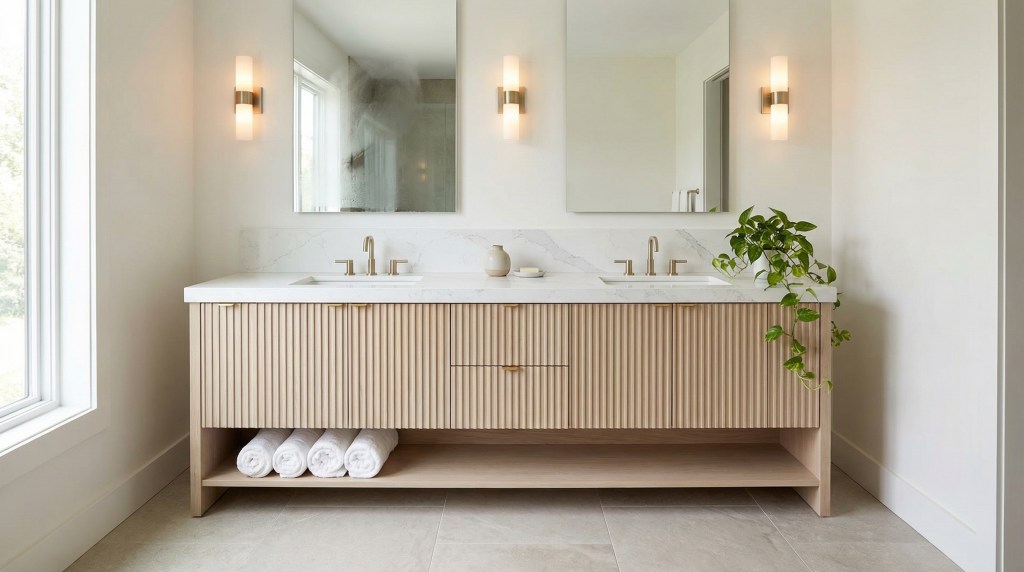
Fluted white-oak vanities are everywhere in 2025 makeovers, reviving the chic ’70s groove pattern designers love for its light-catching texture (Homes & Gardens).
White oak isn’t just fashionable. According to Tools Radar, tight, tylose-filled pores limit the wood’s expansion to about two percent even at 90 percent humidity—roughly one-third that of red oak—so it resists warping in steamy bathrooms.
We vetted seven standout cabinets—from a trim 30-inch single to a 72-inch double—rating build, storage, and style. First up is the Willow Bath & Vanity “Manhattan,” whose ribbed façade and hidden power drawer set a high bar for modern luxury.
Why choose a white-oak vanity?

A fluted white oak double vanity brings warm texture and spa-like style to a modern bathroom
Steam-filled bathrooms are rough on cabinets, yet white oak stays calm. Tiny tyloses plug its pores, blocking water. Lab tests show white oak expands about two percent at ninety percent relative humidity, while red oak swells near eight percent, so white oak is three times as dimensionally stable. Its Janka rating is 1,350 pounds-force, which lets it shrug off dropped hair-dryers.
Looks matter too. A straight, even grain accepts everything from Nordic whitewash to deep honey stain, so your vanity can track color trends for years. Because builders mill doors and dovetailed drawers from solid boards that remain flat, hinges stay aligned and soft-close slides keep their whisper-quiet glide.
Choosing white oak also supports responsible forestry. More than 36 million acres of U.S. forestland carry FSC certification, much of it white-oak stands. Buying one durable piece today means you skip sending a flimsy replacement to the landfill five years from now.
Finally, solid-wood cabinetry signals quality to appraisers and buyers. Real-estate pros list hardwood vanities as an upgrade that can lift resale value. In short, white oak offers long-term insurance for style, strength, and sustainability.
Compare your options at a glance
Use this quick chart to match a vanity to your space, budget, and style. It lists build details, mount type, available widths, a standout feature, and a simple price key ($ = budget, $$ = premium).
| Model | Build & finish | Mount type | Widths (in.) | Signature feature | Price |
|---|---|---|---|---|---|
| Willow “Manhattan” | Solid white-oak frame, reeded front, sealed quartz top | Freestanding (modern) | 60, 72 | Power drawer with outlets; fluted texture | $$ |
| Homestead | Solid oak, Carrara marble top | Freestanding (rustic) | 30 | Ships fully assembled | $ |
| Avanity “Windsor” | Solid oak, Carrara marble top | Freestanding (transitional) | 42 | Furniture-style detailing | $ |
| Wyndham “Soho” | Oak veneer over hardwood core, integrated sink | Floor-set, recessed base | 36 | Slim 18-in. depth | $ |
| Swiss Madison “Classe” | Moisture-sealed oak veneer, ceramic basin | Wall-mounted (floating) | 36 | Space-saving drawers | $–$ |
| James Martin | Furniture-grade oak, Carrara marble top | Freestanding (mid-century) | 72 | Four deep drawers plus tip-outs | $$ |
| Kohler “Damask” | Solid oak cabinet, top sold separately | Freestanding (traditional) | 30 | Catalyzed moisture-proof finish | $ |
Keep the chart handy as you read; each upcoming review refers back to these specs so you can compare details without scrolling.
Willow Bath & Vanity “Manhattan”: modern luxury, ranked #1
Fluted wood fronts are the texture designers reach for in 2025 bathrooms, a ‘70s detail now solidly back in vogue. Manhattan delivers the look in solid white oak and tops it with a dramatic 13-centimeter quartz slab—about five inches—giving your vanity a bold, architectural profile.

Willow Bath & Vanity Manhattan fluted white oak double-sink bathroom vanity (willowbathandvanity.com)
Beyond style, the cabinet is engineered for daily convenience. A deep center drawer hides a built-in AC + USB outlet and hair-dryer holster, so cords stay off the counter. Two double-door side compartments handle bulk bottles, and soft-close slides keep every touch quiet.
Construction blends a white-oak frame with furniture-grade plywood panels to curb weight yet resist humidity. Manhattan ships in two locking sections that fit through standard doorways; once bolted together, seams disappear for a seamless install.
Willow Bath & Vanity stocks vanities from compact 24-inch singles to expansive 96-inch doubles, and each collection includes a downloadable spec sheet that spells out every dimension.
For the Manhattan model, the PDF lists its 22-inch depth, 36-inch counter height, sink-cutout sizes, and the powered drawer’s outlet placement—details you can grab directly from Willow Bath and Vanity so plumbing and wiring line up before delivery.
Finish choices—Natural, Nordic whitewash, or Dark Oak—arrive pre-sealed for moisture protection. Widths of 60 inches or 72 inches suit main baths. The premium materials place it in the $ tier, but the durability and built-in tech make it a long-term upgrade rather than a short-term splurge.
Choose Manhattan if you want a spa-level statement piece that doubles as hardworking storage.
Homestead 30-inch vanity: big character for small spaces
Powder rooms are tight, yet Homestead fits real-wood quality into a 30 by 21 inch footprint. The cabinet ships fully assembled with a Carrara marble top bonded to the sink, so you can set it in place and connect plumbing in less than an hour.

Homestead 30 inch white oak vanity with Carrara marble top for small powder rooms
Doors and face frame use solid white oak finished in a warm honey stain that highlights the grain. Hardwood construction keeps the piece steady, and the doors stay true each time you grab a towel. Inside, a two-door compartment and adjustable shelf hold tissue rolls and cleaning spray—plenty for a guest bath.
Carrara marble resists hot-tool marks and daily splashes; plan to reseal it once a year for best stain defense. Priced in the $ tier, Homestead proves you can downsize without giving up genuine stone, real wood, or farmhouse charm.
Avanity “Windsor” 42-inch: classic elegance that never dates
Windsor fits traditional baths: raised-panel doors, furniture feet, and a warm medium-oak stain echo crown molding and vintage sconces without feeling ornate. The cabinet measures 42 inches wide, 21.5 inches deep, and 34 inches high, giving you extra elbow room while still matching standard single-sink plumbing.

Avanity Windsor 42 inch traditional white oak vanity with Carrara marble top (www.lowes.com)

Build quality is solid. A white-oak frame with dovetailed drawers and soft-close hinges keeps doors aligned through daily use. Up top, a factory-mounted Carrara marble slab with an undermount sink arrives pre-drilled for an eight-inch widespread faucet, so installation is mostly a quick plumbing hook-up.
Storage combines two doors with a full-width drawer. An adjustable shelf handles tall shampoo bottles, and the drawer corrals brushes and hand towels. Buyers note the vanity ships fully assembled and crated, so you can move from delivery to installation in one evening.
Priced in the $ tier, Windsor bridges the gap between compact singles and sprawling doubles, giving you timeless style, real stone, and hardwood durability in one turnkey upgrade.
Wyndham “Soho” 36-inch: minimalist form, maximum function
Soho serves city bathrooms where every inch matters. The cabinet measures 36 inches wide, 18 inches deep, and 34 inches high, freeing floor space while still hosting an integrated resin sink.

Wyndham Soho 36 inch slim-depth oak veneer bathroom vanity
Design stays crisp: flat-panel drawers with finger pulls, a recessed toe kick, and a mid-tone oak veneer that warms clean lines without clashing with chrome, black, or brass fixtures. Because the base sits on low inset legs, you get the visual lightness of a wall-hung unit without opening drywall for blocking.
Storage comes from two full-extension drawers built from plywood and rated to 90 pounds on soft-close slides. Skin-care bottles stand upright, towels fold flat, and the counter stays clear. The one-piece resin top has no seams to trap grime—wipe once and it is clean.
Installation is straightforward: level the cabinet, secure it to the wall, then connect plumbing. Priced in the $ tier, Soho gives condo owners a boutique-hotel vibe without boutique hassle.
Swiss Madison “Classe” 36-inch: float your vanity, free your floor
Classe brings a true wall-mount look in a 36.5 by 18.5 by 21 inch package. Lift the cabinet completely off the tile and you reclaim about three square feet of visible floor in a typical 5 by 7 bath.

Swiss Madison Classe 36 inch floating white oak bathroom vanity (swissmadison.com)

The box uses moisture-sealed MDF wrapped in a 3 millimeter white-oak veneer. Laser-sealed edges prevent steam from lifting the grain, so drawers still glide after hot showers. A factory-installed steel hanging rail speeds installation: level the bar on two studs, click the cabinet into place, and connect plumbing. No wrestling with a full-size cabinet on a ladder.
Storage comes from two soft-close drawers on full-extension slides. Each drawer is eight inches deep and includes removable organizers for hair tools or bulk bottles. Because the floor stays open, you can slide a step stool or scale underneath.
A one-piece ceramic basin tops the cabinet. It is scratch-resistant, non-porous, and pre-drilled for a single-hole faucet, so the silhouette stays clean. Priced in the $–$ range, Classe offers an airy, spa-like vibe without overspending, making it a smart upgrade for renters or remodelers chasing modern minimalism.
James Martin 72-inch: mid-century style, maximum storage
James Martin channels sixties credenzas in a 72 by 23 by 34.5 inch double vanity finished in Mid-Century Walnut. Tapered legs lift the oak case, so even at six feet wide it looks light rather than bulky.

James Martin 72 inch mid-century double vanity with tapered legs (jamesmartinvanities.com)

Build quality meets furniture standards. A kiln-dried white-oak frame, solid-wood dovetailed drawers, and full-extension slides rated to 100 pounds handle daily wear with ease. The layout tames couple clutter with four deep center drawers plus two door cabinets that include adjustable shelves.
A one-piece 3 centimeter Carrara marble slab arrives pre-sealed and drilled for widespread faucets. Installation is simple: set the top and connect supply lines because the cabinet ships fully assembled in a protective wood crate.
Priced in the $ tier, you pay for showroom design and heirloom construction that should last decades. Select James Martin if you want a statement vanity that blends vintage flair with serious storage.
Kohler “Damask” 30-inch: trusted quality in a compact footprint
Damask brings Kohler’s plumbing pedigree to cabinetry in a 30.8 by 21.9 by 34.5 inch vanity shell. The frame pairs solid hardwood rails with white-oak veneer panels sealed under Kohler’s catalyzed conversion varnish, a finish tested to withstand five years of ninety-percent-humidity cycles without peeling.

Kohler Damask 30 inch compact traditional white oak vanity cabinet (www.lowes.com)

Design stays classic—Shaker panels, furniture feet, and satin-nickel knobs—so the piece fits traditional or transitional baths. Inside, a two-door compartment and adjustable shelf handle spare towels and bulk cleaners.
Damask ships as a base-only cabinet. Add any 31-inch marble, quartz, or solid-surface top to match your tile, then drop in a widespread faucet. Pre-cut plumbing openings simplify the hook-up.
The cabinet sits in the $ tier and includes Kohler’s one-year limited warranty, giving busy households peace of mind. Choose Damask when you need hardwood construction, brand support, and a space-saving 30-inch size that still feels custom.
Buying guide: choose the right white-oak vanity
1. Measure with NKBA numbers in mind.
• Width: Standard singles run 24 to 48 inches; a comfortable double starts at 60 inches center to center, matching the NKBA 30-inch sink-spacing guideline.
• Depth: Most vanities sit 21 inches front to back, but slim models trim to 18 inches for tight baths (NKBA cabinet planning).
• Clearance: Keep 36 inches of aisle between the vanity front and the opposite wall or fixture for easy passage.
Tip: Sketch your plumbing rough-ins so drawers never collide with supply lines.
2. One sink or two?
Couples who prep at the same time benefit from doubles, but remember two bowls cut counter space. If mornings are staggered, a single 36- to 48-inch vanity often feels roomier.
3. Pick a mount that your walls can handle

Use NKBA bathroom guidelines to choose a vanity width, depth and aisle clearance that truly fits your space
• Freestanding: Easiest to install and hides uneven floors.
• Floating: Makes a small room look larger but needs two-by-six blocking between studs or plywood backing before tile goes up. When in doubt, hire a carpenter for the blocking.
4. Match storage to your routine
Doors swallow tall bottles; shallow top drawers corral razors and contacts. Powered drawers with outlets are ideal for hot tools. Measure interior depth—not just exterior width—on floating models; some 36-inch boxes leave only 14 inches of usable depth after plumbing.
5. Inspect construction, not just color chips.
Look for a solid-oak frame, dovetailed hardwood drawers, and soft-close hardware rated above 50 pounds. Veneer over furniture-grade plywood is fine; skip thin vinyl film over MDF, which can blister in 110 degree steam.
6. Choose a countertop you can live with.
• Marble: unmatched veining but needs annual sealing.
• Quartz: stain-proof and low-maintenance, costs five to fifteen percent more than entry-level granite.
• Integrated solid surface: easiest to clean, perfect for kid baths.
7. Think long-term value and sustainability.
White oak from FSC-certified North American forests travels fewer miles and can be refinished rather than replaced. A sturdy vanity today keeps one more flimsy cabinet out of the landfill tomorrow.
Measure your space first
- Width and depth
• Measure stud-to-stud width; that is your absolute cabinet limit.
• Most stock vanities run 21–22 inches deep. The NKBA notes this depth can crowd walkways when the room is under 36 inches wide. In a tight bath, choose a slim 18-inch model like the Wyndham Soho.
- Height
• Standard height: 33–34 inches.
• Comfort height: 35–36 inches, easier on adult backs but tall for young kids. Check that faucets, mirrors, and sconces align with the chosen height to avoid last-minute rewiring.
- Plumbing rough-ins
Sketch your supply lines and drain location. Centered drains suit drawer-heavy designs; off-center drains may call for a freestanding unit or a vanity with open shelves. Floating cabinets must line up with both studs and pipes, so measure twice before tile goes up.
Decide between one sink or two
Start by asking how often two people really get ready at the same time. A double vanity adds plumbing but cuts counter space. The NKBA recommends at least 30 inches of frontage per user, so 60 inches is the practical floor for two bowls. Below that width, faucets collide and a single basin with extra counter feels roomier and wipes down faster.
Check your supply lines before you commit. Splitting hot and cold feeds or relocating a drain in an older house can add 200–400 dollars in plumbing labor, according to national averages. If pipes already sit at the center of the wall, keeping one sink may save both money and storage volume.
Think resale by zip code. Listings in family-heavy suburbs often tout “double vanity,” while downtown condo buyers prize drawer organization over bowl count. Match the choice to your daily routine first and let local market norms serve as a tie-breaker.
Pick a mounting style that matches your walls, not just your mood
Freestanding
• Fastest swap-in: set it, level it, and secure through the back rail.
• Hides uneven flooring and offers the most storage volume.
• Ideal when you are replacing an old cabinet and do not want to open drywall.

Freestanding, floating and furniture-base hybrid vanities each change how your white oak cabinet meets the floor and wall
Floating (wall-hung)
• Exposes floor tile, so a five-foot bath feels longer.
• Easy to mop because there is no toe-kick dust trap.
• Loses the bottom shelf and needs sturdy framing. Fine Homebuilding recommends two rows of two-by-six blocking aligned with the vanity’s top and bottom mounting rails to spread the load across every stud. A 36-inch oak box with a stone top can weigh 180 pounds, so blocking prevents sagging screws over time.
Furniture-base hybrids
Recessed legs on models like the Wyndham Soho create a floating look while still resting weight on the floor, which helps if you cannot add blocking behind finished tile.
Match storage layout to your morning routine
Think in zones:
• Tall bottles. Keep at least one door cabinet with 12 to 14 inches of clear shelf height for shampoo jugs and cleaning spray.
• Small daily items. Shallow top drawers, three to four inches deep, stop lip balm and contacts from vanishing behind bleach bottles.
• Hot tools and chargers. A deep, eight-inch powered drawer stores hair dryers while cords stay hidden.
Look inside, not just outside. A 36-inch wall-hung box may leave only 14 inches of usable drawer depth after the drain trap, while a 30-inch freestanding unit with one door and one drawer offers about 1.2 cubic feet more space.
Check the back panel as well. An open back simplifies plumbing but lets bottles knock drywall; a finished back with cut-outs costs a bit more, stiffens the cabinet, and looks truly built-in.
Inspect construction, not just color swatches
Flip a drawer and check the facts:
• Frame. Look for a solid white-oak face frame joined with dowels or mortise-and-tenon joints.
• Drawers. True furniture drawers use dovetailed hardwood sides; stapled particleboard cracks under weight.
• Hardware. Quality slides and hinges are soft-close, full-extension, and rated at least fifty pounds.
• Panels. White-oak veneer over three-quarter-inch furniture-grade plywood resists seasonal movement better than wide solid boards, which can cup as humidity swings. Avoid thin paper foil on MDF; steam can blister edges within a year.
• Weight check. A thirty-six-inch vanity with a stone top usually ships between 120 and 140 pounds. Anything under ninety pounds often signals an MDF core and plastic fixtures, so verify specs before you click “buy.”
Choose a countertop you can live with
• Marble. Offers one-of-a-kind veining, yet it needs sealing once a year to resist etching.
• Quartz. Stays stain-proof and low-maintenance, and typically costs five to fifteen percent more than entry-level granite.
• Integrated solid surface. Molded counter and sink come in one piece, so seams cannot trap grime. This option wipes clean fastest, making it ideal for kids’ baths.
Care Tips
- Wipe water right away. Even sealed oak can darken if moisture sits along door edges. Keep a soft microfiber cloth handy and blot puddles after each use.
- Weekly cleaning. Mix a drop of mild dish soap with warm water; skip ammonia or bleach, which can cloud clear finishes. Rinse with a damp cloth and buff dry.
- Mind the humidity. Run the exhaust fan during showers and aim for 60 percent relative humidity or lower; steady moisture keeps panels flat and joints tight.
- Care for the stone top. Seal marble once a year and granite every two to three years. Quartz never needs sealing. Follow the sealer’s directions and wipe off excess.
- Tighten hardware seasonally. Check hinge screws and adjust drawer fronts so gaps stay even. Clean dust from soft-close slides to extend their life.
- Refresh the finish. If sheen dulls after years, scuff-sand with 320-grit paper and apply a water-based polyurethane. Real oak lets you refinish instead of replace and saves waste.
Conclusion
White oak bathroom vanities succeed where style and performance intersect. Their moisture resistance, strength, and timeless grain make them a smart investment for modern bathrooms. Whether you want the tech-forward luxury of Willow Manhattan, the space-saving ease of a floating cabinet, or the heirloom feel of solid furniture construction, the right white-oak vanity will elevate daily routines while holding its value for years to come.
FAQ: straight answers to common white-oak vanity questions
Will a white-oak vanity warp in a steamy bathroom?
Not if it is built correctly. Kiln-dried white oak changes dimension by only about three percent between thirty and ninety percent relative humidity. Add a catalyzed finish and wipe splashes quickly, and the cabinet should stay flat for decades.
How does white oak compare to MDF or particleboard?
White oak measures 1,360 pounds-force on the Janka scale. MDF is wood fiber plus resin. Oak resists dents and water, while MDF can swell up to fifteen percent after twenty-four hours of water exposure. You pay more up front for oak but avoid replacing a swollen cabinet later.
Can I paint my white-oak vanity later?
Yes. Lightly sand with 220-grit paper, prime with a bonding primer, then add two coats of acrylic enamel. The open grain still shows, giving painted oak more depth than a flat MDF panel.
Is floating installation safe on drywall?
Only with proper blocking. Fine Homebuilding recommends two rows of two-by-six blocking anchored to every stud to support a 150-pound vanity and stone top. Lag screws should penetrate at least one-and-a-half inches into solid wood.
What is the yearly upkeep cost?
About twenty dollars per year for marble sealer and a mild wood cleaner you likely already own. Weekly wipe-downs take around five minutes.
Related
<!–
–>